
Database testing is a crucial type of software testing that ensures data integrity, consistency, and performance by validating how data is stored, accessed, and managed within applications.
- Ensures data accuracy, integrity, and adherence to business rules across all database operations.
- Detects performance, security, and consistency issues early to prevent potential data loss or application failures.
Types of Database Testing
Database testing can be classified into three types of testing:
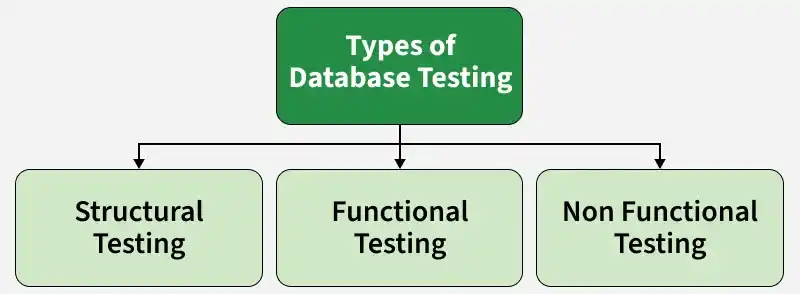
Structural Testing
Validates the internal components of a database that are not directly accessible to end users.
- Schema Testing: Checks schema formats, unmapped tables/columns, and overall database structure.
- Table & Column Testing: Ensures correct mapping, naming, and field length between front-end and back-end.
- Database Server Validation: Verifies server configurations, authorized actions, and capacity for user transactions.
Functional Testing
Ensures database operations and transactions meet business requirements.
- Black Box Testing: Tests functionality and data flow without checking internal structures.
- White Box Testing: Validates internal database structures, triggers, and logical views.
Non-Functional Testing
Checks performance, security, and usability of the database.
- Load Testing: Measures system behavior under normal and peak loads.
- Stress Testing: Evaluates system robustness beyond normal operating limits.
- Security Testing: Identifies vulnerabilities and protects data from unauthorized access.
- Usability Testing: Ensures the database system is easy to use from an end-user perspective.
- Compatibility Testing: Verifies database performance across different platforms and environments.
Database Testing Process
- Test Environment Setup: Prepare the database and tools required for testing.
- Test Scenario Generation: Design test cases covering various inputs, transactions, and business rules.
- Test Execution: Run the test cases to validate database functionality and performance.
- Analysis: Review results to ensure tests executed correctly and data integrity is maintained.
- Defect Logging: Report any defects or inconsistencies found to the development team for resolution.
Database Testing Components
The following components are used to validate different database operations and structures.
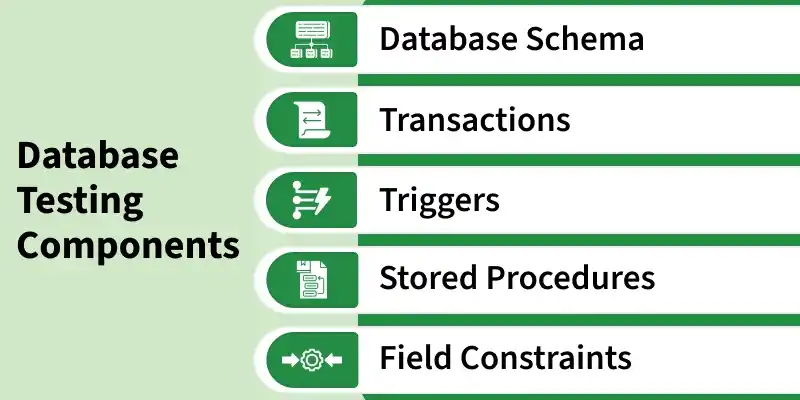
- Transactions: Validate data access and retrieval while ensuring ACID properties are maintained.
- Database Schema: Checks the structure and organization of data using tools like SchemaCrawler or SQL queries.
- Triggers: Test automatic actions triggered by specific events in tables using black-box or white-box testing.
- Stored Procedures: Verify sets of database commands that manage transactions and ensure correct execution.
- Field Constraints: Confirms that default values, unique keys, and foreign key rules are correctly enforced.
Database Testing Tools
Below are automation tools that can be used in database testing:
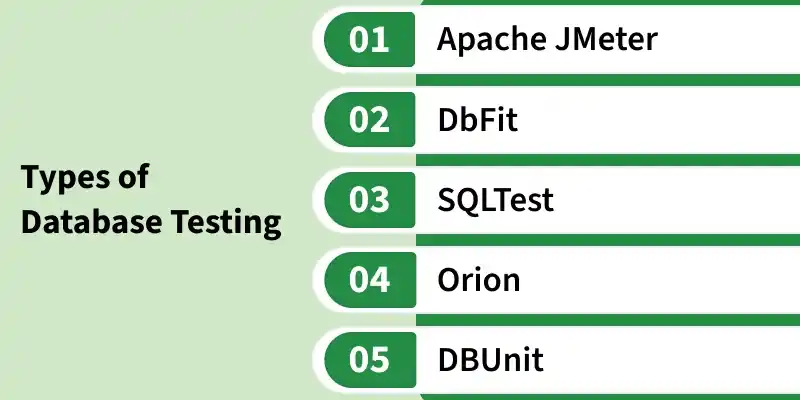
- Apache JMeter: Open-source tool for load, stress, and functional testing; supports multiple protocols (JDBC, LDAP) and distributed testing.
- DbFit: Lightweight tool for automated database tests with version control, data-driven testing, and simple syntax.
- SQLTest: Designed for SQL Server; automates testing of stored procedures, triggers, and provides detailed execution reports.
- Orion: Open-source tool for performance and stress testing; supports Oracle, MySQL, DB2, and multi-threaded execution.
- DBUnit: JUnit extension for creating test data, inserting it, and validating results; supports multiple databases and both unit and integration testing.
Objectives of Database Testing
The following objectives define the main goals of database testing.
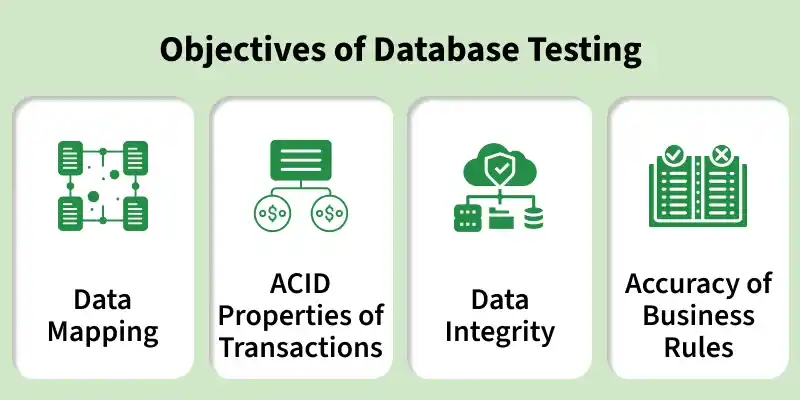
- Data Mapping: Ensures front-end fields are correctly mapped to database tables and that CRUD operations work as expected.
- ACID Properties: Verifies that transactions follow Atomicity, Consistency, Isolation, and Durability for reliable database operations.
- Data Integrity: Confirms that updated data is consistent, accurate, and reflected across all forms and screens.
- Business Rule Accuracy: Validates complex rules, triggers, and stored procedures to ensure proper application behavior.
Myths and Misconceptions about Database Testing
- Requires Expertise: While knowledge helps, even non-experts can perform structured tests with proper tools.
- Time-Consuming: It may take time, but it improves overall database quality and reliability.
- Adds Extra Work: Database testing enhances application value rather than creating bottlenecks.
- Expensive: Though there is a cost, it is a long-term investment for robust and stable applications.
Limitations of Database Testing
- Complex Database Structures: Testing large and complex databases can be difficult and time-consuming.
- High Cost and Time Consumption: Database testing requires skilled resources, proper tools, and significant testing time.
- Frequent Schema Changes: Changes in database structure may require continuous updates to test cases and scripts.
- Large Volume of Test Data: Managing and validating huge amounts of data can be challenging.
- Security and Privacy Concerns: Handling sensitive data during testing may create security and privacy risks.
- Dependency on Skilled Testers: Effective database testing requires knowledge of SQL, database concepts, and testing techniques.
Applications of Database Testing
Database testing ensures accurate, secure, and reliable database operations.
- Validates data integrity, consistency, and business rules.
- Checks performance, security, and scalability under various conditions.
- Verifies triggers, stored procedures, and queries.
- Ensures compatibility and reliability after updates or schema changes.
User-Interface Testing Vs Data Testing
| Parameter | User Interface (UI) Testing | Database Testing |
|---|---|---|
| Also Known As | Front-end or GUI Testing | Back-end or Data Testing |
| Knowledge Required | Business requirements, automation tools | Database technologies like SQL |
| Purpose | Validates the look, feel, and usability of the application | Ensures data integrity, consistency, and correctness |
| Includes | Text boxes, buttons, dropdowns, navigation, images | Schemas, tables, columns, triggers, stored procedures |
| Validation Focus | Display, page navigation, UI elements | Data accuracy, duplicates, server validation, transactions |