Showing posts with label Denmark. Show all posts
Showing posts with label Denmark. Show all posts
09 March 2015
Do It For Denmark ~ Pro-Growth Promo;-)
Jeff Beer at Fast spots Do It For Denmark conception campaign;-)

13 October 2014
Fowl Factories? ~ Yes, Amazing Food Production!
It's fantastic to see the efficiency and scale of chicken-related agribusiness, from hatching to slaughtering, egg sorting through consumption. First, an overview of industrial farming in the German context, including the perspective of both producer and protestor...
Hatching Chicks...
Processing Eggs...
The amazing "Long Egg" process!-)
Slaughtering Chickens...
Processing Chickens...
Serving it up at KFC...
Next, check out this piece from Westgate Integrity in Kenya showing how that market is beginning the process of modernizing towards the global state-of-the-art in chicken care and egg production... Finally, be aware that there's a counter-movement to all this efficiency-orientation. Generously speaking, the "free-ranger" assert greater quality of overall product and spin the benefits of so-called "organic" production. And it's certainly believable that factors such as stress and feed indeed make a difference to ultimate meat-taste, so there's room for improvement in the factory approach. On the other end of the spectrum, however, we have criminal "animal liberators" run amok as revealed in this Australian 60 Minutes piece...
05 August 2014
Bicycle Innovations ~ Streetfilms on Copenhagen!
Mikael Colville-Andersen from Copenhagenize spotlights The Green Waves of Copenhagen and points to a nice little Streetfilm about Bicycle Innovations...
"The busiest bicycle street in the world has changed! Now the Knippelsbro Bridge boasts 40,700 riders per day! And speaking of bridges, Copenhagen is building SIX new bike/ped only bridges to help its citizens get around easier. Last month another cool bridge debuted -- the Cykelslangen "Cycle Snake" or "The Snake". You'll see lots of footage as we travelled back and forth over it. It is truly a work of beauty and the riding is incredibly smooth. Even going uphill seems pretty easy! You'll see lots of other things that will make you happy (or angry your city isn't doing it!) Including waste baskets angled for cyclists, LED lights that indicate whether riders have to speed up to catch the green wave, and a cool treatment for cobblestone streets that helps make biking easier."
27 August 2013
Cycle Path Details ~ Micro Design Really Matters!
Copenhagenize has nice video series on cycling infrastructure with latest installment spotlighting Micro Design ~ Top 10 Design Elements in Copenhagen's Bicycle Culture... One of my favorite nuggets is their Hold On+Foot Rest...  Mark Wagenbuur from BicycleDutch has numerous posts on cycle path details, including Drainage in NL...
 And here Mark spotlights David's video of NL's red cyclepath construction...
"The City of Copenhagen has implemented this double railing simply as a convenience for the cyclists who stop here. A high railing to grasp with your hand and a foot railing for putting your foot up..."
Mark Wagenbuur from BicycleDutch has numerous posts on cycle path details, including Drainage in NL... "With so many people cycling in the Netherlands and with the average amount of precipitation in their country, the Dutch need a system that keeps the infrastructure dry without endangering all those people cycling. And of course the Dutch have such a system. Key difference to some of the other systems of the world is that the openings for rain water to get into the sewer system are not horizontally in the street surface, but vertically set in the kerbs [...] As a cyclist you do not have to ride over these openings that way and that makes all the difference."David Hembrow's View From the Cycle Path spots many details, including latest piece on Bollards, both horrible and acceptable examples...
"Bollards appear primarily where cycling routes meet driving routes. They're also used to prevent minor roads from being used for through journeys (segregating modes without a cycle-path and helping to unravel driving routes from cycling routes) and in other places, for example to discourage parking of cars where they are not wanted."Latest designs include flexible bollards... And this David Hembrow piece on Angled Curbs...
"Parallel kerbs can be quite dangerous for cyclists. A slight lapse of concentration and you can be off your bike, and possibly injured badly [...] The kerb shown here is one of many "forgiving" 45 degree kerbs in use in Assen. These kerbs make it possible to cross from the cycle path to the pedestrian path without falling from your bike. They reduce the risk of injury due to a lapse of concentration."
And here Mark spotlights David's video of NL's red cyclepath construction...
10 August 2013
Too Many Bikes? ~ Euro Cycle Boom Backlash
 Holger Dambeck asks in DerSpiegel are there Too Many Bikes? Europe's Cycling Boom Sees a Backlash...
 "More bicycles were supposed to make Europe's cities more livable. Instead, the popularity of two-wheeled travel is causing problems in some cities in Holland and Denmark, where traffic jams and parking shortages are common. [...] Cycling has been heavily promoted, and more and more people are taking to the pedal -- but eventually cycling paths, bike racks and other parking areas have begun to run out of space. The bike boom -- long seen as the universal solution to roads jammed with parked cars, dead inner cities and other urban maladies like noise, smog and lack of exercise -- threatens to choke on its own success."
05 August 2013
Extreme Engineering ~ Statoil & Maersk Lead...
11 April 2013
From A to B ~ van der Vleuten's Parcelcam;-)
24Oranges spots Ruben van der Vleuten's From A to B parcel post video...
17 July 2012
Cycle Superhighway ~ DK's Green Light for Bikes
NYTimes video on updated cycling infrastructure in Denmark...
01 January 2012
Fehmarn Tunnel ~ Linking Germany & Denmark
Hauke Goos writes in Der Spiegel about Germans and Danes Split over Undersea Link... 


"...an enormous, groundbreaking project: nearly 20 kilometers (12.5 miles) long, 40 meters (130 feet) wide, nearly 10 meters high -- and expected to cost at least €5.5 billion ($7.2 billion). Four tubes are planned: two for the highway, each with two lanes, and two for the railway, each with one track. The tunnel would consist of huge concrete elements assembled on land and lowered by boats into a colossal trench on the Baltic seafloor. It would be one of the longest immersed tunnels ever built."
06 November 2011
Hedonistic Sustainability ~ BIG @ AR Innovation
Bjarke Ingels keynote at Architectural Record Innovation Conference...
"He explained his idea of "hedonistic sustainability," which holds that design does not need to make a "Protestant" sacrifice in order to be ecologically or socially attuned."He also challenges architects to not merely focus on buildings, but on entire ecosystems.
16 October 2011
Bike Lane Upkeep ~ Proper Maintenance is Key
Cycle Pathster David Hembrow spotlights bike lane maintenance in a recent piece on Autumn leaves... The need for such action is even greater in a snowy winter. I wrote about such civilized cycling support earlier and here you can see, courtesy Copenhagenize, all about bike lane snow clearance! Finally, here Mark Wagenbuur shows cycle path pavement upkeep...
05 May 2011
Flip Phone ~ Concept Design by Larsen in DK...
Thanks to Prat Vemana for spotting this Flip Phone concept by Kristian Ulrich Larsen...
01 May 2011
Complete Streets ~ Turner on Urban Livability...
 Chris Turner writes on the Mother Nature Network, Forget sci-fi cities: Street-level livability is a better way to urban sustainability...
 "On the outskirts of Abu Dhabi, Emirati gold is being spun into a solar-powered city of the future called Masdar. But the most widely copied model for sustainable urban design is the humble, pedestrian-scale 'complete street' approach. [...] The model city of Masdar on the outskirts of Abu Dhabi might be the most ambitious effort mounted anywhere to deliberately foster cleantech innovation. [There is, by contrast...] a different kind of innovation as the foundation of green urban design in the 21st century [...represented by Danish architect Jan Gehl.] In a place like Masdar, you might find some fascinating future-tense technologies, but if you’re looking for the state of the art in complete street design, mixed-use development and multimodal transit -- in urban sustainability, that is -- then Copenhagen’s the place to go. [...] In a sense, Masdar views innovation as a pure function of industrial R&D, a question fundamentally of technology. Jan Gehl’s Copenhagen looks at innovation as a question fundamentally of people, their wants and needs -- a system design challenge, not an engineering problem. Masdar assesses the sustainability challenge as one primarily of energy production, and Copenhagen shows that it is much more a question of energy use. Masdar asks: How do you want to generate power in the future? Copenhagen asks instead: How do you want to live right now? And for now, Copenhagen’s innovation remains the far more significant one."Do you buy this characterization? Perhaps there's a "third way" here?
24 April 2011
Sperm Bullitt ~ Brilliant Bicycle Delivery Service!
Thanks to Copenhagenize.com for spotting the Sperm Bullitt! 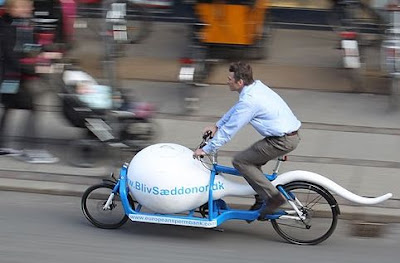
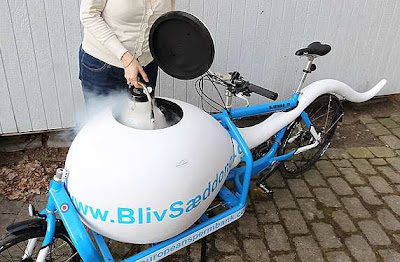
"Just when you thought you had seen everything in the Copenhagen bicycle culture, the Sperm Bullitt appears on the cycle tracks of the city. Yes. The Sperm Bullitt. This is brilliant. If you're cycling around Copenhagen, keep your eyes peeled for this bike. Nordisk Cryobank (European Sperm Bank) is one of Europe's leading sperm banks and the company was looking at environmentally-friendly alternatives to how they could transport their sperm samples to the fertility clinics around Greater Copenhagen."
23 March 2011
Bikeman ~ Cycle Repair Pro w/ Mobile Workshop!
Thanks to Copenhagenize for spotting The Bikeman, the mobile bicycle repairs and fix-it guy...
"Meet Jacob -- aka The Bikeman. He's a bike mechanic with a rolling workshop. He has everything he needs in his cargo box, including a portable stand for suspending bikes. He'll go anywhere you need him to on his Bullitt in the city centre. Jacob also has arrangements with various companies. He comes out during work hours and the employees can go down and get their bikes adjusted, tuned, de-squeaked, whatever you need. No need to sacrifice your bicycle for a day by chucking it into a bikeshop. Brilliant. The professional bikeshop comes to you."There should be a whole network of Bikemen, just like GeekSquad!
12 February 2011
Urban Skiing ~ Danish Downhill Garbage Slopes
Thanks to Der Spiegel for spotting der Danish slopes, BIG's new waste-to-energy incineration plant in Copenhagen which also serves as a skiable hill... 


"The €420 million ($570 million) plant, which goes by the not-entirely-Alpine name of Amagerforbraending, will be replacing an existing, 1970s-era power plant and is situated in an industrial area of the city that has hardly been much of a recreation destination until now. Skiers will be able to access the slopes via an elevator to the peak of the building. The slippery, artificial grass surface means that skiers will also be able to hit the slopes when there is no snow on the ground. "We propose a new breed of waste-to-energy plant, one that is economically, environmentally and socially profitable..."
03 February 2011
Snow Go ~ Competent Cleaning Tools & Methods
These tools and methods for vanquishing snow are worth emulating... 

09 January 2011
Cities for People ~ Jan Gehl, Urban Superhero...
 Cooper-Hewitt featured an exhibit on Why Design Now? and this talk on Cities for People by Danish urban superhero designer Jan Gehl...
 "For more than forty years Jan Gehl has helped to transform urban environments around the world based on his research into the ways people actually use -- or could use -- the spaces where they live and work. In this revolutionary book, Cities for People, Gehl presents his latest work creating (or recreating) cityscapes on a human scale. He clearly explains the methods and tools he uses to reconfigure unworkable cityscapes into the landscapes he believes they should be: cities for people."
30 December 2010
BIG's Bjarke Ingels ~ Studio Banana TV Interview
Thanks to Architecture Lab for spotlighting this Studio Banana TV interview with Danish designer-architect Bjarke Ingels... Plus check out some of his BIG & KiBiSi building designs... 


 And their BIG archicomic manifesto, Yes Is More...
  Finally, here's Ingels speaking about Yes Is More at the Royal Institute of British Architects (RIBA).
And their BIG archicomic manifesto, Yes Is More... Finally, here's Ingels speaking about Yes Is More at the Royal Institute of British Architects (RIBA).
18 December 2010
Clear Lanes ~ Civilized, Competent Infrastructure
Many thanks to Copenhagenize for showing how civilized and competent infrastructure and support services operate during and after a snowstorm as they clear the bicycle lanes and sidewalks... My favorite image of this process remains... 
Subscribe to:
Posts (Atom)


.svg.png)


