"The geography of the 2016 election is spiky."

Exponential Innovations Everywhere
* * *
Joost Bonsen's Opinions on How Money, Ideas, and Talent can
Enable Health, Wealth, and Happyness for Each plus Achieve Liberty, Prosperity, and Vitality for All and Ultimately Help Us Spread Beyond Our Cradle Planet Earth
"The geography of the 2016 election is spiky."
"The 2016 election was a virtual tie, with Hillary Clinton narrowly winning the popular vote, while Donald Trump won just enough states for a majority in the Electoral College. But if elections were based on economic output instead of population, the 2016 election would have been a blowout for Clinton. That’s the takeaway from this graphic produced by the Metropolitan Policy Program at the Brookings Institution. Brookings researchers looked at county-level election returns and compared it with data on economic output for those same counties. It found that the counties Clinton won accounted for 64 percent of the nation’s economic output, while Trump’s counties produced only 36 percent. The reason is simple: Clinton won almost every significant urban county in the US."


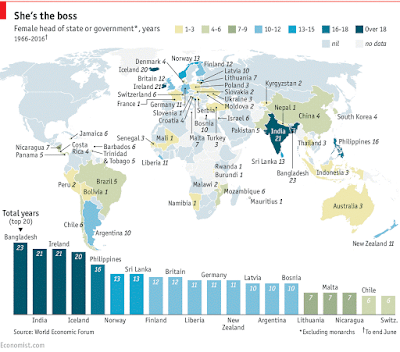
"Around the world, women rarely get the top job. The World Economic Forum, a think-tank, has tallied data on women in power in 144 countries for the past 50 years. During that time period, just under two-fifths of the countries surveyed had a female head of state or government at some point for at least a year (excluding monarchs). In half of those countries, the total time served by female leaders falls short of five years, a common length of a single full term in office."
 These cluster into three big categories: Transformational Ventures, Creative Places, and Emergent Futures. Details below & online...


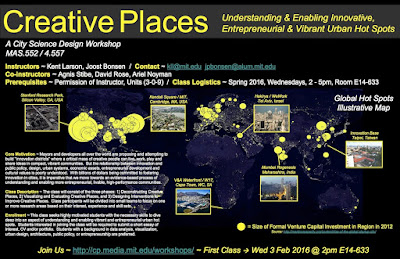 I'm co-teaching Creative Places class this Spring 2016 together with MIT Media Lab colleague Kent Larson and team, starting Wednesday, 3 February at 2pm, as part of our MIT Cities Initiative. We're particularly keen on understanding and enabling innovation, entrepreneurship, and creative vitality in cities. We seek better indices (or rankings or scores) and analyses especially of important but often intangible aspects of the city. Ultimately we aspire to deep understanding of how urban attractiveness can be best achieved through design, zoning, development, and more. Join us at first class Wed afternoon 2pm February 4th, 2016 in Media Lab E14-633.


.svg.png)


