Showing posts with label Climate. Show all posts

22 November 2019

Aridia ~ Towards Oasis Cities in the Drylands?

The WEF writes about Desertification: what is it and why is it one of the greatest threats of our time?
"The combined impact of climate change, land mismanagement and unsustainable freshwater use has seen the world’s water-scarce regions increasingly degraded. This leaves their soils less able to support crops, livestock and wildlife. This week, the Intergovernmental Panel on Climate Change (IPCC) will publish its special report on climate change and land. The report, written by hundreds of scientists and researchers from across the world, dedicates one of its seven chapters solely to the issue of desertification."
The 30 year climate map illustrates the geographies involved (plus see also Koppen climate maps)... In this light, it's worth inverting the issues and seeking opportunities in such drylands.  The big technological achievements of the past half-century are solar power and desalination.  But there's more, including much greater sophistication around water use, shades of greywater, cycling, and design and landscaping for water retention.  Furthermore, reforestation, for instance in the Sahel, has been done with hardier plant varieties and is increasingly including soil modification or assistive techniques to both preserve water and make maximum use of every little bit.  On arid but foggy coasts (e.g. Atacama, Namibia, etc) inexpensive materials are boosting the effectiveness of fog harvesting.  And we can learn from classic desert cities and ancient techniques (e.g. Petra, the medinas, etc) about greening the desert.  In any case, when you stitch all the existing and emergent ideas together, I believe there's a blossoming new category of "oasis cities" in arid regions.

14 March 2019

Tectonics in the Tropics ~ Ice Age Triggers!

Jennifer Chu of MIT News spotlights recent research indicating that Tectonics in the Tropics Trigger Earth’s Ice Ages...
"Over the last 540 million years, the Earth has weathered three major ice ages [each] preceded by tropical “arc-continent collisions” -- tectonic pileups that occurred near the Earth’s equator -- in which oceanic plates rode up over continental plates, exposing tens of thousands of kilometers of oceanic rock to a tropical environment.  [The] heat and humidity of the tropics likely triggered a chemical reaction between […] the rocks’ calcium and magnesium […] pulling the [CO2] out of the atmosphere and permanently sequestering it in the form of carbonates such as limestone [cooling] temperatures globally and ultimately [setting] off an ice age."
https://eapsweb.mit.edu/news/2019/tectonics-tropics-trigger-earths-ice-ages-study-finds

25 January 2019

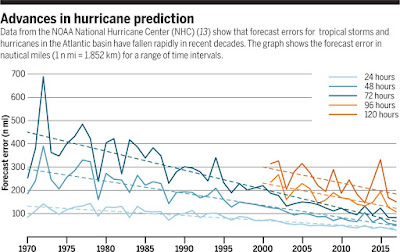
Hurricane Prediction ~ Forecast Quality Progress

Richard B. Alley, Kerry A. Emanuel, Fuqing Zhang write in Science about Advances in weather prediction...
"In recent decades, advances in forecasting have been rapid, arising from improved observations and models, and better integration of these through data assimilation and related techniques. Investment in weather forecasting pays large dividends, ranging from 3 to 10 times the costs.  [But] the developing world is especially vulnerable to weather disasters yet is underserved by forecasting."
http://science.sciencemag.org/content/363/6425/342?fbclid=IwAR1H8uKcUtkZpnxS3Wghw5sAjI2ftM4dkstvd8Xg5lmRfHkhJSj5i-i8xkY

30 September 2017

Flood Resiliency ~ Dutch Lessons for World Cities

Rising sea levels generally and ocean storm surges, river floodwaters, and intense rainfalls particularly inspire new kinds of thinking about water management, going beyond higher dikes and barriers towards more defense-in-depth, including flood-friendly construction, making room for the rivers, and building absorbent greener cities. Here are some good surveys of this movement...

08 October 2016

Ventusky ~ Remapping Wind Rain and Temps!

Lovely new Ventusky mapping of wind, rain, and temperature!
"Developed for you at our company, InMeteo [...] a Czech meteorological company based in Pilsen. At our company, we focus on weather prediction and meteorological data visualisation. [...] The name itself, Ventusky, is a combination of two words. The first is the Latin word, Ventus, means wind, and the second is the English word, Sky. The Ventusky application is freely accessible to anyone around the world, aimed at improving awareness about meteorological events in our atmosphere. Images from the application can be redistributed and thus help us achieve our goal."
https://www.ventusky.com/

23 July 2016

Volcanic Climate Change ~ Sulfate Evidence...

OpenMind shares 1816, the Year Without a Summer when...
"It snowed and froze in parts of Europe and North America. Crops were ruined, triggering the worst famine of the nineteenth century [and] became known as “the year without a summer,” a climatic anomaly that affected the northern hemisphere"
We now know this is at least partly due to the massive Tambora volcanic eruption.
"Evidence of the long range of the emissions from Tambora has been found in the high sulphur content in samples of polar ice from the time, says paleoclimatologist Robert Mulvaney of the British Antarctic Survey [...] “Very large eruptions (such as Tambora) can lift material very high in the atmosphere, and into the stratosphere,” explains Mulvaney. “Once in the stratosphere, the sulfur dioxide can oxidise into sulphuric acid, which is taken up by tiny water droplets to form a haze in the stratosphere that can reflect incident sunlight back away from the Earth, causing less light to penetrate through the atmosphere, and the Earth to cool.” This sulphuric acid circulating in the stratosphere is then detected in ice cores. In this way, scientists can estimate the volume of emissions from an eruption."
Here's the evidence showing it's happened at huge scale at least a couple times per century, so inquiring minds want to know "when's next"? https://www.bbvaopenmind.com/en/1816-the-year-without-a-summer/

19 August 2013

Sea Level Rise Explorer ~ Map of Coastal Risk

Check out Sea Level Rise Explorer, a zoomable worldmap of elevation relative to sea-level and thus indicator of coastal flood risk...

25 June 2013

PlaNYC ~ A Stronger, More Resilient New York...

Mayor Michael Bloomberg recently announced PlaNYC: A Stronger, More Resilient New York recommending how to rebuild communities post-Sandy and boost infrastructural resiliency...
"If this plan is implemented, New York City will not be “climate-change proof” -- an impossible goal -- but it will be far safer and more resilient than it is today. While no one can say with certainty exactly how much safer, the climate analysis in Chapter 2 shows that the investments recommended in this plan certainly will be worthwhile.
Lives will be saved and many catastrophic losses avoided. [...] Over time, implementation of this plan would address many of the risks that a coastal city like New York faces. By hardening our coastline, by making our building stock stronger, by creating a more durable power network and better stormwater infrastructure, and so much more, we can be better prepared for anything the future holds. We are a coastal city -- and we cannot, and will not, abandon our waterfront. Instead, we must build a stronger, more resilient city -- and this plan puts us on a path to do just that. It will not be easy, and it will take time; but as New Yorkers we are more than up to the task."

25 February 2012

Ancient Climate Change ~ Modeling Mayan Times

LiveScience spotlights NASA's Goddard Institute for Space Studies climatologist Benjamin Cook whose team computer modeled forest-clearing by ancient Mayans and its effect on climate...