
Local Search Algorithms in Artificial Intelligence are optimization techniques that improve a solution by repeatedly moving to a better neighbouring state. Instead of exploring every possible path, they focus on finding efficient and practical solutions for complex problems.
- Improve solutions through neighbouring states
- Useful for optimization and decision-making problems
- Commonly used in scheduling, routing, and machine learning tasks
Basic Terminologies
- State: A possible solution to the problem
- Current State: The solution currently being evaluated
- Neighbour State: A solution formed by making small changes to the current state
- Objective Function: A function used to measure the quality of a solution
- Local Optimum: The best solution among nearby states
- Global Optimum: The best possible solution in the entire search space
Working
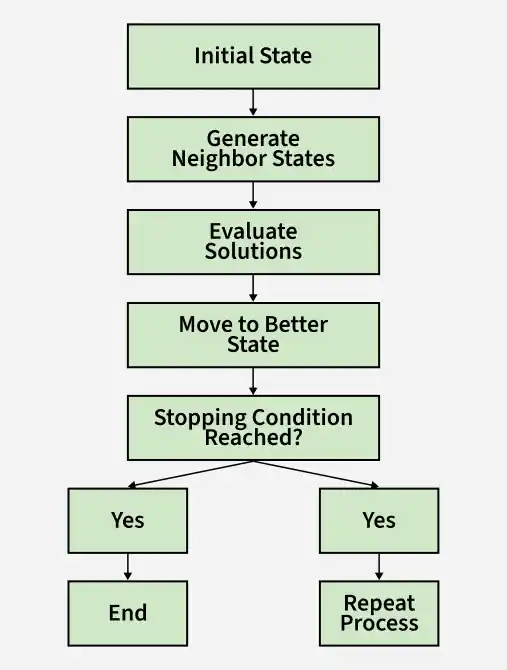
1. Pick a starting point: Start with a possible solution which is often random but sometimes based on rule.
2. Find the Neighbours:
- Neighbours are similar solutions we can get by making small, simple changes to the current one.
- For example, in a puzzle, swapping two pieces creates a neighbour.
3. Compare: Look around at all neighbors to see if any are better.
4. Move: If a better neighbor exists, move to it, making it our new “current” solution.
5. Repeat: Keep searching from the new point, following the same steps.
6. Stop: When none of the neighbors are better or after enough tries.
Types of Local Search Algorithms
1. Hill-Climbing Search Algorithm
Hill-Climbing search algorithm is a simple local search algorithm that continuously moves toward a better neighboring solution until no improvement is possible.
Process:
- Start: Begin with an initial solution.
- Evaluate: Assess the neighboring solutions.
- Move: Transition to the neighbor with the highest objective function value if it improves the current solution.
- Repeat: Continue this process until no better neighboring solution exists.
Pros:
- Easy to implement.
- Works well in small or smooth search spaces.
Cons:
- May get stuck in local optima.
- Limited exploration of the search space.
import random


def f(x):
    return - (x - 3)**2 + 5


def hill_climb():
    current_x = random.uniform(0, 6)
    step_size = 0.1
    max_iterations = 100
    for i in range(max_iterations):
        neighbors = [current_x + step_size, current_x - step_size]
        neighbors = [x for x in neighbors if 0 <= x <= 6]
        neighbor_scores = [f(x) for x in neighbors]
        best_neighbor_idx = neighbor_scores.index(max(neighbor_scores))
        best_neighbor = neighbors[best_neighbor_idx]
        if f(best_neighbor) > f(current_x):
            current_x = best_neighbor
        else:
            break
    return current_x, f(current_x)


result_x, result_value = hill_climb()
print(f"Found maximum at x = {result_x:.2f}, value = {result_value:.2f}")
Output: Found maximum at x = 3.02, value = 5.00
2. Simulated Annealing
Simulated Annealing is a local search algorithm inspired by the heating and cooling process in metallurgy. It occasionally accepts worse solutions to escape local optima, with the acceptance probability decreasing over time.
Process:
- Start: Begin with an initial solution and an initial temperature.
- Move: Transition to a neighboring solution with a certain probability.
- Cooling Schedule: Gradually reduce the temperature over time.
- Probability Function: Accept worse solutions with decreasing probability as temperature lowers.
Pros:
- Helps escape local optima due to probabilistic acceptance of worse solutions.
- Explores the search space more effectively.
Cons:
- Requires careful parameter tuning.
- Computationally expensive due to repeated evaluations.
import math
import random


def f(x):
    return - (x - 3)**2 + 5


def get_neighbor(x, step_size=0.1):
    return x + random.uniform(-step_size, step_size)


def simulated_annealing():
    current_x = random.uniform(0, 6)
    best_x = current_x
    best_eval = f(current_x)
    temp = 10
    max_iterations = 1000
    for i in range(max_iterations):
        t = temp / float(i + 1)
        candidate = get_neighbor(current_x)
        candidate = max(0, min(6, candidate))
        candidate_eval = f(candidate)
        if candidate_eval > best_eval or random.random() < math.exp((candidate_eval - best_eval) / t):
            current_x = candidate
            best_eval = candidate_eval
            best_x = current_x
    return best_x, f(best_x)


result_x, result_value = simulated_annealing()
print(f"Best found x = {result_x:.2f}, value = {result_value:.2f}")
Output: Best found x = 3.02, value = 4.96
3. Genetic Algorithms
Genetic Algorithms (GAs) are inspired by the process of natural selection and evolution. They work with a population of solutions and evolve them over time using genetic operators like selection, crossover and mutation.
Process:
- Initialize: Start with a population of random solutions.
- Evaluate: Assess the fitness of each solution.
- Select: Choose the best solutions for reproduction based on their fitness.
- Crossover: Combine pairs of solutions to produce new offspring.
- Mutate: Apply random changes to offspring to maintain diversity.
- Replace: Form a new population by selecting which solutions to keep.
Pros:
- Can explore a broad solution space and find high-quality solutions.
- Suitable for complex problems with large search spaces.
Cons:
- Can be computationally expensive
- Requires tuning of various parameters like population size and mutation rate.
import random


def f(x):
    return - (x - 3)**2 + 5


def genetic_algorithm():
    population = [random.uniform(0, 6) for _ in range(20)]
    max_generations = 50
    for _ in range(max_generations):
        scores = [f(x) for x in population]
        best = population[scores.index(max(scores))]
        new_population = [best]  # keep best
        while len(new_population) < len(population):
            parents = random.sample(population, 2)
            child = (parents[0] + parents[1]) / 2
            # mutation: small random step
            if random.random() < 0.3:
                child += random.uniform(-0.2, 0.2)
                child = max(0, min(6, child))
            new_population.append(child)
        population = new_population
    scores = [f(x) for x in population]
    best = population[scores.index(max(scores))]
    return best, f(best)


result_x, result_value = genetic_algorithm()
print(f"Best found x = {result_x:.2f}, value = {result_value:.2f}")
Output: Best found x = 3.00, value = 5.00
4. Tabu Search
Tabu Search enhances local search by using a memory structure called the tabu list to avoid revisiting previously explored solutions. This helps to prevent cycling back to local optima and encourages exploration of new areas.
Process:
- Start: Begin with an initial solution and initialize the tabu list.
- Move: Transition to a neighboring solution while considering the tabu list.
- Update: Add the current solution to the tabu list and potentially remove older entries.
- Aspiration Criteria: Allow moves that lead to better solutions even if they are in the tabu list.
Pros:
- Reduces the chance of getting stuck in local optima.
- Effective in exploring large and complex search spaces.
Cons:
- Requires careful management of the tabu list and aspiration criteria.
- Computational complexity can be high.
import random


def f(x):
    return - (x - 3)**2 + 5


def tabu_search():
    current_x = random.uniform(0, 6)
    tabu_list = []
    tabu_size = 5
    step_size = 0.1
    max_iterations = 100
    best_x = current_x
    best_eval = f(current_x)
    for _ in range(max_iterations):
        neighbors = [current_x + step_size, current_x - step_size]
        neighbors = [x for x in neighbors if 0 <=
                     x <= 6 and x not in tabu_list]
        if not neighbors:
            break
        neighbor_scores = [f(x) for x in neighbors]
        best_neighbor_idx = neighbor_scores.index(max(neighbor_scores))
        best_neighbor = neighbors[best_neighbor_idx]
        if f(best_neighbor) > best_eval:
            best_x, best_eval = best_neighbor, f(best_neighbor)
        tabu_list.append(current_x)
        if len(tabu_list) > tabu_size:
            tabu_list.pop(0)
        current_x = best_neighbor
    return best_x, f(best_x)


result_x, result_value = tabu_search()
print(f"Best found x = {result_x:.2f}, value = {result_value:.2f}")
Output: Best found x = 3.02, value = 5.00
Comparison of Local Search Algorithms
| Feature | Hill-Climbing | Simulated Annealing | Genetic Algorithm | Tabu Search |
|---|---|---|---|---|
| Search Style | Local search | Probabilistic search | Population-based search | Memory-based search |
| Moves to Worse Solutions | No | Yes | Yes | Rarely |
| Avoids Local Optima | No | Yes | Yes | Yes |
| Speed | Fast | Moderate | Slower | Moderate |
| Best Use Case | Small problems | Problems with many local optima | Complex optimization problems | Problems with repeated states |
Applications
- Scheduling: Creating timetables for schools, jobs, or exams while avoiding conflicts
- Routing: Finding efficient paths for delivery and travel problems such as the Traveling Salesperson Problem
- Resource Allocation: Assigning limited resources like machines, rooms, or staff efficiently
- Games and AI: Making fast decisions and strategic moves in complex games
- Machine Learning: Tuning model parameters to improve performance
Advantages
- Require less memory compared to exhaustive search methods
- Work efficiently for large and complex search spaces
- Can quickly find good or near-optimal solutions
- Useful for real-world optimization problems
Limitations
- May get stuck in local optima
- Do not always guarantee the best solution
- Performance can depend on the initial state
- Some algorithms require careful parameter tuning