
CycleGAN is a GAN architecture used for image-to-image translation without requiring paired training data. It uses two generators and two discriminators to transform images between domains and reconstruct the original image using cycle consistency loss.
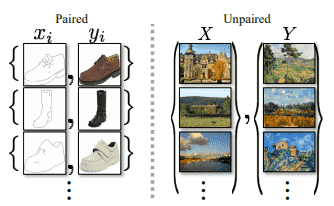
- Performs image translation without paired images
- Uses two generators and two discriminators
- Learns reversible mappings between image domains
- Uses cycle consistency loss for reconstruction
- Applied in style transfer and image transformation tasks
Architecture of CycleGAN
CycleGAN uses two generators and two discriminators to perform image translation between two domains without paired data.
1. Generators
Create new images in the target style.
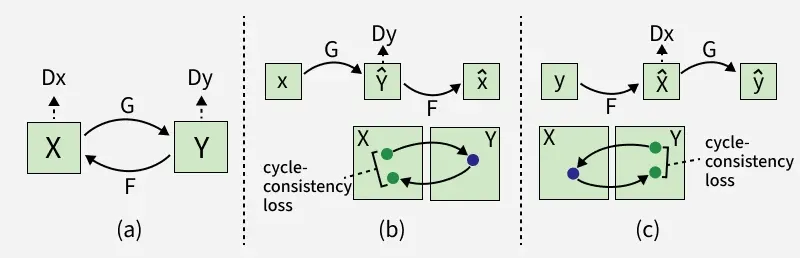
CycleGAN has two generators G and F:
- G transforms images from domain X like photos to domain Y like artwork.
- F transforms images from domain Y back to domain X.
The generator mapping functions are as follows:
\begin{array}{l} G : X \rightarrow Y \\ F : Y \rightarrow X \end{array}
where
2. Discriminators
Decide if images are real (from dataset) or fake (generated). There are two discriminators
Dₓ distinguishes between real images fromX and generated images fromF(y) .Dᵧ distinguishes between real images fromY and generated images fromG(x) .
Cycle Consistency Loss
To further regularize the mappings the CycleGAN uses two more loss function in addition to adversarial loss.
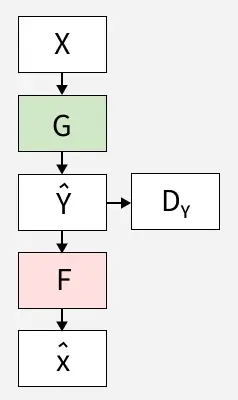
1. Forward Cycle Consistency Loss: Ensures that when we apply G and then F to an image we get back the original image
For example: .
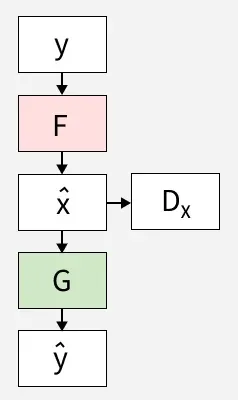
2. Backward Cycle Consistency Loss: Ensures that when we apply F and then G to an image we get back the original image.
For example:
Generator Architecture
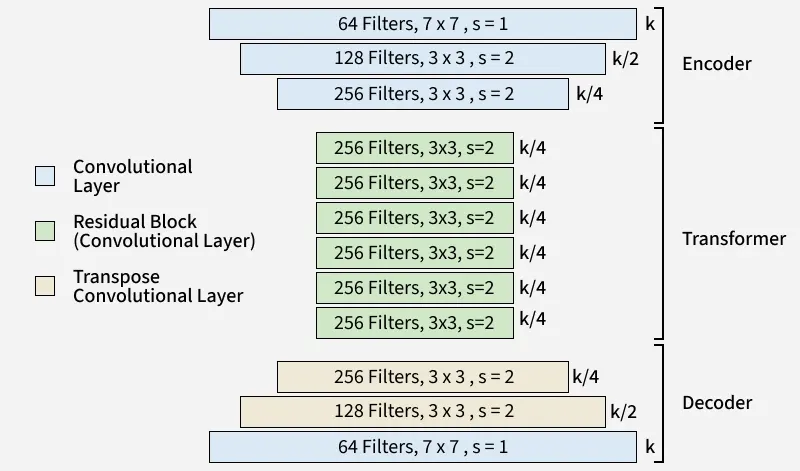
Each CycleGAN generator consists of an encoder, transformer and decoder for image translation.
- Encoder: The input image is passed through three convolution layers which extract features and compress the image while increasing the number of channels. For example a 256×256×3 image is reduced to 64×64×256 after this step.
- Transformer: The encoded image is processed through 6 or 9 residual blocks depending on the input size which helps retain important image details.
- Decoder: The transformed image is up-sampled using two deconvolution layers and restoring it to its original size.
Generator Structure:
c7s1-64 → d128 → d256 → R256 (×6 or 9) → u128 → u64 → c7s1-3
- c7s1-k: 7×7 convolution layer with k filters.
- dk: 3×3 convolution with stride 2 (down-sampling).
- Rk: Residual block with two 3×3 convolutions.
- uk: Fractional-stride deconvolution (up-sampling).
Discriminator Architecture (PatchGAN)
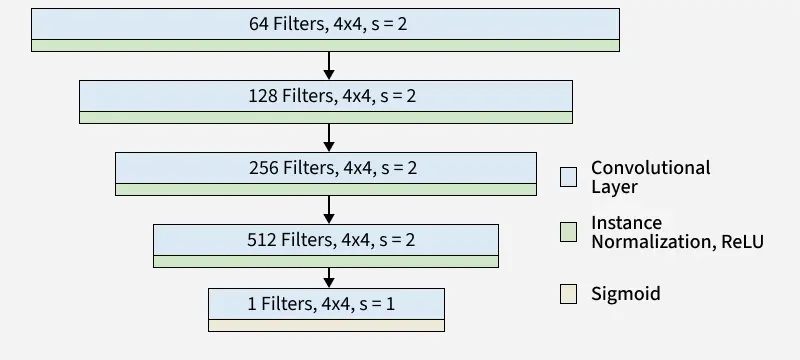
In CycleGAN the discriminator uses a PatchGAN instead of a regular GAN discriminator.
- A regular GAN discriminator looks at the entire image (e.g 256×256 pixels) and outputs a single score that says whether the whole image is real or fake.
- PatchGAN breaks the image into smaller patches (e.g 70×70 patches). It outputs a grid (like 70×70 values) where each value judges if the corresponding patch is real or fake.
Discriminator Structure
C64 → C128 → C256 → C512 → Final Convolution
- Ck: 4×4 convolution with k filters, InstanceNorm and LeakyReLU except the first layer.
- The final layer produces a 1×1 output and marking real vs. fake patches.
Cost Function in CycleGAN
CycleGAN uses a combined loss function to train generators and discriminators effectively. The total cost function consists of adversarial loss and cycle consistency loss.
1. Adversarial Loss
Adversarial loss helps generators produce realistic images that can fool the discriminators.
Loss_{advers}\left ( G, D_y, X, Y \right ) =\frac{1}{m}\sum \left ( 1 - D_y\left ( G\left ( x \right ) \right ) \right )^{2}
Loss_{advers}\left ( F, D_x, Y, X \right ) =\frac{1}{m}\sum \left ( 1 - D_x\left ( F\left ( y \right ) \right ) \right )^{2}
- Encourages generators to create realistic images
- Helps discriminators distinguish real and fake images
2. Cycle Consistency Loss
Cycle consistency loss ensures that translating an image to another domain and back reconstructs the original image.
- Preserves important image content during translation
- Ensures meaningful reversible mappings between domains
Loss_{cyc}\left ( G, F, X, Y \right ) =\frac{1}{m}\left [ \left ( F\left ( G\left ( x_i \right ) \right )-x_i \right ) +\left ( G\left ( F\left ( y_i \right ) \right )-y_i \right ) \right ]
The Cost function we used is the sum of adversarial loss and cyclic consistent loss:
L\left ( G, F, D_x, D_y \right ) = L_{advers}\left (G, D_y, X, Y \right ) + L_{advers}\left (F, D_x, Y, X \right ) + \lambda L_{cycl}\left ( G, F, X, Y \right )
and our aim is :
arg \underset{G, F}{min}\underset{D_x, D_y}{max}L\left ( G, F, D_x, D_y \right )
Applications
1. Collection Style Transfer: CycleGAN can learn styles from entire artwork collections such as Van Gogh, Monet and Cezanne, allowing it to generate diverse artistic image styles.


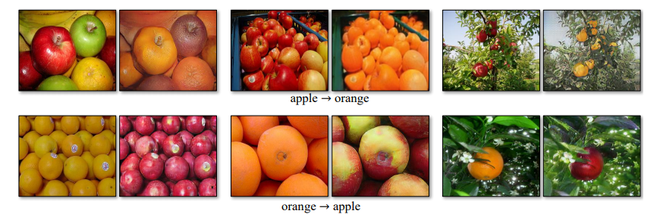
2. Object Transformation: CycleGAN can transform objects between different classes, such as apples to oranges or zebras to horses, making it useful for image editing and content generation.
3. Seasonal Transfer: CycleGAN can transform images between different seasons, such as converting winter scenes into summer landscapes and vice versa.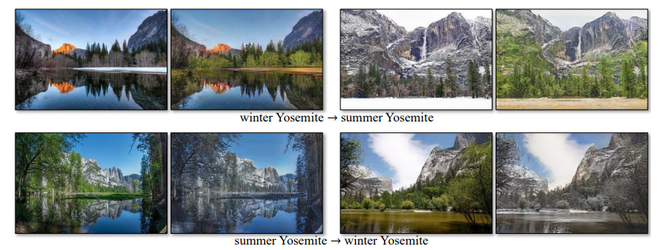
4. Photo Generation from Paintings: CycleGAN can transform paintings into realistic photos and convert photos into artistic paintings, making it useful for artistic and image editing applications. This loss can be defined as
L_{identity}\left ( G, F \right ) =\mathbb{E}_{y~p\left ( y \right )}\left [ \left \| G(y)-y \right \|_1 \right ] + \mathbb{E}_{x~p\left ( x \right )}\left [ \left \| F(x)-x \right \|_1 \right ]
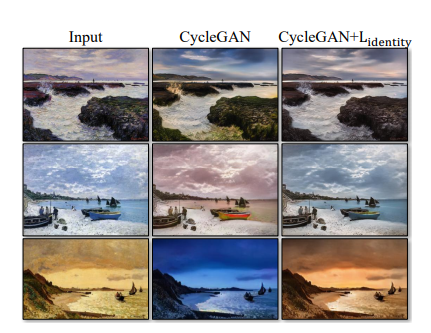
5. Photo Enhancement: CycleGAN can enhance smartphone photos to resemble DSLR-quality images by improving visual quality and depth effects.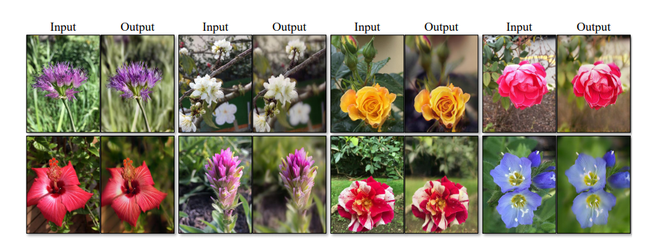
Evaluating CycleGAN’s Performance
CycleGAN performance is evaluated using both human perception and quantitative metrics.
- AMT Perceptual Studies: Real users compare generated images with actual images to judge visual realism
- FCN Scores: Measure image understanding accuracy using metrics such as pixel accuracy and Intersection over Union (IoU)
Limitations
CycleGAN is effective for texture and style transformation but has limitations in handling major structural changes.
- Works better for changing textures and colors than object shapes
- Struggles with large structural modifications
- Generated images may sometimes contain distortions or unrealistic details
- Can produce unpredictable results in complex transformations