
An AI agent is a software system that perceives its environment, processes information, and takes actions to achieve specific goals. It operates with a degree of autonomy to complete assigned tasks effectively.
- Collects and analyzes data from its environment to support decision-making
- Selects appropriate actions to accomplish tasks or escalate when needed
Key Features
- Autonomous: Act without constant human input and decide next steps from past data like a bookstore bot flags missing invoices.
- Goal‑driven: Optimize for defined objectives like a logistics AI balancing speed, cost and fuel use.
- Perceptive: Gather info from sensors, inputs or APIs like a cybersecurity agent tracking new threats.
- Adaptable: Adjust strategies when situations change.
- Collaborative: Work with humans or other agents toward shared goals like healthcare agents coordinating with patients and doctor.
Classification
An agent is a system designed to perceive its environment, make decisions and take actions to achieve specific goals. Agents operate autonomously, without direct human control and can be classified based on their behavior, environment and number of interacting agents.
- Reactive Agents: Respond to immediate environmental stimuli without foresight or planning.
- Proactive Agents: Anticipate future states and plan actions to achieve long-term goals.
- Single-Agent Systems: One agent solves a problem independently.
- Multi-Agent Systems: Multiple agents interact, coordinate or compete to achieve goals; may be homogeneous (similar roles) or heterogeneous (diverse roles).
- Rational Agents: Choose actions to maximize expected outcomes using both current and historical information.
Types of Agents
1. Simple Reflex Agents
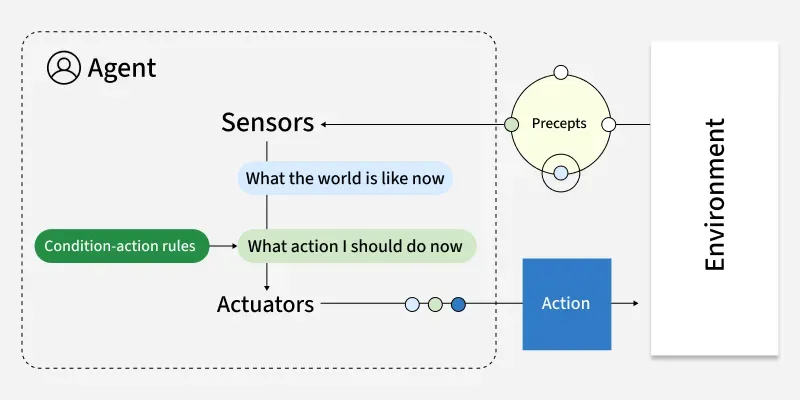
Simple reflex agents act only on the current perception of the environment using predefined condition–action rules. They do not rely on past experiences or predict future outcomes and respond directly using simple “if–then” logic.
- Operate without memory of past states or stored information
- Do not maintain any internal model of the environment
- Work best in fully observable and predictable environments
For Example, Traffic light control systems that change signals based on fixed timing.
2. Model-Based Reflex Agents
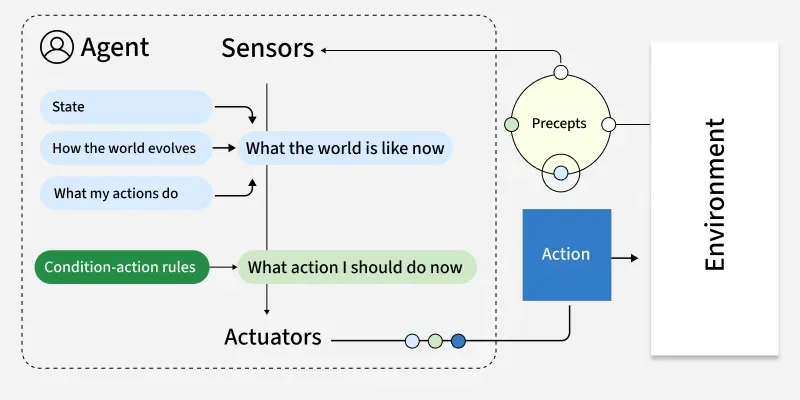
Model-based reflex agents maintain an internal model of the environment to handle situations where full information is not directly available. This helps them make better decisions by considering changes in the environment and the impact of their actions.
- Use internal memory to update and maintain environment state
- Infer missing details from partial or incomplete observations
- React based on current input while using stored context for better decisions
For example, Robot vacuum cleaners that map rooms and tracks cleaned areas.
3. Goal-Based Agents
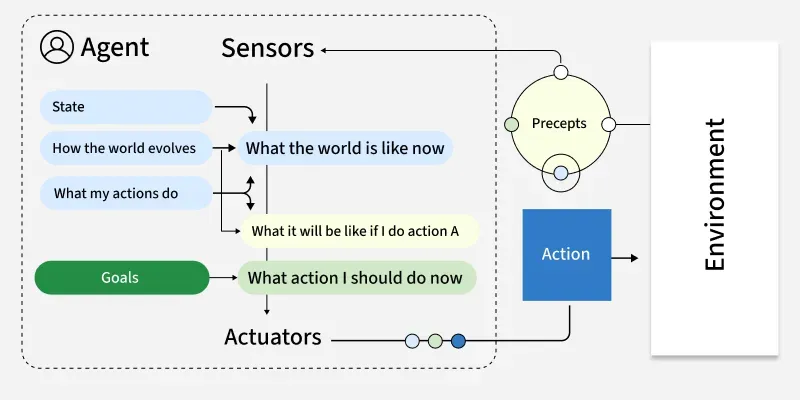
Goal-based agents choose their actions by focusing on a specific objective and evaluating how different choices can help achieve it. Instead of reacting only to the current situation, they plan ahead and consider possible future outcomes.
- Use search and planning techniques to find suitable action paths
- Judge actions based on how well they move toward the goal
- Consider future consequences before making decisions
- Explore multiple possible routes to reach the desired outcome
For example, Logistics routing agents that find optimal delivery routes based on factors like distance and time. They continually adjust to reach the most efficient route.
4. Utility-Based Agents
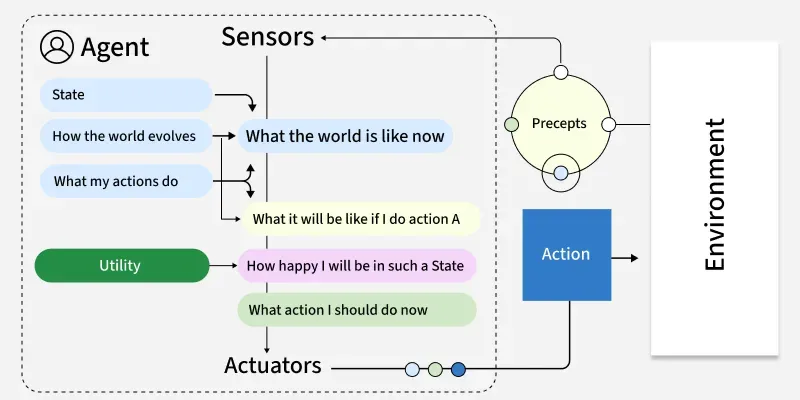
Utility-based agents go beyond simply achieving goals by evaluating how beneficial each action is using a utility function, which measures the overall “value” or satisfaction of an outcome. This helps them choose the best option when dealing with trade-offs or uncertainty.
- Make decisions in uncertain or probabilistic environments
- Select actions based on expected usefulness or reward
- Optimize choices while working within given constraints
For example, Financial portfolio management agents that evaluate investments based on factors like risk, return and diversification operate by choosing options that provide the most value.
5. Learning Agents
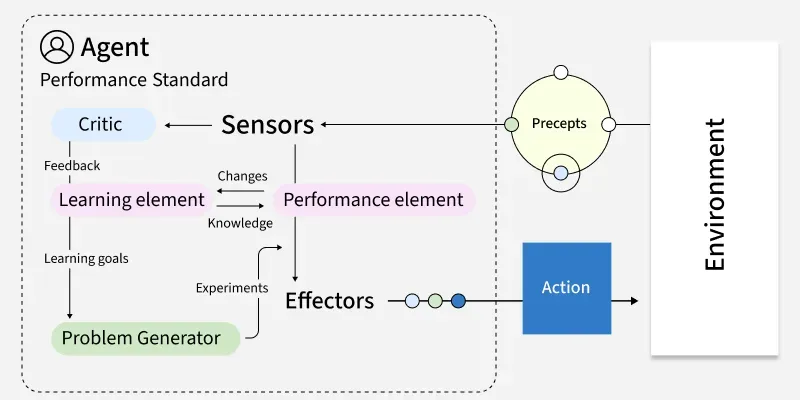
Learning agents improve their behavior over time by using feedback from past actions. They continuously refine their internal models to make better decisions in future situations.
- Adapt their behavior based on experience and feedback
- Improve decision-making by updating internal models
- Combine action execution with a learning mechanism
- Create new knowledge instead of relying only on fixed rules
For example, Customer service chatbots can improve response accuracy over time by learning from previous interactions and adapting to user needs.
6. Multi-Agent Systems (MAS)
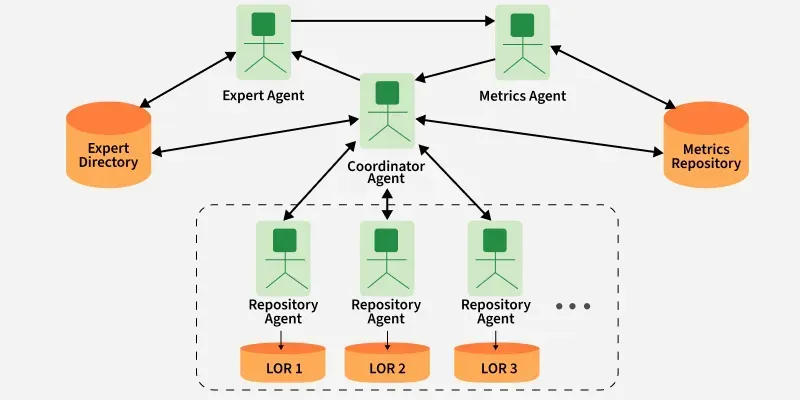
Multi-agent systems consist of multiple autonomous agents that interact within a shared environment, where they may cooperate, compete, or do both depending on the situation.
- Include different interaction types such as cooperative, competitive, and mixed agent behavior
- Operate without a central controller, with decisions distributed across agents
- Remain robust even if some agents fail or stop functioning
Example: A warehouse system where robots navigate using reflexes, plan tasks using goals, prioritize work using utility, and improve routes through learning
7. Hierarchical agents
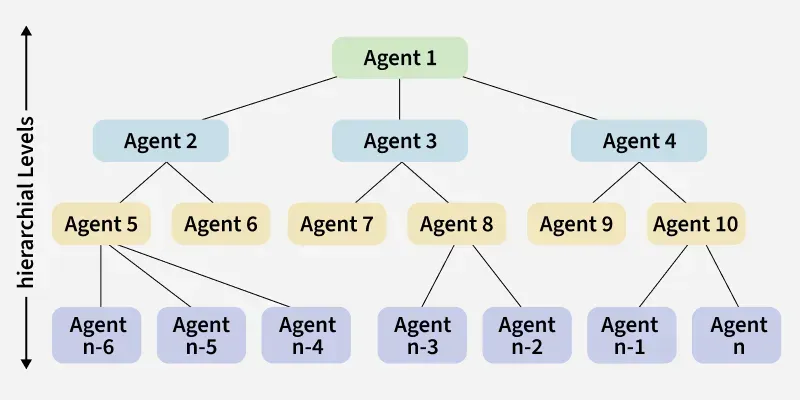
Hierarchical agents organize decision-making in layers, where higher levels focus on planning and lower levels handle execution. This structure helps manage complex tasks by separating strategy from operational details.
- Break tasks into structured levels of control and responsibility
- High-level agents focus on planning and coordination
- Low-level agents handle direct execution of actions
- Reduce complexity by simplifying how information and decisions flow across levels
For example, Drone delivery systems in which fleet management is done at top level and individual navigation at lower level.
Architecture
- Profiling Module: This module helps the agent understand its role and purpose. It gathers information from the environment to form perceptions. For example: A self-driving car uses sensors and cameras to detect obstacles.
- Memory Module: The memory module enables the agent to store and retrieve past experiences. This helps the agent learn from prior actions and improve over time. For example: A chatbot remembers past conversations to give better responses.
- Planning Module: This module is responsible for decision-making. It evaluates situations, weighs alternatives and selects the most effective course of action. For example: A chess-playing AI plans its moves based on future possibilities.
- Action Module: The action module executes the decisions made by the planning module in the real world. It translates decisions into real-world actions. For example: A robot vacuum moves to clean a designated area after detecting dirt.
Working
1. Persona: Each agent is assigned a defined role, personality, and communication style, along with instructions and available tools. This ensures consistent behavior while adapting over time through experience and interaction.
2. Memory: Agents typically have multiple types of memory:
- Short‑term memory for the current interaction
- Long‑term memory for storing historical data and conversations
- Episodic memory for recalling specific past events
- Consensus memory for sharing knowledge among multiple agents
Memory enables an agent to keep context, learn from experience and adapt its behaviour over time.
3. Tools: These are external functions or resources an agent uses to access information, process data, control systems, or connect with other services. Agents learn when and how to use them based on context and capability.
4. Model: Agents use large language model (LLM) which serves as the agent’s “brain”. The LLM interprets instructions, reasons about solutions, generates language and orchestrates other components including memory retrieval and tools to use to carry out tasks.
Use Cases
- Robotics: Used to control robots for automation in manufacturing, logistics, and transportation
- Smart homes: Manage lighting, heating, and energy use to improve comfort and efficiency
- Healthcare: Support patient monitoring, treatment planning, and resource optimization
- Finance: Enable automated trading, fraud detection, and risk analysis
- Games: Create intelligent opponents for more realistic and challenging gameplay
Benefits
- Fast and efficient operations.
- Adapt and learn from experience.
- Scalable for large or complex problems.
- Operate autonomously with minimal human input.
- Consistent, reliable task performance.
Limitations
- Struggle with complex or unpredictable environments.
- High computational needs for learning and planning.
- Communication issues in multi-agent setups.
- Risk of bias or unintended actions.
- Challenges in designing clear goals and utility functions.