
Digital Twins are virtual models of physical things like bridges, industries or entire environments that update in real time using data from sensors and other sources. They mirror what's happening in the real world, letting engineers monitor performance, predict when things might break and test changes virtually before making them in reality.
Generative AI is a type of artificial intelligence designed to create new content such as text, images, music or even code by learning patterns from existing data. These models generate original outputs that are often indistinguishable from human-created content. These models use techniques like deep learning and neural networks to generate output.
How they work together
Generative AI makes digital twins better in several ways
- It can help build the twin itself by learning how systems work from historical data instead of requiring engineers to manually code every rule.
- It adds conversational interfaces through large language models like GPT-4 or Gemini, so people can ask questions in normal language instead of learning specialized software.
- It creates synthetic data to fill gaps in historical records, especially for rare events that haven't happened often enough to provide good examples.
Before any AI-generated idea reaches a decision-maker, it runs through simulations in the digital twin to make sure it's safe, physically possible and economically viable. This keeps the AI grounded in reality while still letting it be creative.
How the Technology works
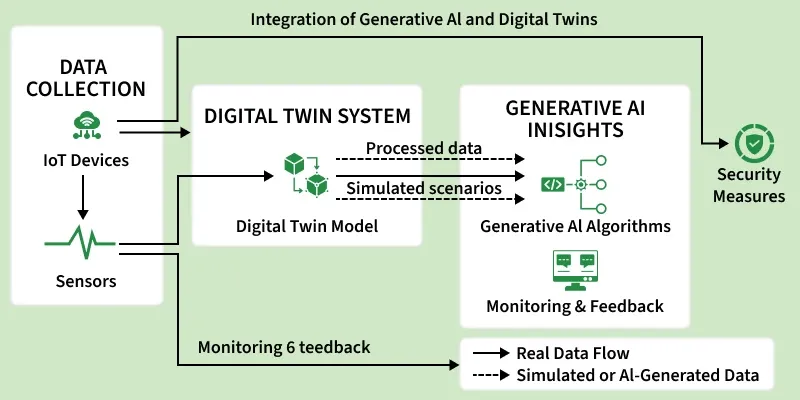
- Data Collection : Information is continuously gathered from sensors, control systems, maintenance records and similar sources. All of this flows into a central platform so the digital twin always reflects what is happening in the real system.
- Shared data foundation : The same, up-to-date data is used by both the digital twin and the AI components. This ensures every model, prediction or recommendation is based on a consistent and accurate view of reality.
- Modeling layer : The digital twin itself is built using physics-based models, machine-learning models or a mix of both. This layer represents how the system behaves under different conditions.
- Generative AI layer : On top of the twin, generative AI techniques (such as GANs, transformers or diffusion models) explore new options. These might include alternative designs, maintenance plans, operating strategies or future scenarios.
- Validation and safety checks : Every AI-generated suggestion is tested against engineering constraints, safety limits and regulatory rules. Ideas that are unrealistic or unsafe are automatically filtered out.
- Automation and reporting : The system can automatically generate reports, summaries and documentation. This reduces manual work and allows engineers to spend more time on analysis and decision-making rather than paperwork.
Advantages
- Accelerated Development : Generative AI can be used to come up with novel features in the form of ideas and code which can help provide suggestions , recommendations and improve efficiency.
- Increased Security : By testing out new features directly in the digital twin enviornment , the chance of miscalculations or error happening in real life is drastically reduced.
- Real time monitoring & Maintenance : Digital twins enhanced with generative AI enable continuous real-time monitoring and predictive maintenance, significantly reducing downtime and operational costs
Limitations
- High Initial Costs : Creating a digital twin requires resources in the form of both compute and skilled manpower, also investment is needed for sensors or radar data , this process creates barriers for smaller organizations.
- Complexity and Expertise Requirements : Setting up and maintaining generative AI-enhanced digital twins is complex, requiring specialized multidisciplinary expertise spanning domain knowledge, AI/ML skills and systems integration.
- Data Quality Dependencies : Digital twins and generative AI are only as accurate as the data and models they're based on. They require high-volume, high-quality databases to function effectively. Poor data quality can lead to misleading results and inaccurate predictions.