Showing posts with label Berlin. Show all posts

Sunday, 19 April 2026

The Berlin brewing industry in 1944

A Schultheiss Malzbier label featuring a man in 16th-century dress holding a large mug of beer.
Getting numbers for brewing in Germany in WW II isn't an easy task. I only have very incomplete information. Mostly, for the  early war years.

It may well be that there is no accurate information for the final chaotic months of the war. When people had lots of other things to worry about. And brewing statistics weren't much of a priority. If brewing was taking place at all.

That's why I was so happy to find these numbers for brewing in Berlin in 1944.

I'm fairly gobsmacked at the total quantity produced: almost 4 million hl. Though that does include drinks other than beer. And I imagine that most of the beer was so weak as to be barely recognisable as beer.

There are 21 breweries in total. Of which, 11 were in East Berlin. Interesting, that. As West Berlin was double the size of East Berlin. However, the two largest breweries, Kindl Neuköln and Schulthess Kreuzberg, were both in the West.

Several companies operated multiple breweries: Schulthess 6, Engelhardt 3, Kindl 2 and Löwenbrauerei 2. With these spread across the East and West sections of the city. Which made things complicated. In the 1980s, there were beers branded Schultheiss and Kindl in both the East and West. Using exactly the same logos, even though they were completely separate enterprises. 

Key operational data of Berlin breweries 1944
Brewery Production of beer and beverages in hl Total employees Special production/headcount in hl/a Special production/Total workforce in hl/a Energy consumption in kg/hl 2)
Berliner Bürgerbräu 201,915 211 1309 914 13.62
Böhmisches Brauhaus-Löwenbrauerei 268,628 354 1226 783 16.25
Bergschloß-Brauerei 104,821 107 1442 957 22.7
Bötzow-Brauerei 113,311 218 776 513 18.15
Engelhardt-Brauerei, Abt. Stralau 161,607 203 1468 817 17.44
Engelhardt-Brauerei, Abt. Pankow 155,730 183 1426 874 20.07
Engelhardt-Brauerei, Abt. Charlottenb. 55,215 78 1222 689 13.25
Groterjan-Brauerei 276,270 420 1083 622 7.45
Hochschul-Brauerei 1) 30,503 57 824 535 21.98
Monopol-Brauerei 97,724 99 1396 1303 18.28
Kindl-Brauerei. Abt, Neukölln 392,522 508 1570 837 20.76
Kindl-Brauerei. Abt, Weißensee 272,657 321 1855 931 22.17
Schloß-Brauerei 2) 150,972 185 1399 851 17.58
Schultheiss-Brauerei, Abt. Kreuzberg 421,659 511 1310 872 14.42
Schultheiss-Brauerei, Abt. NO 304,497 524 675 563 18.25
Schultheiss-Brauerei, Abt. Schönh. Al. 245,648 326 1150 802 11.46
Schultheiss-Brauerei, Abt. Spandau 233,024 351 938 693 16.88
Schultheiss-Brauerei, Abt. Nd.-Schw. 220,137 254 1121 899 16.15
Schultheiss-Brauerei, Abt. Stromstr. 193,899 335 830 604 14.08
Willner Brauerei 14,167 41 616 383 26.44
Total 3,914,906 5,286      
1) Already bomb damaged
2) In kilograms of hard coal at 6600 heat units/kg
Source:
Die Brau- und Malzindustrie in Deutschland-Ost zwischen 1945 und 1989, VLB, 2016, page 111.


Tuesday, 31 March 2026

Brauerei Potsdam-Rehbrücke output in 1988

A Potsdam Rex Pils Spezial label, featuring a drawing of Sans Souci and a soldier in 18th-century uniform.
The division of Germany caused many problems. In Potsdam, it was one of beer supply. Before the war, the area had mostly been served by breweries in West Berlin. Local breweries, which were small and old-fashioned, were unable to meet local demand. And breweries in East Berlin didn't have the spare capacity to supply Potsdam.

In the mid-1960s, local breweries were only able to produce about 50% of the beer consumed in Potsdam. Therefor it was decided to construct an entirely new brewery in Rehbrücke. It was supposed to start production in 1971. However, due to problems in obtaining the machinery, it didn't actually start production until 1981.

This is one of the few places in "Die Brau- und Malzindustrie in Deutschland-Ost zwischen 1945 und 1989" where there are some numbers for the output of different beer types. And it's very different from what we saw at the Diamant brewery of Magdeburg in 1960. Where three-quarters of their output was Helles.

In Potsdam, Pilsner was king, accounting for over 50% of production. And that's just the standard Pilsner. If you include Pilsator and Spezial, that increases to 88%. While Helles was a mere 5%. Did this represent a change in the relative popularity of the different styles? Or was Potsdam just specialising in Pilsner? I suspect a bit of both. It could also be a regional thing, as I remember Berlin pubs mostly sold Pilsner, not Helles.

Interestingly, three strong beers were brewed: pale and dark Bock and Märkischer Landmann.

I can remember drinking Potsdam Rex Pilsner, as it did seem to be available in Thüringen. At least in some outlets. I think in Delikat shops. It was a decent enough Pils. 

Brauerei Potsdam-Rehbrücke output in 1988
type hl %
Vollbier Hell 40,000 5.34%
Pilsner 444,200 59.26%
Spitzenbier 21,300 2.84%
Spezialbier 118,000 15.74%
Pilsator 99,900 13.33%
Heller Bock 10,500 1.40%
Dunkler Bock 9,200 1.23%
Märkischer Landmann 6,500 0.87%
total 749,600  
Source:
Die Brau- und Malzindustrie in Deutschland-Ost zwischen 1945 und 1989, VLB, 2016, page 269.


Thursday, 31 July 2025

An interesting anniversary

An Engehardy Hell Vollbier label with a drawing of an angel holding a glass of beer and the text "Brauerei Abzug" and " Berlin O17 Alt Stralau 62".
This is a bit of a weird article. Which was inspired by a 70th anniversary. One I'm a bit dubious of.

A curious and interesting anniversary was celebrated at Berlin on the first day of the current month. It was nothing less than the seventieth anniversary of the introduction of Bavarian beer into the capital of Prussia, and, as the Daily Telegraph observes, this was no ordinary fete day, inasmuch as "it records an immense revolution in the bibulous habits and tastes of a very thirsty section of a notoriously absorptive race of people.” There is probably no unduly imaginative notion set afoot, when one declares that beer has played a great role in drawing the peoples of North and South Germany into close political and social union. When Herr Goschenhofer started his Bavarian beer brewery in Berlin, that is to say, in the year 1829, the political relations, existing between Prussia and Bavaria were, to use the language of diplomacy, somewhat strained, and the since realised dream of a United Germany appeared almost impossible of realisation. 
The Brewers' Journal vol. 35 1899, September 15th 1899, page 530.

1829 seems very early to me for the first Lager brewery in Berlin. I'm sure I used yo have the dates for the first bottom-fermenting breweries in North Germany. Where the hell did I put that?

It seems that there were a few more Berlin Lager brewers in the first half of the 19th century.

During the interval between 1829 and 1850 some three or four Bavarian beer breweries appear to have sprung up, and to have commanded very fair business, but the real beginning of the general taste for South German beers dates from the years 1870-71, when the united German armies beat the French, and when the little “blue devils” of Bavaria enforced upon their superior Prussian comrades the respect they were entitled to by reason of the genuine prowess and bon camaraderie they everywhere displayed throughout that terrible campaign. 
The Brewers' Journal vol. 35 1899, September 15th 1899, page 530.

Unification would obviously give a boost to Bavarian beer in the rest of Germany as lots of trade barriers were removed.

A Schultheiss Einfachbier Malzbier label featuring a burger in 16th-century dress holding a foaming mug of beer. There's the text "VEB Schultheiss Brauerei, Berlin NO, Leninallee" and "Brauerei Abzug".
Here's a description of the types of beers brewed in Berlin.

In a work indited by the late Henry Vizetelly, and entitled "Wines of the World,” we find the beers of Berlin thus described:— "Besides its weiss Bier,” says Vizetelly, writing in 1875, "Berlin is celebrated for its Baierisch Bier, brewed according to the Bavarian method, as well as its bitter, braun, josty, and weizen Biere. The bitter beer is very thin, whereas the brown beer is thick and often sweet. The josty beer, which takes its name from its brewer, has a flavour of herbs, and the weizen Bier, brewed like the weiss, from wheat malt, dispenses altogether with hops.” 
The Brewers' Journal vol. 35 1899, September 15th 1899, page 530.

Odd that a book on wine should describe the types of beer brewed in Berlin. I'm wondering what is meant by "weizen Bier". It seems to be another type of wheat beer. I can't remember hearing of another type of Berlin wheat beer. Especially one without hops.

In all probability Bismarck set the fashion of drinking Baierisch bier; at all events, the custom of imbibing luscious draughts has so much increased that Berlin stands first in point of production of any town in the Fatherland. There are twenty large breweries, producing in the course of the year 2,805,000 hectolitres of beer. As a country Bavaria takes the lead in Germany, considered from the point of view of beer production, inasmuch as 16,000,000 hectolitres are annually brewed, the larger proportion being turned out from the splendid establishments at Munich. It will be of interest if we quote the figures representing the amount of alcoholic liquors produced in Germany in the course of a year. Beer, 61,000,000 hectolitres; wine, 32,000,000 litres; and 230,000,000 litres of brandy represent the amount required to assuage the thirst of that eminently thirsty nation. This means, as regards beer, 235.8 litres per head per annum in Bavaria ana 206 litres in Berlin. The inhabitants of Munich consume 566 litres per head annually, a record it would be hard to beat. 
The Brewers' Journal vol. 35 1899, September 15th 1899, page 530.

Those consumption per head figures are totally crazy. 566 litres is more than ten litres a week. Given that there must have been people who drank little or no beer, there also must have been plenty of drinkers knocking back three litres or more every day. Just as well Lager wasn't really intoxicating.

The figure for wine production doesn't look right. I think it's more likely 30 million hectolitres, rather than litres.

The consumption of lager in this country appears to be but a mere drop in the ocean as compared with the home-brewed article, inasmuch as the first six months of the year only indicate imports of lager at the rate of 50,000 barrels a year, yet in the face of the facts we have stated as to the ever-growing popularity of beers brewed on the Bavarian system in Berlin, we should hardly like to say that it is impossible that lager may grow in public estimation in London, and England generally, especially if the price is moderate and the liquor good. The experiment is to be tried, and its issue will be watched with no common degree of interest by every brewer, in almost equal measure, in fact, as by the enterprising Burton firm who are taking up the production of this much-vaunted “conversational ale.”
The Brewers' Journal vol. 35 1899, September 15th 1899, page 530.

Lagers may have been growing in popularity, but the quantities consuned were still tiny. And would remain so for a long while. Possobly because the price of Lager remained much higher than that of other beers.

The last section clearly refers to Allsopp and their purchase of a Lager plant. And their experiment in brewing certainly didn't work out. They only brewed Lager in Burton for around a decade, the plant then falling into disuse. And was eventually moved to Arroll in Alloa. 

Thursday, 30 June 2022

Berliner Weisse today

I’m going to limit myself here to versions brewed in Berlin. Yes, I know many, quite possibly hundreds, are brewed in the USA, to varying degrees of authenticity. But I’m going to stick to those brewed in the style’s home city.

Berliner Weisse is the best-known German sour beer, which is somewhat ironic given that it’s virtually extinct in its home city. There’s currently only one example really brewed on a large scale: Kindl. And that’s crap.

In 2010 just 10,180 hl of Berliner Weisse were sold in the off trade , meaning total output couldn’t have been more than 20,000 or 25,000 hl.

In the late 1980’s there had been three different Berliner Weisses brewed: East Berlin Schultheiss, West Berlin Schultheiss and West Berlin Kindl. First West Berlin Kindl bought East Berlin Schultheiss and closed it. Then West Berlin Schultheiss and Kindl merged and the Schultheiss Berliner Weisse was dropped. Which was really annoying because the Kindl was by far the worse of the two.

But . . . there are more authentic versions being brewed, albeit on a fairly small scale. Better than nothing, I say.


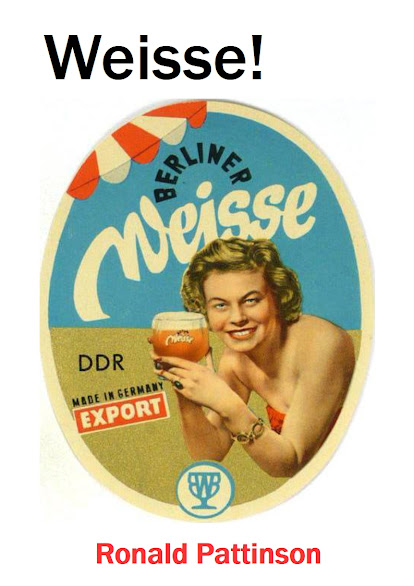
That was an extract from my recently published book on Berliner Weisse, "Weisse!"

 Buy your copy now!


Wednesday, 29 June 2022

Let's Brew wednesday - 1907 Berliner Weisse (Schankbier)

To celebrate the publication of my book about Berliner Weisse, here's one of the recipes from it.

This recipe is based on a description in "Die Fabrikation obergäriger Biere in Praxis und Theorie" by Grennell.

The book describes four different ways of brewing Berliner Weisse, this is method II. It differs considerably from Schönfeld’s procedure. For a start, half of the wort is boiled during the decoction. The hops were added during the decoction rather than to the mashing water.

As always, some time secondary conditioning is required to bring out the required Brttanomyces character. A minimum of four weeks, longer if you like your beer with more bite and funk.

1907 Berliner Weisse (Schankbier)
wheat malt 5.25 lb 75.00%
lager malt 1.75 lb 25.00%
Hallertau 30 mins 0.50 oz
OG 1032
FG 1007
ABV 3.31
Apparent attenuation 78.13%
IBU 5.5
SRM 2.5
acidity (pH) 3.63 to 3.73 
Mash single decoction  
Boil time 30 minutes
pitching temp 60º F
Yeast Wyeast 2565 Kölsch
lactobacillus delbruckii
Brettanomyces bruxellensis


 Buy your copy now!

Tuesday, 28 June 2022

Weisse! has just been published

Yes, after a couple of weeks of not really all that intensive work it's done. My book about Berliner Weisse is finished and published.

99 pages of Berliner Weisse fun, tracing the history of the style from the 18th century to today. Including a look at Weisse from both sides of the Berlin wall. As an extra special bonus there are 19 historic recipes hand crafted by me.

It's easily the best book in English about Berliner Weisse*

 Buy your copy now!

 * I'm pretty sure it's the only one.

Monday, 27 June 2022

Brewing Berliner Weisse between the wars

The Berliner Weisse book is coming along nicely. I just need to finish off the recipes and write the section on the current situation

I've learnt quite a bit. Enough to change my opinions on some topics. Or at least have a more nuanced approach. The level of sourness being a big one. You'll need to buy the book if you want to learn all the details.

In the meantime, here's  a description of the brewing process at one Berlin brewery between the was.

In the kettle, the malt was doughed in with water at 30º C. The temperature was slowly raised to 53º-54º C where it was held for 30 minutes for a protein rest.

The temperature was raised to 75º C by which time saccharification should have occurred.

A third of the wort was transferred to the lauter tun and the remainder of the wort in the kettle brought to the boil. 

After boiling for 30 minutes, it was mixed with the other third of the wort in the lauter tun, making sure the temperature didn’t exceed 76º C. The mixture was left to stand for 40 minutes before running off.

The clear wort was returned to the kettle and brought to 95º C for 15 to 20 minutes. Then immediately cooled to 18º C.

The wort was pitched at 16º C and after four days the temperature rose to 20º C. When it had dropped back down to 16º C, primary fermentation was done. 

1º to 1.25º Plato gravity needed to be left for bottle conditioning. If not, Frischbier needed to be added to raise the gravity to the required level.
"Die Herstellung obergärige Biere und die Malzbierbrauerei Groterjan A.G. in Berlin" by A. Dörfel, 1947 pages 12 - 14.


Sunday, 26 June 2022

Berliner Weisse in the 1880s and 1890s

The internet is wonderful for research. Sometimes you come across wonderful information in the oddest of places. Like the stuff that follows.

I found it in a book about the architecture of Berlin. There's a section on breweries which has some dead useful information. For me, at least.

In the late 1880s and early 1890s, around two thirds of Berlin’s breweries were top fermenting, but they only produced one third of the beer. The table below lists all top-fermenting breweries which did not all necessarily brew Weissbier.

Intriguing that more new top-fermenting breweries were arriving than bottom-fermenting ones: 27 compared to 8. Though that’s probably due to Lager breweries operating on a larger scale and requiring more capital to set up.

It’s hard to see any trends in the production figures.

Remember that there were several other top-fermenting styles in Berlin: Braunbier, Porter, Bitterbier. The quantity of Weissbier brewed was lower than the number in the table, which is for all types of top-fermented beer.

There’s no discernible shift from top to bottom fermenting that I can see. The proportion is always around one third to two thirds. Though it’s clear that the bottom-fermenting breweries were on a larger scale.

The difference in scale only became larger over time.

The average output of a top-fermenting brewery remained rooted at 20,000 hl. While that of bottom-fermenting breweries increased by more than 50%.

Number of Berlin breweries 1872 - 1894
Year Bottom fermenting Top fermenting Total
1872 21 43.75% 27 56.25% 48
1888/89 26 36.62% 45 63.38% 71
1889/90 26 34.67% 49 65.33% 75
1890/91 27 36.00% 48 64.00% 75
1891/92 27 35.53% 49 64.47% 76
1892/93 29 38.16% 47 61.84% 76
1893/94 29 34.94% 54 65.06% 83
Source:
Berlin und seine Bauten, Architecten-Verein zu Berlin, Wilhelm Ernst & Sohn, Berlin, 1896, page 648.


Output of Berlin breweries 1872 - 1894
Year Bottom fermenting Top fermenting Total
1872         898,049 62.89%        530,000 37.11%     1,428,049
1888/89      1,858,530 64.21%     1,036,058 35.79%     2,894,588
1889/90      1,891,693 63.95%     1,066,378 36.05%     2,958,071
1890/91      1,939,023 64.66%     1,060,001 35.34%     2,999,024
1891/92      1,936,987 67.62%        927,678 32.38%     2,864,665
1892/93      2,116,979 67.95%        998,661 32.05%     3,115,640
1893/94      1,988,179 63.87%     1,124,491 36.13%     3,112,670
Source:
Berlin und seine Bauten, Architecten-Verein zu Berlin, Wilhelm Ernst & Sohn, Berlin, 1896, page 648.


Average output of Berlin breweries 1872 - 1894
Year Bottom fermenting Top fermenting
1872           42,764           19,630
1888/89           71,482           23,024
1889/90           72,757           21,763
1890/91           71,816           22,083
1891/92           71,740           18,932
1892/93           72,999           21,248
1893/94           68,558           20,824
Source:
Berlin und seine Bauten, Architecten-Verein zu Berlin, Wilhelm Ernst & Sohn, Berlin, 1896, page 648.


Saturday, 25 June 2022

Let's Brew - 1834 Berliner Weisse

This is based on the description in Johann Heinrich Moritz Poppe ‘s "Die Bierbrauerei auf der höchsten Stufe der jetzigen Vervollkommnung"

I’ve had to make a few guesses. Such as the OG and FG. Which I’ve based on the ingredients and analyses. I could be wrong.

What I am certain about is the proportion of wheat and barley malt. Which was three to one. Though I wouldn’t be surprised if it varied from brewery to brewery

Altmark hops were specified. I don’t think they exist anymore. So, I’ve plumped for Hallertau. Given the low level of bitterness, it probably doesn’t matter so much which type of hops you use.

How sour should it be? That probably depends on how long you age it. Bottle-conditioning for at least a couple of weeks is the way to go.

1834 Berliner Weisse
smoked wheat malt 7.50 lb 75.00%
lager malt 2.50 lb 25.00%
Hallertau 15 mins 1.25 oz
OG 1045
FG 1021
ABV 3.18
Apparent attenuation 53.33%
IBU 13
SRM 3
Mash single decoction  
Boil time 15 minutes
pitching temp 66º F
Yeast Wyeast 2565 Kölsch
Lactobacillus clausenii
Brettanomyces clausenii


action temperature time (minutes)
Mashed in 100º F 30
first rest 133º F 30
deoction with hops   15
mash out 167º F  


Friday, 24 June 2022

Another way of mashing Berliner Weisse in 1845

Here's the method recommended Gumbinner. It's main point of difference is the absence of a decoction. Something Gumbinner seemed to have a particular aversion to.

He was keen that Berlin brewers adapted his method, which he claimed produced a better and more stable beer, so they could see off the threat of Bavarian beer, i.e. Lager. He can't have had much success, as Berlin brewers were still decocting their Berliner Weiss 150 years later.

Mash in 2,887.5 kg wheat malt and 412.5 kg barley malt with 2,404.5 litres of water at 45º to 50º C.

While the water and malt were being mixed, water was brought to the boil in the kettle. This was slowly mixed into the grains in the mash tun, every five minutes adding more water. The temperature was taken regularly to see if the mixture had reached 65º to 67.5º C, which should occur when almost all the water from the kettle. In total, 3,206 litres of boiling water.

In winter, the mash was left to stand for 30 minutes, covered. In summer, 60 minutes, uncovered.

The mash tun was tapped and, when the wort began to run clear, it was pumped to the kettle. When the kettle was half full, between 122 gm and 176 gm of hops per 55 kg of malt were added. By the time it came to the boil, the kettle was full.

The wort was boiled for 20 to 30 minutes, then was filtered through a hop basket into the cooler.

More water (3,206 litres) was brought to the boil and slowly mixed with the grains. When all the boiling water had been added, the mash should be at 63.75º to 65º C. It was stood for 30 minutes in summer, 60 in winter.

It was drawn off and boiled in the same way as the first wort, that is, for 20 to 30 minutes. After which it went to the cooler. 

Recommended was to have two coolers allowing both worts to be cooled at the same time and blended together when the yeast was pitched. Though in winter, you could just throw the second wort into the cooler with the first wort.

There was a third charge of cold water, stood for 30 to 60 minutes, for Kovent.
"Handbuch der praktischen Bierbrauerei" by Dr. Julius Ludwig Gumbinner, 1845, pages 234 - 237.

All this and much more, will be in my book "Weisse!", which should be available soon. I just need to finish writing it.

Tuesday, 21 June 2022

Cooling and fermenting Berliner Weisse in 1845

I've started the week a fun way - reading my way through an old German brewing text. It's so much fun. Really.

We've bot past the mashing section and are now looking at the remainder of the process. This time there are some temperatures given. Even though the brewery in question didn't seem to believe in them, relying instead on the ever-so-reliable finger method.

After standing, the wort began to be drawn off. At first the tap was only opened a little and the wort returned to the top of the filter tub until it began to run clear. The tap was then opened wide and the wort run off into the grant and from there pumped to the cooler. When the wort started to become cloudy again the tap was closed.

Meanwhile the kettle had been refilled with water and brought to the boil. This was now poured over the grain bed in the filter tun. This was left to stand without being touched for around 30 minutes.

The kettle had meanwhile been refilled and brought to the boil again. The boiling water was added to the filter tub and left to stand for another 30 minutes.

The first wort was now returned from the cooler to the cleaned mash tun and the second wort transferred to the cooler.

When the first wort reached a temperature of 27.5º to 30º C, some of it was drawn off and mixed with yeast. The yeast mostly came from a previous brew, but twice in the week yeast shipped from Cottbus was used.

After about an hour this wort started to ferment and it was mixed with the first wort in the mash tun, which was now about 22.5º C.

When fermentation of the first wort had kicked off, after 6 to 8 hours, the second wort was added. This new mix started to ferment after around an hour. It was then filled into barrels and immediately shipped out to publicans. 

What little fermenting wort remained was transferred to barrels in the fermentation cellar. Fermentation was completed in 18 to 20 hours.

A third addition of cold water was poured over the grain bed and left to stand for between 30 and 60 minutes. This was drawn off, pitched with yeast and sold to the poorer classes as Koventbier. Fermentation was completed in their home. To make it more palatable, it was often mixed with some strong Weisse before bottling.
"Handbuch der praktischen Bierbrauerei" by Dr. Julius Ludwig Gumbinner, 1845, pages 225 - 230.

Once again, the wort was pitched in the mash tun. Note that the majority of even the primary fermentation was performed by publicans. Only a small amount was fermented in the brewery itself.

Tuesday, 7 June 2022

Brewing Berliner Weisse in the 1840s

The proportions of wheat and barley malt varied through time. At this point, the quantity of wheat malt was higher than usual.

There’s a fairly brief description of how Berliner Weisse was brewed in a book published in 1842.

Berliner Weisse was brewed from 5 parts wheat malt to one part barley malt. 

The malt was mashed in with water at 35º C, 35.35 litres per 55 kg of malt. Another 80 litres of boiling water were added to the mash and mixed in. 

Some of the thin mash was transferred to the kettle and brought to a boil with 0.234 kg of Altmark hops per 55 kg of malt. The hops had been soaked in water or very thin mash for 30 minutes beforehand. 

The boiled mash was returned to the mash tun, raising the temperature to 72.5º C. The mash was left to stand for 30 minutes, then pumped to the cooler.

45.8 to 57.25 litres per 66 kg of malt of boiling water were poured over the goods in the mash tun to form the second wort. This was mixed with the first wort and when, the temperature had fallen to 18.75º C, yeast was pitched. The next day the beer was already delivered to pubs. 

The author makes this interesting comment about wheat beers in general:

"all wheat beers, especially in the summer, easily turn sour and sometimes even sour during the brewing process." 

And, finally, there’s a mention of smoke. Zimmermann recommends that those still using an old-fashioned smoke kiln should use dry oak, beech or coke as fuel, as these gave off relatively little smoke. 

Wednesday, 23 September 2020

Brewing in Germany in WW II

I'm back to bother you with more tables from the wonderful book on brewing in Berlin. Aren't you lucky?

I'm mostly going to let the numbers speak for themselves.We'll kick off with the quantity of beer brewed in Berlin. I've included the pre-war numbers, too, so that you can see the long-term trends.

On the face of it, beer production held up well, even as late as early 1944. There are a couple of reasons this was possible. 

First, having learnt from Germany's experiences during WW I, when war broke out in September 1939, there was enough grain stockpiled to last three years.* I'm guessing that they didn't count on the war lasting longer than that. Considering this, beer output looks much less impressive.

Because the second way beer output was boosted was by a reduction in gravity. Which started pretty much simultaneously with hostilities. Already in late 1939, nothing above 10º Plato could be brewed.** But it would get much worse. By late 1941, the maximum gravity was reduced to just 8.5º Plato. Though stronger beer was brewed for German armed forces.

Time for some tables:

Berlin beer output 1930 - 1944
Fiscal year April/March output (hl)
1930/31 5,104,770
1931/32 3,829,163
1932/33 3,466,521
1933/34 3,348,422
1934/35 3,569,403
1935/36 3,729,845
1936/37 3,746,010
1937/38 4,070,553
1938/39 4,430,542
1939/40 4,586,631
1940/41 4,492,130
1941/42 4,274,308
1942/43 3,699,443
1943/44 3,380,155
Source:
Beiträge zur Geschichte des Berliner Brauwesens und seiner Organisation by Karl Bullemer, Berlin, 1959, page 146.

In 1944 beer production seems to have come to pretty much a total stop.

Now the gravity restrictions:

Gravity bands November 1939
type OG
Einfachbier 3 - 4º
Schankbier max 6.5º
Lagerbier 9 - 10.3º
Source:
Beiträge zur Geschichte des Berliner Brauwesens und seiner Organisation by Karl Bullemer, Berlin, 1959, page 149.

In 1941, at least the stronger types were a bit intoxicating. 

Gravity bands August 1941
type OG
Lagerbier 7.5 - 8.0º
Spezialbier 8.2 - 8.5º
Berliner Weiße, Grätzer 6.5 - 7.0º 
Einfachbier 3.0 - 6.0º
Source:
Beiträge zur Geschichte des Berliner Brauwesens und seiner Organisation by Karl Bullemer, Berlin, 1959, page 150.

But in 1943 gravities were reduced to ridiculously low levels. Even the strongest types were under 1020º. Meaning they would have been 2% ABV at the very best. Try getting pissed on that. At the same time in the UK, there was some beer over 5% ABV and even the weakest were 2.7% ABV. While average strength remained over 3$ ABV for the whole war.

Gravity bands November 1943
type OG
Schankbier 2.7 - 4.1º
Malzbier 4.2 - 4.7º
Einfachbier 1.7 - 2.4º
Source:
Beiträge zur Geschichte des Berliner Brauwesens und seiner Organisation by Karl Bullemer, Berlin, 1959, page 156.


* Beiträge zur Geschichte des Berliner Brauwesens und seiner Organisation by Karl Bullemer, Berlin, 1959, page 147.

** Beiträge zur Geschichte des Berliner Brauwesens und seiner Organisation by Karl Bullemer, Berlin, 1959, page 148.

Sunday, 20 September 2020

The ups and downs of brewing in Berlin

I used to think brewing the UK was a rollercoaster in the interwar years. Things were far more extreme in Germany.

It took a few years after the end of WW I,  but by the mid-1920s, beer production was just about back to its pre-war level. A bit slower that the recovery in the UK. But, then again, brewing had fallen far lower in Germany. Almost completely petering out by the end of 1918.

In the final years of the 1920s, Berlin was even brewing more than before WW I. It didn't last long. The Wall Street Crash of 1929 brought down the whole world's economy, including Germany's. And it had a devastating effect on German brewing.

Because, as in the UK, the German government tried to raise much needed revenue by bumping up the tax on beer. And, just like in the UK, it was a total disaster. Beer production slumped and the tax revenue with it. You can see the effect in the table:

Beer production in Berlin 
financial year output (hl) % change
1912/13 5,394,398  
1923/24 2,687,668 -50.18%
1924/25 3,873,554 44.12%
1925/26 5,134,156 32.54%
1926/27 5,145,801 0.23%
1927/28 5,195,836 0.97%
1928/29 5,580,715 7.41%
1929/30 6,110,647 9.49%
1930/31 5,104,770 -16.46%
1931/32 3,829,163 -24.99%
1932/33 3,466,521 -9.47%
1933/34 3,348,422 -3.41%
Source:
Beiträge zur Geschichte des Berliner Brauwesens und seiner Organisation by Karl Bullemer, Berlin, 1959, pages 66 and 79.