
Test Closure is the final phase of the Software Testing Life Cycle (STLC) where all testing activities are completed, evaluated, and documented. It ensures the testing process is properly concluded and lessons are captured for future projects.
- Marks completion of all testing activities
- Ensures all defects are resolved or documented
- Provides final test summary and reports
Need for Test Closure
Test Closure is essential to formally complete the testing process and ensure that all objectives are met. It helps in evaluating results, documenting outcomes, and improving future testing cycles.
- Ensures Completion of Testing: Confirms all test cases are executed and testing objectives are met.
- Verifies Defect Resolution: Ensures no critical defects remain unresolved before release.
- Provides Quality Assurance: Gives a clear view of product quality and system stability.
- Supports Decision Making: Helps stakeholders confidently decide on product release.
- Improves Future Testing: Captures lessons learned to enhance upcoming projects.
- Promotes Best Practices: Helps avoid repeating past issues in future testing cycles.
- Maintains Documentation: Records test results, reports, and key metrics systematically.
- Supports Audits & Compliance: Provides necessary documentation for audits and future reference.
- Enhances Traceability: Ensures all requirements and defects are properly tracked.
- Ensures Accountability: Clearly defines ownership and closure status of tasks and defects.
Phases of Test Closure
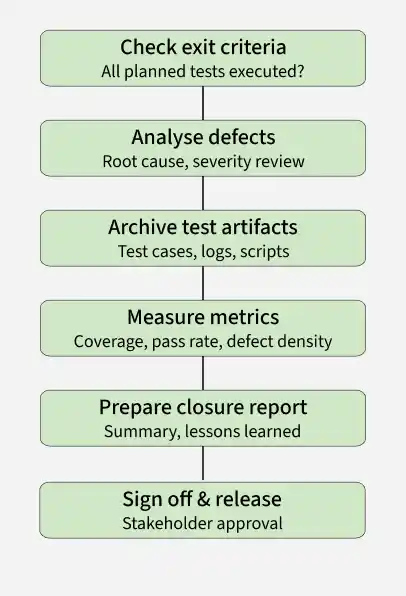
Phase 1: Check Exit Criteria
This phase ensures that all planned testing activities are completed and quality goals are achieved before closure. It confirms readiness to move forward.
- Verify all test cases are executed successfully
- Ensure critical defects are fixed or properly documented
Phase 2: Defect Analysis
In this phase, all identified defects are carefully reviewed to understand their impact and root cause. It helps improve product quality and future processes.
- Analyze defects based on severity, priority, and status
- Review open, closed, and deferred defects for final decisions
Phase 3: Archive Test Artifacts
All testing-related documents and data are stored systematically for future reference, audits, and knowledge reuse.
- Save test cases, scripts, logs, and reports
- Maintain proper documentation for compliance and reuse
Phase 4: Measure Metrics
This phase focuses on evaluating testing performance using measurable indicators to assess quality and efficiency.
- Calculate metrics like test coverage, pass/fail ratio, defect density
- Analyze results to measure testing effectiveness
Phase 5: Prepare Closure Report
A final report is created summarizing the entire testing process, outcomes, and key insights for stakeholders.
- Document results, risks, and deviations from the plan
- Include lessons learned and improvement suggestions
Phase 6: Sign-off & Release
The testing phase is formally closed after approval, and the product is handed over for release or deployment.
- Obtain sign-off from stakeholders or clients
- Officially close testing and proceed to release
Test Closure Report
A Test Closure Report is a final document in Software Testing that summarizes all testing activities and results. It provides a clear view of product quality and confirms whether the system is ready for release.
- Summarizes test execution, defects, and overall quality status
- Helps stakeholders make release decisions
- Documents lessons learned for future improvement
Test Closure Report – Key Sections
- Project Info: Includes project name, version, and testing duration.
- Test Summary: Shows total test cases executed, passed, failed, and skipped.
- Defect Summary: Provides count of defects categorized as critical, major, and minor.
- Test Coverage: Indicates the percentage of requirements covered during testing.
- Lessons Learned: Highlights what worked well and areas for improvement.
Real-World Example
A banking application completes its regression testing cycle with strong quality results. The team executes 450 test cases, achieving a 97% pass rate, with no critical defects open and only 3 minor defects deferred to the next sprint.
- QA lead prepares a detailed closure report and summarizes key metrics
- All test artifacts are archived in JIRA, and stakeholder sign-off is obtained
- The build is formally approved and released to production
Key Points to Remember
- Exit vs Entry Criteria: Entry criteria define when testing begins, while exit criteria confirm when testing can be successfully closed
- Importance of Lessons Learned: Capturing lessons learned helps improve future testing cycles and avoid repeated mistakes
- Risk of Skipping Closure: Missing closure can lead to untracked defects, poor traceability, and lack of accountability
- Standard Practice (ISTQB): Test closure is a mandatory activity at all levels—unit, integration, system, and UAT
Test Closure Activities
Test closure activities are the specific tasks performed at the end of a testing phase to formally wrap up, document, and sign off on all testing work. These activities ensure nothing is left incomplete before a product is released.
There are four types of Test Closure Activities:
1. Verification activities
These confirm that all pre-defined exit criteria have been satisfied before closure is declared.
- Check that 100% of planned test cases have been executed (pass, fail, or skipped with reason)
- Verify all critical and high-severity defects are either resolved or formally deferred
- Confirm that test coverage targets (requirements coverage, code coverage) are achieved
- Ensure no mandatory test environments or test data are left unvalidated
2. Defect analysis activities
These focus on understanding the quality of the product and the effectiveness of testing.
- Perform root cause analysis on major defects to identify systemic issues
- Calculate defect density — total defects per module or feature
- Classify deferred defects by risk and document the decision rationale
- Conduct escape analysis — how many defects slipped to production and why
3. Archiving activities
Everything generated during testing must be properly stored for future reference, audits, or regression cycles.
- Archive all test cases, test scripts, and automation suites in the version control or test management tool
- Save execution logs, screenshots, and test reports with timestamps
- Preserve the requirements traceability matrix (RTM)
- Store test environment configs, test data sets, and setup guides
4. Reporting & sign-off activities
The final step — produce the closure document and get formal stakeholder approval.
- Prepare the test closure report covering results, coverage, defect summary, and deviations from plan
- Document lessons learned: what went well, what failed, process improvements for next time
- Share key metrics (pass rate, defect density, test effort) with the project manager and stakeholders
- Obtain formal sign-off from the product owner or QA manager to officially close testing
Quick Reference — Closure Checklist
| Activity | Responsible | Output |
|---|---|---|
| Exit criteria verification | QA Lead | Signed checklist |
| Defect triage | QA + Dev Team | Defect report |
| Artifact archiving | QA Engineer | Archived repository |
| Metrics calculation | QA Lead | Metrics dashboard |
| Closure report | QA Manager | Closure document |
| Stakeholder sign-off | Project Manager | Approval email / signature |