Trigonometric identities are equations involving trigonometric functions that hold true for all values of the variables where the functions are defined.
They describe the relationships among sine, cosine, tangent, and the other trigonometric functions.
Fundamental tools for simplifying expressions, proving formulas, and solving trigonometric equations.
Widely used in fields like geometry, engineering, and physics.
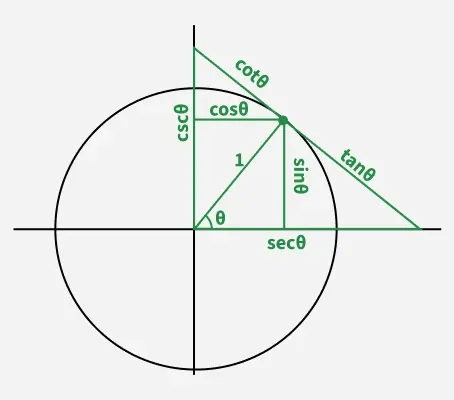
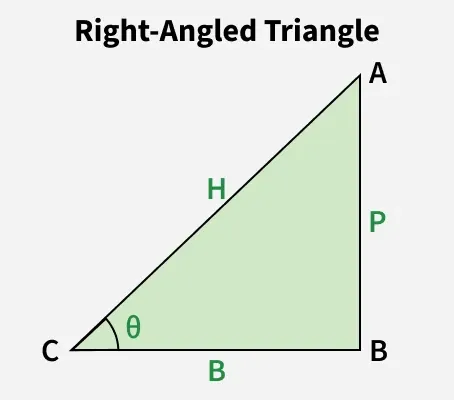
These are useful whenever trigonometric functions are involved in an expression or an equation. The six basic trigonometric ratios are sine, cosine, tangent, cosecant, secant, and cotangent. All these trigonometric ratios are defined using the sides of the right triangle, such as the adjacent side, the opposite side, and the hypotenuse.
List of Trigonometric Identities
There are a lot of identities in the study of Trigonometry, which involve all the trigonometric ratios. These identities are used to solve various problems throughout the academic landscape as well as the real life. Let us learn all the fundamental and advanced trigonometric identities.
Reciprocal Trigonometric Identities
In all trigonometric ratios, there is a reciprocal relation between a pair of ratios, which is given as follows:
As tan and cot are defined as the ratio of sin and cos, which is given by the following identities:
tan θ = sin θ/cos θ
cot θ = cos θ/sin θ
Trigonometric Identities of Opposite Angles
In trigonometry, angles measured in the clockwise direction are measured in negative parity, and all trigonometric ratios defined for negative parity of angle are defined as follows:
sin (-θ) = -sin θ
cos (-θ) = cos θ
tan (-θ) = -tan θ
cot (-θ) = -cot θ
sec (-θ) = sec θ
cosec (-θ) = -cosec θ
Complementary Angles Identities
Complementary angles are a pair of angles whose measures add up to 90°. Now, the trigonometric identities for complementary angles are as follows:
sin (90° – θ) = cos θ
cos (90° – θ) = sin θ
tan (90° – θ) = cot θ
cot (90° – θ) = tan θ
sec (90° – θ) = cosec θ
cosec (90° – θ) = sec θ
Supplementary Angles Identities
Supplementary angles are a pair of angles whose measures add up to 180°. Now, the trigonometric identities for supplementary angles are:
sin (180°- θ) = sinθ
cos (180°- θ) = -cos θ
cosec (180°- θ) = cosec θ
sec (180°- θ)= -sec θ
tan (180°- θ) = -tan θ
cot (180°- θ) = -cot θ
Periodicity of Trigonometric Function
Trigonometric functions suchas sin, cos, tan, cot, sec, and cosec are all periodic and have different periodicities. The following identities for the trigonometric ratios explain their periodicity.
sin (n × 360° + θ) = sin θ
sin (2nπ + θ) = sin θ
cos (n × 360° + θ) = cos θ
cos (2nπ + θ) = cos θ
tan (n × 180° + θ) = tan θ
tan (nπ + θ) = tan θ
cosec (n × 360° + θ) = cosec θ
cosec (2nπ + θ) = cosec θ
sec (n × 360° + θ) = sec θ
sec (2nπ + θ) = sec θ
cot (n × 180° + θ) = cot θ
cot (nπ + θ) = cot θ
Where, n ∈ Z, (Z = set of all integers)
Note: sin, cos, cosec, and sec have a period of 360° or 2π radians, and for tan and cot period is 180° or π radians.
Sum and Difference Identities
Trigonometric identities for the Sum and Difference of angles include formulas such as sin(A+B), cos(A-B), tan(A+B), etc.
sin (A+B) = sin A cos B + cos A sin B
sin (A-B) = sin A cos B - cos A sin B
cos (A+B) = cos A cos B - sin A sin B
cos (A-B) = cos A cos B + sin A sin B
tan (A+B) = (tan A + tan B)/(1 - tan A tan B)
tan (A-B) = (tan A - tan B)/(1 + tan A tan B)
Note: Identities for sin (A+B), sin (A-B), cos (A+B), and cos (A-B) are called Ptolemy’s Identities.
Double Angle Identities
Using the trigonometric identities of the sum of angles, we can find a new identity, which is called the Double Angle Identities. To find these identities, we can put A = B in the sum of angle identities. For example,
a we know, sin (A+B) = sin A cos B + cos A sin B
Substitute A = B = θ on both sides here, and we get:
sin (θ + θ) = sinθ cosθ + cosθ sinθ
sin 2θ = 2 sinθ cosθ
Similarly,
cos 2θ = cos2θ - sin 2θ = 2 cos 2 θ - 1 = 1 - 2sin 2 θ
tan 2θ = (2tanθ)/(1 - tan2θ)
Half-Angle Formulas
Using double-angle formulas, half-angle formulas can be calculated. To calculate the angle formula, replace θ with θ/2, then,
sin \frac{\theta}{2} = \pm\sqrt{\frac{1-cos \theta}{2}}
The following identities state the relationship between the sum of two trigonometric ratios with the product of two trigonometric ratios.
\sin A + \sin B = 2 \sin \frac{A + B}{2} \cos \frac{A - B}{2}
\cos A + \cos B = 2 \cos \frac{A + B}{2} \cos \frac{A - B}{2}
\sin A - \sin B = 2 \cos \frac{A + B}{2} \sin \frac{A - B}{2}
\cos A - \cos B = -2 \sin \frac{A + B}{2} \sin \frac{A - B}{2}
Products Identities
Product Identities are formed when we add two of the sum and difference of angle identities, and are as follows:
\sin A \cos B = \frac{\sin (A + B) + \sin (A - B)}{2}
\cos A \cos B = \frac{\cos (A + B) + \cos (A - B)}{2}
\sin A \sin B = \frac{\cos (A - B) - \cos (A + B)}{2}
Triple Angle Formulas
Other than double and half-angle formulas, there are identities for trigonometric ratios that are defined for triple angles. These triple-angle identities are as follows: