
Inverse trigonometric identities are mathematical expressions involving inverse trigonometric functions such as sin-1(x), cos-1(x), and tan-1(x), etc. These functions provide the angles (or arcs) corresponding to a given trigonometric ratio.
The inverse trigonometric identities help in simplifying complex expressions and solving equations involving trigonometric functions.
Domain and Range of Inverse Trigonometric Identities
The following table shows the inverse-trigonometric functions with their domain and range.
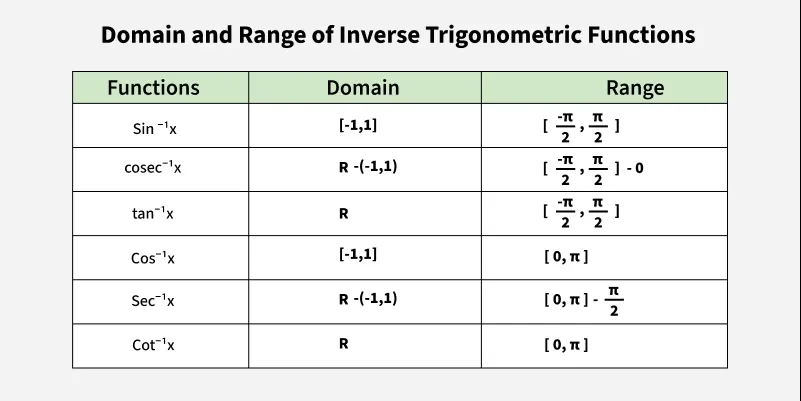
Properties of Inverse Trigonometric Functions
The following are the properties of inverse trigonometric functions:
Property 1:
- sin-1 (1/x) = cosec-1 x, for x ≥ 1 or x ≤ -1
- cos-1 (1/x) = sec-1 x, for x ≥ 1 or x ≤ -1
- tan-1 (1/x) = cot-1 x, for x > 0
Property 2:
- sin-1 (-x) = -sin-1 x, for x ∈ [-1 , 1]
- tan-1 (-x) = -tan-1 x, for x ∈ R
- cosec-1 (-x) = -cosec-1 x, for |x| ≥ 1
Property 3
- cos-1 (-x) = π - cos-1 x, for x ∈ [-1 , 1]
- sec-1 (-x) = π - sec-1 x, for |x| ≥ 1
- cot-1 (-x) = π - cot-1 x, for x ∈ R
Property 4
- sin-1 x + cos-1 x = π/2, for x ∈ [-1,1]
- tan-1 x + cot-1 x = π/2, for x ∈ R
- cosec-1 x + sec-1 x = π/2 , for |x| ≥ 1
Property 5
- tan-1 x + tan-1 y = tan-1 ( x + y )/(1 - xy), for xy < 1
- tan-1 x - tan-1 y = tan-1 (x - y)/(1 + xy), for xy > -1
- tan-1 x + tan-1 y = π + tan-1 (x + y)/(1 - xy), for xy >1 ; x, y >0
Property 6
- 2tan-1 x = sin-1 (2x)/(1 + x2), for |x| ≤ 1
- 2tan-1 x = cos-1 (1 - x2)/(1 + x2), for x ≥ 0
- 2tan-1 x = tan-1 (2x)/(1 - x2), for -1 < x <1
Identities of Inverse Trigonometric Function
The following are the identities of inverse trigonometric functions:
- sin-1 (sin x) = x provided -π/2 ≤ x ≤ π/2
- cos-1 (cos x) = x provided 0 ≤ x ≤ π
- tan-1 (tan x) = x provided -π/2 < x < π/2
- sin(sin-1 x) = x provided -1 ≤ x ≤ 1
- cos(cos-1 x) = x provided -1 ≤ x ≤ 1
- tan(tan-1 x) = x provided x ∈ R
- cosec(cosec-1 x) = x provided -1 ≤ x ≤ ∞ or -∞ < x ≤ 1
- sec(sec-1 x) = x provided 1 ≤ x ≤ ∞ or -∞ < x ≤ 1
- cot(cot-1 x) = x provided -∞ < x < ∞
sin^{-1}(\frac{2x}{1 + x^2}) = 2 tan^{-1}x cos^{-1}(\frac{1 - x^2}{1 + x^2}) = 2 tan^{-1}x tan^{-1}(\frac{2x}{1 - x^2}) = 2 tan^{-1}x - 2cos-1 x = cos-1 (2x2 - 1)
- 2sin-1x = sin-1 2x√(1 - x2)
- 3sin-1x = sin-1(3x - 4x3)
- 3cos-1 x = cos-1 (4x3 - 3x)
- 3tan-1x = tan-1((3x - x3/1 - 3x2))
- sin-1x + sin-1y = sin-1{ x√(1 - y2) + y√(1 - x2)}
- sin-1x - sin-1y = sin-1{ x√(1 - y2) - y√(1 - x2)}
- cos-1 x + cos-1 y = cos-1 [xy - √{(1 - x2)(1 - y2)}]
- cos-1 x - cos-1 y = cos-1 [xy + √{(1 - x2)(1 - y2)}
- tan-1 x + tan-1 y = tan-1(x + y/1 - xy)
- tan-1 x - tan-1 y = tan-1(x - y/1 + xy)
- tan-1 x + tan-1 y +tan-1 z = tan-1 (x + y + z - xyz)/(1 - xy - yz - zx)
Also Check
Sample Problems on Inverse Trigonometric Identities
Question 1: Prove sin-1 x = sec-1 1/√(1-x2)
Solution:
Let sin-1 x = y
⇒ sin y = x , (since sin y = perpendicular/hypotenuse ⇒ cos y = √(1- perpendicular2 )/hypotenuse )
⇒ cos y = √(1 - x2), here hypotenuse = 1
⇒ sec y = 1/cos y
⇒ sec y = 1/√(1 - x2)
⇒ y = sec-1 1/√(1 - x2)
⇒ sin-1 x = sec-1 1/√(1 - x2)Hence, proved.
Question 2: Prove tan-1 x = cosec-1 √(1 + x2)/x
Solution:
Let tan-1 x = y
⇒ tan y = x , perpendicular = x and base = 1
⇒ sin y = x/√(x2 + 1) , (since hypotenuse = √(perpendicular2 + base2 ) )
⇒ cosec y = 1/sin y
⇒ cosec y = √(x2 + 1)/x
⇒ y = cosec-1 √(x2 + 1)/x
⇒ tan-1 x = cosec-1 √(x2 + 1)/xHence, proved.
Question 3: Evaluate tan(cos-1 x)
Solution:
Let cos-1 x = y
⇒ cos y = x , base = x and hypotenuse = 1 therefore sin y = √(1 - x2)/1
⇒ tan y = sin y/ cos y
⇒ tan y = √(1 - x2)/x
⇒ y = tan-1 √(1 - x2)/x
⇒ cos-1 x = tan-1 √(1 - x2)/xTherefore, tan(cos-1 x) = tan(tan-1 √(1 - x2)/x ) = √(1 - x2)/x.
Question 4: tan-1 √(sin x) + cot-1 √(sin x) = y. Find cos y.
Solution:
We know that tan-1 x + cot-1 x = /2 therefore comparing this identity with the equation given in the question we get y = π/2
Thus, cos y = cos π/2 = 0.
Question 5: tan-1 (1 - x)/(1 + x) = (1/2)tan-1 x, x > 0. Solve for x.
Solution:
tan-1 (1 - x)/(1 + x) = (1/2)tan-1 x
⇒ 2tan-1 (1 - x)/(1 + x) = tan-1 x …(1)We know that, 2tan-1 x = tan-1 2x/(1 - x2).
Therefore, LHS of equation (1) can be written as
tan-1 [ { 2(1 - x)/(1 + x)}/{ 1 - [(1 - x)(1 + x)]2}]
= tan-1 [ {2(1 - x)(1 + x)} / { (1 + x)2 - (1 - x)2 }]
= tan-1 [ 2(1 - x2)/(4x)]
= tan-1 (1 - x2)/(2x)Since, LHS = RHS therefore
tan-1 (1 - x2)/(2x) = tan-1 x
⇒ (1 - x2)/2x = x
⇒ 1 - x2 = 2x2
⇒ 3x2 = 1
⇒ x = ± 1/√3Since, x must be greater than 0 therefore x = 1/√3 is the acceptable answer.
Question 6: Prove tan-1 √x = (1/2)cos-1 (1 - x)/(1 + x)
Solution:
Let tan-1 √x = y
⇒ tan y = √x
⇒ tan2 y = xTherefore,
RHS = (1/2)cos-1 ( 1- tan2 y)/(1 + tan2 y)
= (1/2)cos-1 (cos2 y - sin2 y)/(cos2 y + sin2 y)
= (1/2)cos-1 (cos2 y - sin2 y)
= (1/2)cos-1 (cos 2y)
= (1/2)(2y)
= y= tan-1 √x
= LHSHence, proved.
Question 7: tan-1 (2x)/(1 - x2) + cot-1 (1 - x2)/(2x) = π/2, -1 < x < 1. Solve for x.
Solutions:
tan-1 (2x)/(1 - x2) + cot-1 (1 - x2)/(2x) = π/2
⇒ tan-1 (2x)/(1 - x2) + tan-1 (2x)/(1 - x2) = π/2
⇒ 2tan-1 (2x)/(1 - x2) = ∏/2
⇒ tan-1 (2x)/(1 - x2) = ∏/4
⇒ (2x)/(1 - x2) = tan ∏/4
⇒ (2x)/(1 - x2) = 1
⇒ 2x = 1 - x2⇒ x2 + 2x -1 = 0
⇒ x = [-2 ± √(22 - 4(1)(-1))] / 2
⇒ x = [-2 ± √8] / 2
⇒ x = -1 ± √2
⇒ x = -1 + √2 or x = -1 - √2But according to the question x ∈ (-1, 1) therefore for the given equation the solution set is x ∈ ∅.
Question 8: tan-1 1/(1 + 1.2) + tan-1 1/(1 + 2.3) + … + tan-1 1/(1 + n(n + 1)) = tan-1 x. Solve for x.
Solution:
tan-1 1/(1 + 1.2) + tan-1 1/(1 + 2.3) + … + tan-1 1/(1 + n(n + 1)) = tan-1 x
⇒ tan-1 (2 - 1)/(1 + 1.2) + tan-1 (3 - 2)/(1 + 2.3) + … + tan-1 (n + 1 - n)/(1 + n(n + 1)) = tan-1 x
⇒ (tan-1 2 - tan-1 1) + (tan-1 3 - tan-1 2) + … + (tan-1 (n + 1) - tan-1 n) = tan-1 x
⇒ tan-1 (n + 1) - tan-1 1 = tan-1 x
⇒ tan-1 n/(1 + (n + 1).1) = tan-1 x
⇒ tan-1 n/(n + 2) = tan-1 x
⇒ x = n/(n + 2)
Question 9: If 2tan-1 (sin x) = tan-1 (2sec x) then solve for x.
Solution:
2tan-1 (sin x) = tan-1 (2sec x)
⇒ tan-1 (2sin x)/(1 - sin2 x) = tan-1 (2/cos x)
⇒ (2sin x)/(1 - sin2 x) = 2/cos x
⇒ sin x/cos2 x = 1/cos x
⇒ sin x cos x = cos2 x
⇒ sin x cos x - cos2 x = 0
⇒ cos x(sin x - cos x) = 0
⇒ cos x = 0 or sin x - cos x = 0⇒ cos x = cos π/2 or tan x = tan π/4
⇒ x = π/2 or x = π/4But at x = π/2 the given equation does not exist hence x = π/4 is the only solution.
Question 10: Prove that cot-1 [ {√(1 + sin x) + √(1 - sin x)}/{√(1 + sin x) - √(1 - sin x)}] = x/2, x ∈ (0, π/4)
Solution:
Let x = 2y therefore
LHS = cot-1 [{√(1+sin 2y) + √(1-sin 2y)}/{√(1+sin 2y) - √(1-sin 2y)}]
= cot-1 [{√(cos2 y + sin2 y + 2sin y cos y) + √(cos2 y + sin2 y - 2sin y cos y)}/{√(cos2 y + sin2 y + 2sin y cos y) - √(cos2 y + sin2 y - 2sin y cos y)} ]
= cot-1 [{√(cos y + sin y)2 + √(cos y - sin y)2} / {√(cos y + sin y)2 - √(cos y - sin y)2}] = cot-1 [( cos y + sin y + cos y - sin y )/(cos y + sin y - cos y + sin y)]
= cot-1 (2cos y)/(2sin y)= cot-1 (cot y)
= y
= x/2.
Practice Question on Inverse Trigonometric Identities
Question 1: Solve for x in the equation sin-1(x) + cos-1(x) = π/2.
Question 2: Prove that tan-1(1) + tan-1(2) + tan-1(3) = π.
Question 3: Evaluate cos(sin-1(0.5))
Question 4: If tan-1(x) + tan-1(2x) = π/4, then find x.
Answer:-
- x ∈ [-1, 1]
- π
- √3/2.
- (-3±√17)/4