Pythagoras (Pythagorean) Theorem explains the relationship between the three sides of a right-angled triangle. It helps us find the length of a missing side if the other two sides are known.
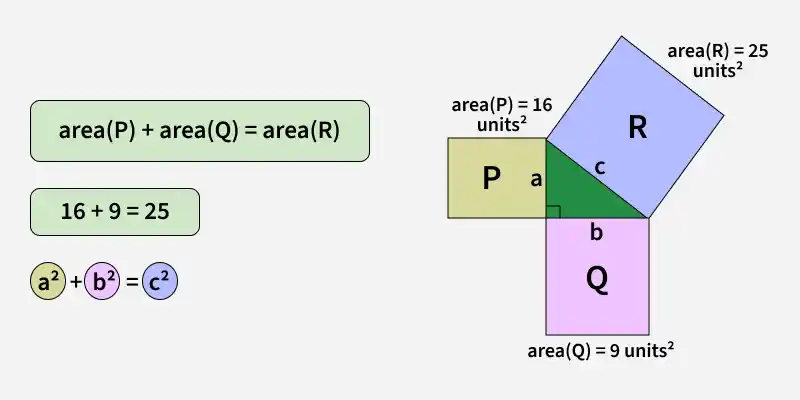
In a right-angled triangle, the square of the length of the hypotenuse (the longest side) is equal to the sum of the squares of the lengths of the other two sides.
In geometric terms, this means the area of the square built on the hypotenuse is equal to the combined areas of the squares built on the other two sides.
Formula
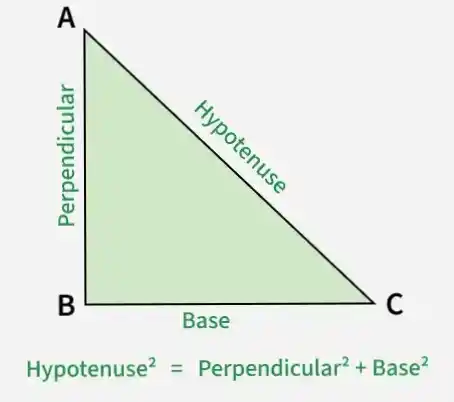
Pythagoras theorem formula is AC2 = AB2 + BC2, where AB is the perpendicular side, BC is the base, and AC is the hypotenuse side.
This formula applies only to a right-angled triangle, which is a triangle that has one angle equal to 90°. The three sides of a right-angled triangle are called the hypotenuse, base, and perpendicular.
A Pythagorean triplet is a set of three numbers (like 3, 4, 5) that satisfy the Pythagoras theorem.
Proof
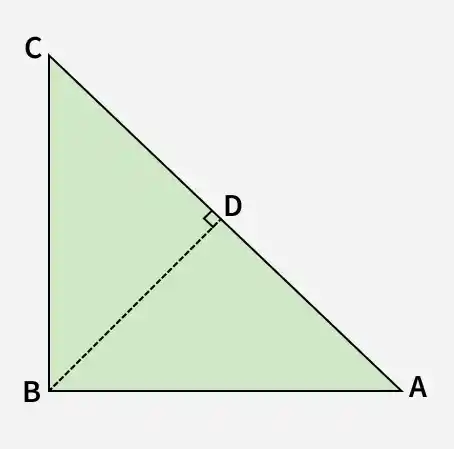
Consider a right-angled triangle having sides A, B, and C. Here, AC is the longest side (hypotenuse), and AB and BC are the legs of the triangle. Draw a perpendicular line BD at AC as shown in the figure below,
In △ADB and △ACB,
∠A = ∠A (Common angle)
∠ADB = ∠ABC (90°)
Therefore, we can say △ADB ∼ △ ACB (By AA Similarity)
Similarly, △BDC ∼ △ACB
Hence, AD/AB = AB/AC
AB2 = AD × AC ⇢ (1)
And, CD/BC = BC/AC
BC2 = CD × AC ⇢ (2)
Adding equations (1) and (2),
AB2 + BC2 = AC × AD + AC × CD
AB2 + BC2 = AC (AD + CD)
AB2 + BC2 = AC × AC
AB2 + BC2 = AC2
Also, AC2 = AB2 + BC2
Hence proved.
Pythagoras Theorem Applications
Below are some of the uses of the Pythagorean Theorem in real life:
Solving Right-Angled Triangles: Students use the theorem to calculate the length of unknown sides of right-angled triangles, given the other two sides. This is crucial for solving problems in trigonometry, mensuration, and coordinate geometry.
Distance and Height Problems: The theorem is applied in real-world problems, such as finding the height of buildings or the distance between two points on a plane, helping students understand practical applications.
Proofs and Derivations: Students also learn to prove Pythagoras’ Theorem and use it to derive other important mathematical properties, such as the distance formula in coordinate geometry.
Vectors and 3D Geometry: Pythagoras' Theorem is applied in calculating the magnitude of vectors and distances between points in three-dimensional space.
Calculus and Coordinate Geometry: The theorem underpins the derivation of formulas used in differential calculus and helps solve problems involving curves, tangents, and distances between geometric figures.
Physics Applications: In physics, students use Pythagoras' Theorem to solve problems involving forces, velocities, and resultant vectors.
Construction and Architecture: Builders and architects use Pythagoras' Theorem to ensure accurate measurements when constructing buildings, bridges, or other structures. It helps in creating right angles and calculating diagonal lengths when designing layouts and foundations.
Navigation: In navigation, the theorem is used to calculate the shortest distance between two points on a map, which is essential for both air and sea travel. By treating distances as right-angled triangles, navigators can find the direct route between locations.
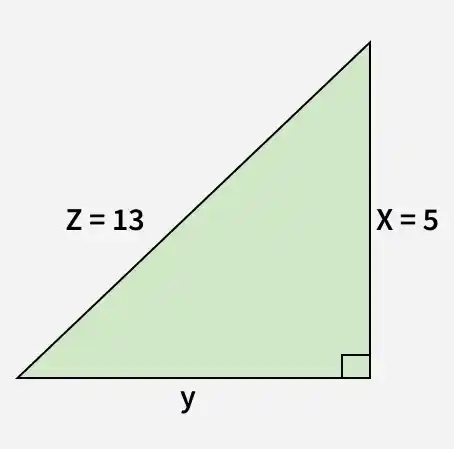
Example 1: In the below given right triangle, find the value of y.
By the statement of the Pythagoras theorem we get,
⇒ z2 = x2 + y2
Now, substituting the values directly we get,
⇒ 132 = 52 + y2
⇒ 169 = 25 + y2
⇒ y2 = 144
⇒ y = √144 = 12
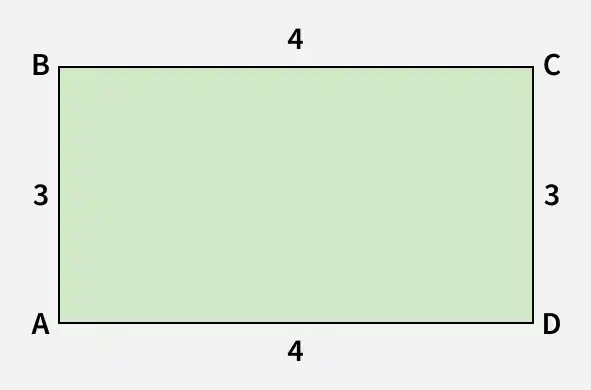
Example 2: Given a rectangle with a length of 4 cm and breadth of 3 cm. Find the length of the diagonal of the rectangle.
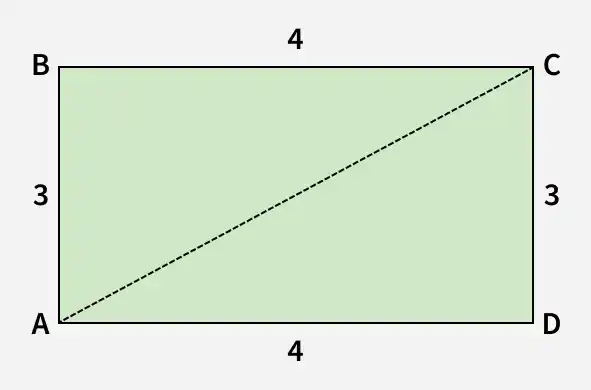
In the above diagram length of the rectangle is 4 cm, and the width is 3 cm. Now we have to find the distance between point A to point C or point B to point D. Both give us the same answer because opposite sides are of the same length i.e., AC = BD. Now let's find the distance between points A and C by drawing an imaginary line.
Now triangle ACD is a right triangle.
So by the statement of Pythagoras theorem,
⇒ AC2 = AD2 + CD2
⇒ AC2 = 42 + 32
⇒ AC2 = 25
⇒ AC = √25 = 5
Therefore length of the diagonal of given rectangle is 5 cm.
Example 3: The sides of a triangle are 5, 12, and 13. Check whether the given triangle is a right triangle or not.
Given,
⇒ a = 5
⇒ b = 12
⇒ c = 13
By using the converse of Pythagorean Theorem,
⇒ a2 + b2 = c2
Substitute the given values in the above equation,
⇒ 132 = 52 + 122
⇒ 169 = 25 + 144
⇒ 169 = 169
So, the given lengths satisfy the above condition.
Therefore, the given triangle is a right triangle.
Example 4: The side of a triangle is of lengths 9 cm, 11 cm, and 6 cm. Is this triangle a right triangle? If so, which side is the hypotenuse?
We know that hypotenuse is the longest side. If 9 cm, 11 cm, and 6 cm are the lengths of the angled triangle, then 11 cm will be the hypotenuse.
Using the converse of Pythagoras theorem, we get
⇒ (11)2 = (9)2 + (6)2
⇒ 121 = 81 + 36
⇒ 121 ≠ 117
Since, both the sides are not equal therefore 9 cm, 11 cm and 6 cm are not the side of the right-angled triangle.
Practice Questions
Q1: If the two shorter sides of a right angled triangle measures 14 and 15 cm, find the length of the longest side.
Q2: If the hypotenuse and perpendicular of a right angled triangle are 5 and 4 cm then find the base.
Q3: In a triangular field the sides measures 24 cm, 7 cm and 25 cm then prove that field is the form of a right triangle.
Q4: A wall is of 12 m height and a ladder of 13 m is placed against it touching its top. Find the distance between the foot of the ladder and the wall.