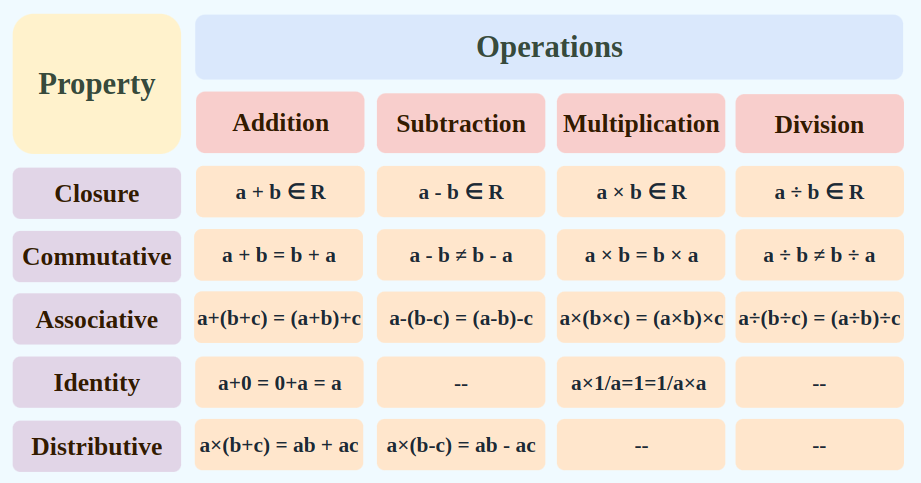
Algebraic operations are mathematical processes that involve the manipulation of numbers, variables, and symbols to produce new results or expressions. The basic algebraic operations are:
- Addition ( + ): The process of combining two or more numbers to get a sum. For example, 3 + 5 = 8.
- Subtraction (−): The process of removing one number from another to get the difference. For example, 7 − 4 = 3.
- Multiplication ( × or ∙): The process of scaling one number by another to get a product. For example, 4 × 6 = 24.
- Division (÷ or /): The process of splitting one number into equal parts based on another number to get a quotient. For example, 12 ÷ 3 = 4.
Note: If we only consider numbers, then algebraic operations are the same as arithmetic operations.
There are various properties defined for various operations, i.e.,