
Pythagorean Identities in trigonometry are derived from the Pythagorean Theorem. They are also called Pythagorean Trigonometric Identities.
The three basic Pythagorean identities are:

However, from these identities, we can derive the other six identities as well.
All 9 Pythagorean identities are:
| Pythagorean Identity | Alternative Identities |
|---|---|
| sin2θ + cos2θ = 1 | 1 - sin2θ = cos2 θ OR 1 - cos2θ = sin2θ |
| sec2θ - tan2θ = 1 | 1 + tan θ = sec2θ OR sec2θ - 1 = tan2θ |
| cosec2θ - cot2θ = 1 | 1 + cot θ = cosec2θ OR cosec2θ - 1 = cot2θ |
Pythagorean Theorem
The Pythagorean theorem states that in a right-angled triangle, the square of the hypotenuse is equal to the sum of the squares of the perpendicular and base. The formula for the Pythagorean theorem is given by:
(Hypotenuse)2 = (Perpendicular)2 + (Base)2
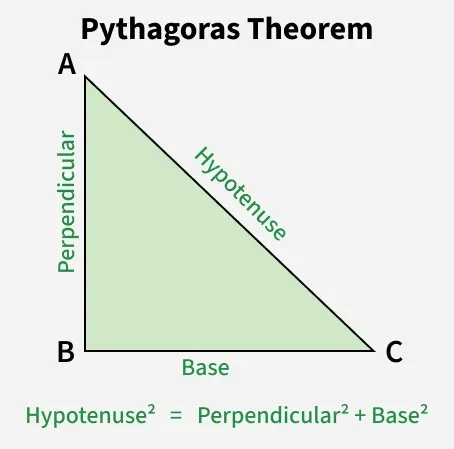
The above figure is of a right-angled triangle ABC with perpendicular AB, base BC, and hypotenuse AC. So, by the Pythagorean theorem: AC2 = AB2 + BC2
Pythagorean Trigonometric Identities: Derivation
Pythagorean identities can be easily proved by applying the Pythagorean theorem in a right-angled triangle. Let's discuss the proof of each identity in detail as follows:
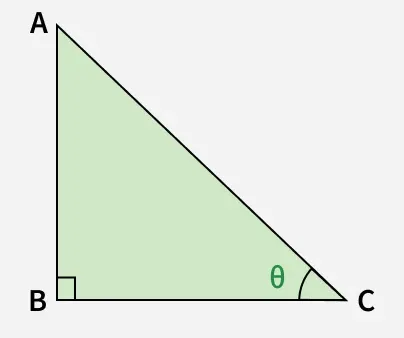
Consider a right-angled triangle ABC with perpendicular AB, base BC, and hypotenuse AC.
Derivation of sin2θ + cos2θ = 1
By the Pythagorean theorem: AC2 = AB2 + BC2
Dividing both sides by AC2
[AC2 / AC2] = [AB2 / AC2] + [BC2 / AC2]
⇒ 1 = [AB / AC]2 + [BC / AC]2 . . . (a)
From the above triangle
[AB / AC] = sinθ, and [BC / AC] = cosθ
Putting these values in equation (a), we get the following:
⇒ sin2θ + cos2θ = 1
Hence Proved.
Derivation of 1 + tan2θ = sec2θ
By the Pythagorean theorem, AC2 = AB2 + BC2
Dividing both sides by BC2
[AC2 / BC2] = [AB2 / BC2] + [BC2 / BC2]
⇒ [AC / BC]2 = [AB / BC]2 + 1 . . . (b)
From the above triangle, we have
[AC / BC] = sec θ, and
[AB / BC] = tan θ
Putting these values in equation (b), we get the following:
⇒ sec2θ = 1 + tan2θ
Hence Proved
Derivation of 1 + cot2θ = cosec2θ
By the Pythagorean theorem, we have AC2 = AB2 + BC2
Dividing both by AB2, we get
[AC2 / AB2] = [AB2 / AB2] + [BC2 / AB2]
⇒ [AC / AB]2 = 1 + [BC / AB] . . . (c)
From the above triangle, we know
[AC / AB] = cosec θ, and [BC / AB] = cot θ
Putting these values in equation (c), we get:
⇒ cosec2θ = 1 + cot2θ
Hence Proved
Some of the other identities include:
Related Articles:
Solved Examples
Example 1: If the angle y is in the second quadrant and cos y = -5/13. Find the value of sin y.
Solution:
By Pythagorean identity
sin2y + cos2y = 1
⇒ sin2y + (-5/13)2= 1
⇒ sin2y = 1 - (25/169)
⇒ sin2y = 144 / 169
⇒ sin y = ± 12/13Since, sin is positive in second quadrant so we will take positive value i.e., sin y = 12/13.
Example 2: Evaluate [1/ (1 - cos x)] + [1/ (1 + cos x)]
Solution:
Given, [1/ (1 - cos x)] + [1/ (1 + cos x)]
= [(1 + cosx) + (1 - cos x)] / [(1 + cosx) (1 - cos x)]
= 2 / (12- cos2x)
= 2 / (1 - cos2x)By Pythagorean identity, sin2y + cos2y = 1 or sin2y = 1 - cos2y
⇒ [1/ (1 - cos x)] + [1/ (1 + cos x)] = 2 / sin2x
⇒ [1/ (1 - cos x)] + [1/ (1 + cos x)] = 2 cosec2x
Example 3: Simplify (tan θ + sec θ)(tan θ - sec θ)
Solution:
Given, (tan θ + sec θ)(tan θ - sec θ)
= (tan2 θ - sec2 θ) [ As (a - b)(a + b) = a2 - b2]
By Pythagorean identity, we have
sec2 θ - tan2 θ = 1
(tan θ + sec θ)(tan θ - sec θ) = -(sec2 θ - tan2 θ) = -1Hence, (tan θ + sec θ)(tan θ - sec θ) = -1
Example 4: Evaluate (cosec z + cot z) [(1 - cos z)/sin z]
Solution:
Given, (cosec z + cot z) [(1 - cos z)/sin z]
Simplifying,
(cosec z + cot z) [(1/sin z) - (cos z/sin z)]
= (cosec z + cot z) (cosec z - cot z) [As 1/ sin z = cosec z and cos z/sinz = cot z]
= (cosec2z - cot2z) [ As (a-b)(a+b) = a2 - b2]By Pythagorean Identity we have, cosec2θ - cot2θ = 1
Hence, (cosec z + cot z) [(1 - cos z)/sin z] = 1
Practice Questions
Question 1: If cot A = 4/3 then, find the value of cosec A.
Question 2: Evaluate [1/ (1 - cosec x)] [1/ (1 + cosec x)].
Question 3: Simplify (cosec θ + cot θ)(cosec θ - cot θ).
Question 4: Prove that sinx - cos4x = sin2x - cos2x.