
If an equation is written in the form ax + by + c = 0, where a, b, and c are real integers and the coefficients of x and y, i.e., a and b, are not equal to zero, it is said to be a linear equation in two variables.
For example, 3x + y = 4 is a linear equation in two variables— x and y. The numbers that come before these variables are called coefficients. Thus, the coefficient of x is 3, and that of y is 1.
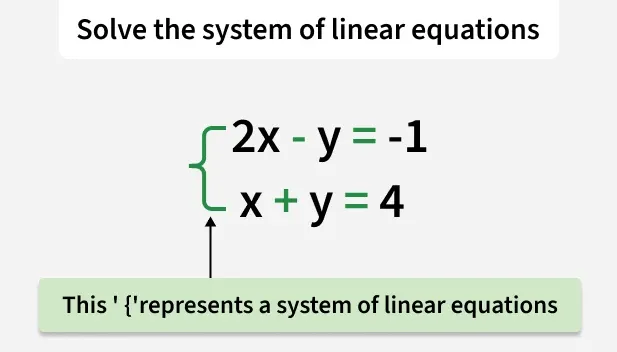
First of all, the elimination method cannot be applied to one single linear equation; it can be applied to a pair of linear equations, also called a system of linear equations (i.e., a group of linear equations). A system of linear equations is represented as
In the elimination method, you either add or subtract the equations to get an equation in one variable. When the coefficients of one variable are of different signs (negative in one equation, positive in the other), you add the equations to eliminate a variable, and when the coefficients of one variable have the same sign (either negative in both equations or positive in both equations), you subtract the equations to eliminate a variable.
Note that the variable to be eliminated needs to have the same coefficient in both equations.
The elimination method of solving a pair (or system) of linear equations is shown below, followed by the steps it entails:
For example, consider the system of linear equations given in the above image:
- 2x - y = -1 ⇢ (1)
- x + y = 4 ⇢ (2)
To solve the given equations by elimination, the coefficients of one of the variables must be equal. Therefore, we multiply equation (1) by 1 and equation (2) by 2 to equate the coefficients of x. we get:
- 2x - y = -1 ⇢ (1)
- 2x + 2y = 8 ⇢ (2)
Now subtracting equation (1) from equation (2), we get:
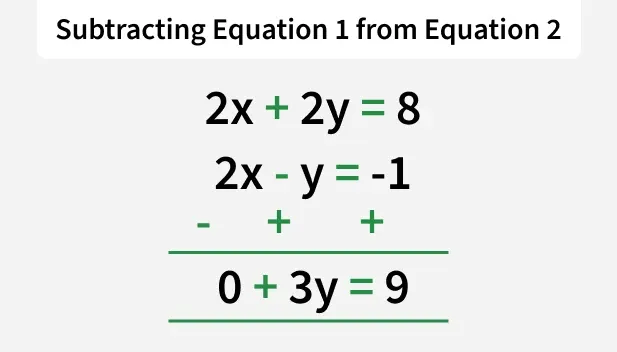
0 + 3y = 9
3y = 9 ....(dividing both sides by 3)
y = 3 .... (result 1)
Now substitute the result 1 (i.e., y=3) in any of the given equations; here we will use Equation 2:
Equation 2 :⇢ x + y = 4 ....(put y= 3)
x + 3 = 4
x = 4 - 3
x = 1 ....(result 2)
Thus we got the Solution as : x = 1 and y = 3
Note : The result be same even if you substitute y=3 in Equation 1
Steps to Solve a Linear Equation using Elimination Method
Step 1: Make sure that both the linear equations are of the form ax + by = c
Step 2: In order to solve the given equations by elimination, the coefficients of one of the variables in both equations must be equal. Look for the numbers, which, when multiplied by the coefficients of the given equations, would equate them. Just like we multiplied the above equation (1) with 1 and equation (2) with 2 in order to eliminate x by changing its coefficient in equation (2) from 1 to 2.
Step 3: Add or subtract the equations to eliminate the variable with equal coefficients. In the above example, variable x was eliminated.
Step 4: Solve for the value of the variable left after elimination of one variable is done. In the example above, after eliminating x, the value of y was calculated.
Step 5: Substitute the value of the variable into any of the given equations and solve for the variable that was eliminated earlier.
Sample Problems
Question 1: Solve 2x + y = 3 and 6x - y = 9 using the elimination method.
Solution:
Given:
2x + y = 3 ⇢ (1)
6x − y = 9 ⇢ (2)
In order to solve the given equations by elimination, the coefficients of one of the variables must be equal. Therefore, multiply the first equation by -3,and multiply the second equation by 1.
−6x − 3y = −9
6x − 3y = 9
Add these equations to eliminate x:
−6y = 0
⇒ y = 0
Substitute y = 0 in equation (1):
2x + 0 = 3
⇒ x = 3/2
Thus, by elimination method, x = 3/2 and y = 0.
Question 2: Solve 4x + 2y = 10, 5x − y = 4 using the elimination method.
Solution:
Given:
4x + 2y = 10 ⇢ (1)
5x − y = 4 ⇢ (2)
In order to solve the given equations by elimination, the coefficients of one of the variables must be equal. Therefore, multiply the first equation by 1,and multiply the second equation by 2.
4x + 2y = 10
10x - 2y = 8
Add these equations to eliminate y:
14x = 18
⇒ x = 18/14
⇒ x = 9/7
Substitute x = 9/7 in equation (1):
⇒ 4(9/7) + 2y = 10
⇒ 36/7 + 2y = 10
⇒ 2y = 34/7
⇒ y = 17/7
Thus, by elimination method, x = 9/7 and y = 17/7.
Question 3: Solve 9a + 2b = 6, 4a − 7b = 2 using the elimination method.
Solution:
Given:
9a + 2b = 6 ⇢ (1)
4a − 7b = 2 ⇢ (2)
In order to solve the given equations by elimination, the coefficients of one of the variables must be equal. Therefore, multiply the first equation by 7,and multiply the second equation by 2.
63a + 14b = 42
8a − 14b = 4
Add these equations to eliminate b:
71a = 46
⇒ a = 46/71
Substitute a = 46/71 in equation (1):
9(46/71) + 2b = 6
⇒ b = 6/71
Thus, by elimination method, a = 46/71 and b = 6/71.
Question 4: Solve 3u + 2t = 8 and 5u + 9t = 2 using the elimination method.
Solution:
Given:
3u + 2t = 8 ⇢ (1)
5u + 9t = 2 ⇢ (2)
In order to solve the given equations by elimination, the coefficients of one of the variables must be equal. Multiply the first equation by 5,and multiply the second equation by −3.
10t + 15u = 40
−27t − 15u = −6
Add these equations to eliminate u:
−17t = 34
⇒ t = −2
Substituting t = −2 in equation (1), we have:
3u + 2(−2) = 8
⇒ 3u = 12
⇒ u = 4
Thus, by elimination method, t = −2 and u = 4.
Question 5: Solve 7p + 4q = 7, 8p + 5q = 5 using the elimination method.
Solution:
Given:
3u + 2t = 8 ⇢ (1)
5u + 9t = 2 ⇢ (2)
In order to solve the given equations by elimination, the coefficients of one of the variables must be equal. Multiply the first equation by 5, and multiply the second equation by −4.
35p + 20q = 35
−32p − 20q = −20
Add these equations to eliminate q:
3p = 15
⇒ p = 15/3
⇒ p = 5
Substituting p = 5 in equation (1), we have:
7(5) + 4q = 7
⇒ 4q = -28
⇒ q = -7
Thus, by elimination method, p = 5 and q = -7.