
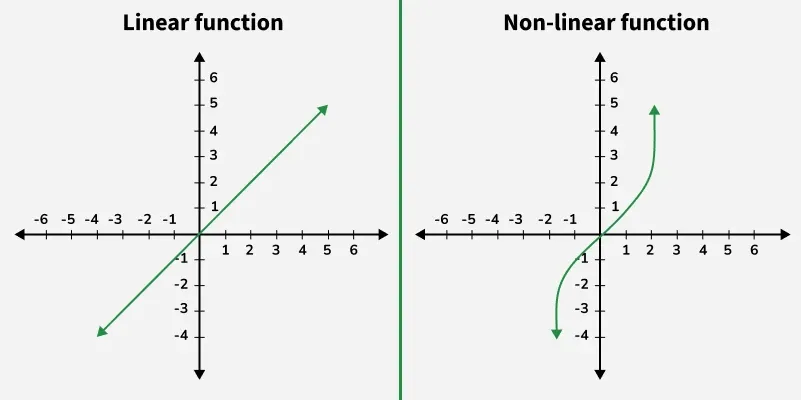
Equations are mathematical statements that show the relationship between variables and constants. They describe completely different kinds of relationships. While linear equations represent straight-line behaviour and proportional changes, nonlinear equations capture more complex, curved relationships that occur in nature and real-world systems.
Understanding Linear Equations
Linear equations are equations where the highest power of the variable is one. They show a constant rate of change between variables. It is used in budgeting, speed-distance-time calculations, simple data trends, unit conversions and planning linear growth scenarios.
General Form:
y=mx+c
Here:
- m = slope i.e. rate of change
- c = y-intercept where the line crosses the y-axis
Characteristics:
- Represent straight lines on a graph.
- Show a direct proportional relationship.
- Easy to solve and interpret.
- The power of the variable is 1.
Understanding Non-Linear Equations
A non-linear equation is an equation where the power of at least one variable is greater than 1 or variables are multiplied together. It represents a curve when plotted. It is used in physics, biology, finance, engineering and environmental modeling which involves complex relationships.
Example Forms:
- y=ax2+bx+c,
- y=ex or xy=k.
Characteristics:
- Represent curved relationships.
- The rate of change is not constant.
- Often describe natural or complex systems like population growth or motion.
- The power of the variable more than 1.
Linear vs Non-Linear Equations
Difference between linear and nonlinear equations:
| Basis | Linear Equation | Non-Linear Equation |
|---|---|---|
| Definition | Equation with degree 1 | Equation with degree > 1 or variable products |
Simplicity | Linear Equations are much simpler to solve. | Non-linear Equations are tricky in nature. |
| Graph Shape | Straight line | Curve (parabola, circle, etc.) |
| Degree of Variable | 1 | 2 or higher |
| Rate of Change | Constant | Variable |
| Example | ||
| Number of Solutions | One | One or more depending on degree |
| Representation |