
The Rank of a Matrix is the maximum number of linearly independent rows or columns in a matrix. It essentially determines the dimensionality of the vector space formed by the rows or columns of the matrix, i.e. the unique information the matrix contains.
It helps determine:
- If a system of linear equations has solutions.
- How many rows or columns contain unique information in the matrix.
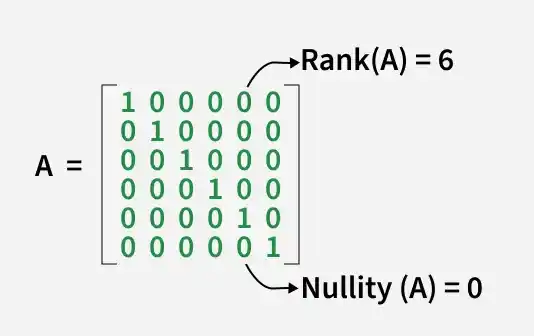
The rank of a matrix is denoted using ρ(A), where A is any matrix. Thus, the number of rows of a matrix is a limit on the rank of the matrix, which means the rank of the matrix cannot exceed the total number of rows in a matrix.
For example, if a matrix is of the order 3×3, then the maximum rank of a matrix can be 3.
Nullity of Matrix
Every column either contributes to the rank (it's linearly independent) or falls into the null space (it's a combination of others).
The number of vectors in the null space is called the nullity of the matrix.
Total columns in a matrix = Rank + Nullity
This relation is known as the Rank Nullity theorem.
Finding Rank of a Matrix
3 methods can be used to get the rank of any given matrix. These methods are as follows:
- Minor Method
- Using Elementary Operations
- Row Echelon Form
- Normal Form
1. Minor Method
To find the rank of a matrix using the minor method, the following steps are followed:
- Calculate the determinant of the matrix (say A).
- If det(A) ≠ 0, then the rank of matrix A = order of matrix A.
- If det(A) = 0, then the rank of the matrix is equal to the order of the maximum possible nonzero minor of the matrix.
Example: Find the rank of a matrix
Given
A = \begin{bmatrix}1 & 2 & 3\\4 & 5 & 6 \\ 7 & 8 & 7\end{bmatrix}
- Step 1: Calculate the determinant of A
det(A) = 1 (35 - 48) - 2 (28 - 42) + 3 (32 - 35)
det(A) = -13 + 28 - 9 = 6
- As det(A) ≠ 0,
ρ(A) = order of A = 3
2. Elementary Operations
Elementary operations are reversible transformations that preserve rank. They come in three types
- Row/Column Swap (Ri ↔ Rj)
- Row/Column Scaling (Ri → kRi, k≠0)
- Row/Column Replacement (Ri → Ri + kRj)
We use these elementary row operations to find Rank by converting the matrix into either:
(a) Row/Column Echelon Form
The following steps are followed to calculate the rank of a matrix using the Echelon form:
- Locate the leftmost non-zero column (this is the pivot column) of the matrix.
- If needed, swap rows to bring a non-zero entry to the top of this column.
- Use row replacement to make all entries below the pivot zero.
- Move to the next row and next column (diagonally down-right).
- Repeat these steps until no more pivots can be formed.
- Count the non-zero rows → that’s the rank.
Example 1: Find the rank of a matrix
Given
A = \begin{bmatrix}1 & 2 & 3\\4 & 5 & 6 \\ 7 & 8 & 9\end{bmatrix}
- Convert A to echelon form
Apply R2 = R2 - 4R1
Apply R3 = R3 - 7R1
A = \begin{bmatrix}1 & 2 & 3\\0 & -3 & -6 \\ 0 & -6 & -12\end{bmatrix} Apply R3 = R3 - 2R2
A = \begin{bmatrix}1 & 2 & 3\\0 & -3 & -6 \\ 0 & 0 & 0\end{bmatrix} As matrix A is now in lower triangular form, it is in Echelon Form.
- Number of non-zero rows in A = 2.
Thus ρ(A) = 2
Example 2: Find the rank of a matrix
Given
\begin{bmatrix}1 & 2 & 3\\2 & 4 & 6 \\ 1 & 1 & 1\end{bmatrix}
- Convert A to echelon form
Apply R2 = R2 - 2R1
Apply R3 = R3 - R1
A = \begin{bmatrix}1 & 2 & 3\\0 & 0 & 0 \\ 0 & -1 & -2\end{bmatrix} Swap R3 and R2
A = \begin{bmatrix}1 & 2 & 3\\0 & -1 & -2 \\ 0 & 0 & 0\end{bmatrix} As matrix A is in Echelon Form.
- Number of non-zero rows in A = 2.
Thus ρ(A) = 2
Example 3: Find the rank of a matrix
Given A =
\begin{bmatrix}2 & 4 & -2\\4 & 9 & -3 \\ -2 & -3 & 7\end{bmatrix}
- Convert A to echelon form
Apply R2 = R2 - 2R1
Apply R3 = R3 - R1A =
\begin{bmatrix}2 & 4 & -2\\0 & 1 & 1 \\ 0 & 1 & 5\end{bmatrix} R3 = R3 - R2
A = \begin{bmatrix}2 & 4 & -2\\0 & 1 & 1 \\ 0 & 0 & 4\end{bmatrix} As matrix A is in Echelon Form.
- Number of non-zero rows in A = 3.
Thus ρ(A) = 3
(b) Normal Form
A matrix is said to be in normal form if it can be reduced to the form
If a matrix can be converted to its normal form, then the rank of the matrix is said to be r.
Example: Find the rank of a matrix
Solution:
Given
A = \begin{bmatrix}1 & 2 & 1 & 2\\1 & 3 & 2 & 2 \\ 2 & 4 & 3 & 4 \\3 & 7 & 4 & 6\end{bmatrix} Apply R2 = R2 - R1 , R3 = R3 - 2R1 and R4 = R4 - 3R1
A = \begin{bmatrix}1 & 2 & 1 & 2\\0 & 1 & 1 & 0 \\ 0 & 0 & 1 & 0 \\0 & 1 & 1 & 0\end{bmatrix} Apply R1 = R1 - 2R2 and R4 = R4 - R2
A = \begin{bmatrix}1 & 0 & -1 & 2\\0 & 1 & 1 & 0 \\ 0 & 0 & 1 & 0 \\0 & 0 & 0 & 0\end{bmatrix} Apply R1 = R1 + R3 and R2 = R2 - R3
A = \begin{bmatrix}1 & 0 & 0 & 2\\0 & 1 & 0 & 0 \\ 0 & 0 & 1 & 0 \\0 & 0 & 0 & 0\end{bmatrix} Apply C4 → C4 - 2C1
A = \begin{bmatrix}1 & 0 & 0 & 0\\0 & 1 & 0 & 0 \\ 0 & 0 & 1 & 0 \\0 & 0 & 0 & 0\end{bmatrix} Thus A can be written as
\begin{bmatrix} I_3 & 0\\ 0 & 0\\ \end{bmatrix} .Thus, ρ(A) = 3
Properties of Rank of a Matrix
The properties of the rank of a matrix are as follows:
- Rank ≤ min(m, n) for an m×n matrix
- The rank of a matrix is equal to the number of non-zero rows if it is in Echelon Form.
- Rank(A) = Rank(AT), Rank of a matrix and it's transpose are equal.
- The rank of the identity matrix is equal to the order of the identity matrix.
- [Rank of matrix] < [Order of matrix], if it is a singular matrix.
- [Rank of matrix] < [minimum {m, n}], if it is a rectangular matrix of order m x n.
- The rank of a zero matrix or a null matrix is zero.
Solved Examples
Example 1: Find the rank of a matrix
Solution:
Given
A = \begin{bmatrix}-1 & -2 & -3\\-4 & -5 & -6 \\ -7 & -8 & -7\end{bmatrix} Step 1: Calculate the determinant of A
det(A) = -1 (35 - 48) + 2 (28 - 42) - 3 (32 - 35)
det(A) = 13 - 28 - 9 = -24
As det(A) ≠ 0, ρ(A) = order of A = 3
Example 2: Find the rank of a matrix
Solution:
Given
A = \begin{bmatrix}2 & 4 & 6\\8 & 10 & 12 \\ 14 & 16 & 0\end{bmatrix} Step 1: Calculate the determinant of A
det(A) = 2(0-192) - 4(0-168) + 6(128-140)
det(A) = -384 + 672 - 72 = 216
As det(A) ≠ 0, ρ(A) = order of A = 3
Example 3: Find the rank of a matrix
Solution:
Given
A = \begin{bmatrix}-1 & -2 & -3\\-4 & -5 & -6 \\ -7 & -8 & -9\end{bmatrix} Step 1: Convert A to echelon form
Apply R2 = R2 - 4R1
Apply R3 = R3 - 7R1
A = \begin{bmatrix}-1 & -2 & -3\\0 & 3 & 6 \\ 0 & 6 & 12\end{bmatrix} Apply R3 = R3 - 2R2
A = \begin{bmatrix}-1 & -2 & -3\\0 & 3 & 6 \\ 0 & 0 & 0\end{bmatrix} As matrix A is now in lower triangular form, it is in Echelon Form.
Step 2: Number of non-zero rows in A = 2.
Thus ρ(A) = 2
Example 4: Find the rank of a matrix
Solution:
Given
A = \begin{bmatrix}2 & 4 & 6\\8 & 10 & 12 \\ 14 & 16 & 18\end{bmatrix} Step 1: Convert A to echelon form
Apply R2 = R2 - 4R1
Apply R3 = R3 - 7R1
A = \begin{bmatrix}2 & 4 & 6\\0 & -6 & -12 \\ 0 & -12 & -24\end{bmatrix} Apply R3 = R3 - 2R2
A = \begin{bmatrix}2 & 4 & 6\\0 & -6 & -12 \\ 0 & 0 & 0\end{bmatrix} As matrix A is now in lower triangular form, it is in Echelon Form.
Step 2: Number of non-zero rows in A = 2.
Thus ρ(A) = 2
Example 5: Find the rank of a matrix
Solution:
Given
A = \begin{bmatrix}2 & 4 & 2 & 4\\2 & 6 & 4 & 4 \\ 4 & 8 & 6 & 8 \\6 & 14 & 8 & 12\end{bmatrix} Apply R2 = R2 - R1 , R3 = R3 - 2R1 and R4 = R4 - 3R1
A = \begin{bmatrix}2 & 4 & 2 & 4\\0 & 2 & 2 & 0 \\ 0 & 0 & 2 & 0 \\0 & 2 & 2 & 0\end{bmatrix} Apply R1 = R1 - 2R2 and R4 = R4 - R2
A = \begin{bmatrix}2 & 0 & -2 & 4\\0 & 2 & 2 & 0 \\ 0 & 0 & 2 & 0 \\0 & 0 & 0 & 0\end{bmatrix} Apply R1 = R1 + R3 and R2 = R2 - R3
A = \begin{bmatrix}2 & 0 & 0 & 4\\0 & 2 & 0 & 0 \\ 0 & 0 & 2 & 0 \\0 & 0 & 0 & 0\end{bmatrix} Apply C4 → C4 - 2C1
A = \begin{bmatrix}2 & 0 & 0 & 0\\0 & 2 & 0 & 0 \\ 0 & 0 & 2 & 0 \\0 & 0 & 0 & 0\end{bmatrix} Apply R1 = R1/2, R2 = R2/2, R3 = R3/2
A = \begin{bmatrix}1 & 0 & 0 & 0\\0 & 1 & 0 & 0 \\ 0 & 0 & 1 & 0 \\0 & 0 & 0 & 0\end{bmatrix} Thus A can be written as
\begin{bmatrix} I_3 & 0\\ 0 & 0\\ \end{bmatrix}
Thus, ρ(A) = 3