
The inverse of a matrix is a matrix that, when multiplied by itself, results in the identity matrix 𝜤.
The inverse of a Matrix "A", denoted as A−1,
A × A-1 = A-1 × A = 𝜤
The inverse of a matrix is obtained by dividing the adjugate (also called adjoint) of the given matrix by the determinant of the given matrix.
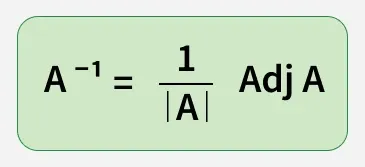
Properties of Inverse Matrix
- Matrix must be square (the same number of rows and columns)
- Matrix must be non-singular (its determinant is not zero) to have an inverse.
- (A-1)-1 = A
- (AT)-1 = (A-1)T
- (AB)-1 = B-1A-1
Terms Related to Inverse of a Matrix
The terminology listed below can help you grasp the inverse of a matrix more clearly and easily.
- The minor of an element in a matrix is the determinant of the matrix formed by removing the row and column of that element.
- For element aij , remove the ith row and jth column to form a new matrix and find its determinant.
- Example: Minor of a11 is the determinant of
A = \begin{bmatrix}5 & 6\\ 6 & 7\end{bmatrix}
- The cofactor of an element is the minor of that element multiplied by (-1)i+j , where i and j are the row and column indices of the element.
- Cofactor of aij = (-1)i+j Minor of aij
- Example: Cofactor of a11 = (-1)1+1 × Minor of a11 = Minor of a11
- The determinant of a matrix is calculated as the sum of the products of the elements of any row or column and their respective cofactors.
- For a row (or column), sum up the product of each element and its cofactor.
- Example: Determinant of A = a11 × Cofactor of a11 +a12 × Cofactor of a12 +a13 × Cofactor of a13.
- The adjoint of a matrix is the transpose of its cofactor matrix.
- Create a matrix of cofactors for each element of the original matrix and then transpose it.
- Example: Adjoint of A is the transpose of the matrix formed by the cofactors of all elements in A.
Finding Inverse of a Matrix
There are two ways to find the Inverse of a matrix in mathematics:
1. Inverse Matrix Formula
The inverse of matrix A, that is A-1 is calculated using the inverse of matrix formula, which involves dividing the adjoint of a matrix by its determinant.
A^{-1}=\frac{\text{Adj A}}{|A|}
where,
- adj A = adjoint of the matrix A, and
- |A| = determinant of the matrix A.

Note: This formula only works on Square matrices.
To find the inverse of the matrix using the inverse of a matrix formula, follow these steps.
Step 1: Determine the minors of all A elements.
- For finding Mij ,the minor of the element aij, we exclude the i-th row and j-th column.
- Form a new smaller matrix with the remaining elements, and find its determinant. For a 3 x 3 matrix M11 is given by:
M_{11} = \begin{vmatrix} a_{22} & a_{23} \\ a_{32} & a_{33} \\ \end{vmatrix} - Likewise, do for all elements in the matrix to form Minor of Matrix M.
M =\begin{pmatrix} M_{11} & M_{12} & M_{13} \\ M_{21} & M_{22} & M_{23} \\ M_{31} & M_{32} & M_{33} \end{pmatrix}
Step 2: Next, compute the cofactors of all elements and build the cofactor matrix by substituting the elements of A with their respective cofactors.
- For the cofactor of a matrix i.e., Cij, we can use the following formula:
Cij = (-1)i+j det (Mij)
Step 3: Take the transpose of A's cofactor matrix to find its adjoint (written as adj A).
Step 4: Multiply adj A by the reciprocal of the determinant of A.
Now, for any non-singular square matrix A,
A-1 = 1 / |A| × Adj (A)
Example: Find the inverse of the matrix
We have,
A=\left[\begin{array}{ccc}4 & 3 & 8\\6 & 2 & 5\\1 & 5 & 9\end{array}\right] Find the value of determinant of the matrix.
|A| = 4(18–25) – 3(54–5) + 8(30–2)
⇒ |A| = 49
Find the adjoint of matrix A by computing the cofactors of each element and then getting the cofactor matrix's transpose.
adj A =
\left[\begin{array}{ccc}-7 & 13 & -1\\-49 & 28 & 28\\28 & -17 & -10\end{array}\right] So, the inverse of the matrix is,
A–1 =
\frac{1}{49}\left[\begin{array}{ccc}-7 & 13 & -1\\-49 & 28 & 28\\28 & -17 & -10\end{array}\right] ⇒ A–1 =
\left[\begin{array}{ccc}- \frac{1}{7} & \frac{13}{49} & - \frac{1}{49}\\-1 & \frac{4}{7} & \frac{4}{7}\\\frac{4}{7} & - \frac{17}{49} & - \frac{10}{49}\end{array}\right]
2. Elementary Transformation Method
Follow the steps below to find an Inverse matrix by the elementary transformation method.
Step 1: Write the given matrix as A = IA, where I is the identity matrix of the order same as A.
Step 2: Use the sequence of either row operations or column operations till the identity matrix is achieved on the LHS also use similar elementary operations on the RHS such that we get I = BA. Thus, the matrix B on RHS is the inverse of matrix A.
Step 3: Make sure we either use Row Operation or Column Operation while performing elementary operations.
We can easily find the inverse of the 2 × 2 Matrix using the elementary operation. Let's understand this with the help of an example.
Example: Find the inverse of the 2 × 2, A =
Solution:
Given: A = 𝜤A
\begin{bmatrix}2 & 1\\ 1 & 2\end{bmatrix}~=~\begin{bmatrix}1 & 0\\ 0 & 1\end{bmatrix}~×~\begin{bmatrix}2 & 1\\ 1 & 2\end{bmatrix} Now, R1 ⇢ R1/2
\begin{bmatrix}1 & 1/2\\ 1 & 2\end{bmatrix}~=~\begin{bmatrix}1/2 & 0\\ 0 & 1\end{bmatrix}~×~A R2 ⇢ R2 - R1
\begin{bmatrix}1 & 1/2\\ 0 & 3/2\end{bmatrix}~=~\begin{bmatrix}1/2 & 0\\ -1/2 & 1\end{bmatrix}~×~A R2 ⇢ R2 × 2/3
\begin{bmatrix}1 & 1/2\\ 0 & 1\end{bmatrix}~=~\begin{bmatrix}1/2 & 0\\-1/3 & 2/3\end{bmatrix}~×~A R1 ⇢ R1 - R2/2
\begin{bmatrix}1 & 0\\ 0 & 1\end{bmatrix}~=~\begin{bmatrix}2/3 & -1/3\\ -1/3 & 2/3\end{bmatrix}~×~A Thus, the inverse of the matrix A =
\begin{bmatrix}2 & 1\\ 1 & 2\end{bmatrix} is A-1 =\begin{bmatrix}2/3 & -1/3\\ -1/3 & 2/3\end{bmatrix}
2 × 2 Matrix Inverse
The inverse of the 2×2 matrix can also be calculated using the shortcut method apart from the method discussed above. Let's consider an example to understand the shortcut method to calculate the inverse of 2 × 2 Matrix.
For given matrix A =
\begin{bmatrix}a & b\\ c & d\end{bmatrix} We know, |A| = (ad - bc)
and adj A =
\begin{bmatrix}d & -b\\ -c & a\end{bmatrix} then using the formula for inverse
A-1 = (1 / |A|) × Adj A
⇒ A-1 =
[1 / (ad - bc)] × \begin{bmatrix}d & -b\\ -c & a\end{bmatrix} Thus, the inverse of the 2 × 2 matrix is calculated.
3 × 3 Matrix Inverse
Let us take any 3×3 Matrix:
A =
The inverse of the 3×3 matrix is calculated using the inverse matrix formula,
A-1 = (1 / |A|) × Adj A
We have,
A=\left[\begin{array}{ccc}a_{11} & a_{12} & a_{13}\\a_{21} & a_{22} & a_{23}\\a_{31} & a_{32} & a_{33}\end{array}\right]
- Minors: Determinant of a matrix made by excluding the respective row and column.
M_{11} = \begin{vmatrix} a_{22} & a_{23} \\ a_{32} & a_{33} \\ \end{vmatrix} ,M_{12} = \begin{vmatrix} a_{21} & a_{23} \\ a_{31} & a_{33} \\ \end{vmatrix} ,and similarly for all elements.Now combine all results and make Minor matrix.
M =
\begin{pmatrix}M_{11} & M_{12} & M_{13} \\M_{21} & M_{22} & M_{23} \\M_{31} & M_{32} & M_{33}\end{pmatrix}
- Cofactor: Sign of minor matrix is modified according to the equation: Cij = (-1)i+j det (Mij)
C =
\begin{pmatrix}M_{11} & (-)M_{12} & M_{13} \\(-)M_{21} & M_{22} & (-)M_{23} \\M_{31} & (-)M_{32} & M_{33}\end{pmatrix}
- Adjoint: Transpose of cofactor matrix is adjoint matrix.
adj A =
\begin{pmatrix}M_{11} & (-)M_{21} & M_{31} \\(-)M_{12} & M_{22} & (-)M_{32} \\M_{13} & (-)M_{23} & M_{33}\end{pmatrix}
- Determinant of the matrix:
|A| = a11(a22. a33 – a23 . a32) – a12(a21. a33 – a23 . a31) + a13(a21. a32 – a22 . a31)
- Therefore, the inverse of the matrix is,
A–1 = (1 / |A|) × adj A
A–1 =
\frac{1}{|A|}\begin{pmatrix}M_{11} & (-)M_{21} & M_{31} \\(-)M_{12} & M_{22} & (-)M_{32} \\M_{13} & (-)M_{23} & M_{33}\end{pmatrix}
Inverse of Diagonal Matrices
Diadonal matrix is a matrix with all its non-diagonal entries as zero.
If you have a diagonal matrix, to find the inverse take the reciprocal of each diagonal element.
For a matrix:
\begin{bmatrix}a & 0 & 0\\ 0 & b & 0\\ 0 & 0 & c\end{bmatrix} The inverse is:
\begin{bmatrix}\frac{1}{a} & 0 & 0\\ 0 & \frac{1}{b} & 0\\ 0 & 0 & \frac{1}{c}\end{bmatrix}
Inverse of Orthogonal Matrices
Orthogonal matrix is a matrix whose rows and columns are mutually perpendicular (orthogonal) unit vectors.
If A is an orthogonal matrix (i.e., AT = A−1), its inverse is simply its transpose.
Determinant of Inverse Matrix
The determinant of the inverse matrix is the reciprocal of the determinant of the original matrix. i.e.,
det(A-1) = 1 / det(A)
The proof of the above statement is discussed below:
det(A × B) = det (A) × det(B) (already know)
⇒ A × A-1 = I (by Inverse matrix property)
⇒ det(A × A-1) = det(I)
⇒ det(A) × det(A-1) = det(I) [ but, det(I) = 1]
⇒ det(A) × det(A-1) = 1
⇒ det(A-1) = 1 / det(A)Hence, Proved.
Singular Matrix
A matrix whose value of the determinant is zero is called a singular matrix, i.e. any matrix A is called a singular matrix if |A| = 0. The inverse of a singular matrix does not exist.
Non-Singular Matrix
A matrix whose value of the determinant is non-zero is called a non-singular matrix, i.e. any matrix A is called a non-singular matrix if |A| ≠ 0. The inverse of a non-singular matrix exists.
Identity Matrix
A square matrix in which all the elements are zero except for the principal diagonal elements is called the identity matrix. It is represented using 𝜤. It is the identity element of the matrix as for any matrix A,
A × 𝜤 = A
An example of an Identity matrix is,
𝜤3×3 =
This is an identity matrix of order 3×3.
Solved Examples
Let's solve some example questions on the Inverse of the Matrix.
Example 1: Find the inverse of the matrix
Solution:
We have,
A=\left[\begin{array}{ccc}2 & 3 & 1\\1 & 1 & 2\\2 & 3 & 4\end{array}\right] Find the adjoint of matrix A by computing the cofactors of each element and then getting the cofactor matrix's transpose.
adj A =
\left[\begin{array}{ccc}-2 & -9 & 5\\0 & 6 & -3\\1 & 0 & -1\end{array}\right] Find the value of determinant of the matrix.
|A| = 2(4–6) – 3(4–4) + 1(3–2)
= –3
So, the inverse of the matrix is,
A–1 =
\frac{1}{-3}\left[\begin{array}{ccc}-2 & -9 & 5\\0 & 6 & -3\\1 & 0 & -1\end{array}\right] =
\left[\begin{array}{ccc}\frac{2}{3} & 3 & - \frac{5}{3}\\0 & -2 & 1\\- \frac{1}{3} & 0 & \frac{1}{3}\end{array}\right]
Example 2: Find the inverse of the matrix
Solution:
We have,
A=
\left[\begin{array}{ccc}6 & 2 & 3\\0 & 0 & 4\\2 & 0 & 0\end{array}\right] Find the adjoint of matrix A by computing the cofactors of each element and then getting the cofactor matrix's transpose.
adj A =
\left[\begin{array}{ccc}0 & 0 & 8\\8 & -6 & -24\\0 & 4 & 0\end{array}\right] Find the value of determinant of the matrix.
|A| = 6(0–4) – 2(0–8) + 3(0–0)
= 16
So, the inverse of the matrix is,
A–1 =
\frac{1}{16}\left[\begin{array}{ccc}0 & 0 & 8\\8 & -6 & -24\\0 & 4 & 0\end{array}\right] =
\left[\begin{array}{ccc}0 & 0 & \frac{1}{2}\\\frac{1}{2} & - \frac{3}{8} & - \frac{3}{2}\\0 & \frac{1}{4} & 0\end{array}\right]
Example 3: Find the inverse of the matrix A=
Solution:
We have,
A=
\left[\begin{array}{ccc}1 & 2 & 3\\0 & 1 & 4\\0 & 0 & 1\end{array}\right] Find the adjoint of matrix A by computing the cofactors of each element and then getting the cofactor matrix's transpose.
adj A =
\left[\begin{array}{ccc}1 & -2 & 5\\0 & 1 & -4\\0 & 0 & 1\end{array}\right] Find the value of determinant of the matrix.
|A| = 1(1–0) – 2(0–0) + 3(0–0)
= 1
So, the inverse of the matrix is,
A–1 =
\frac{1}{1}\left[\begin{array}{ccc}1 & -2 & 5\\0 & 1 & -4\\0 & 0 & 1\end{array}\right] =
\left[\begin{array}{ccc}1 & -2 & 5\\0 & 1 & -4\\0 & 0 & 1\end{array}\right]
Example 4: Find the inverse of the matrix A=
Solution:
We have,
A=
\left[\begin{array}{ccc}1 & 2 & 3\\2 & 1 & 4\\3 & 4 & 1\end{array}\right] Find the adjoint of matrix A by computing the cofactors of each element and then getting the cofactor matrix's transpose.
adj A =
\left[\begin{array}{ccc}-15 & 10 & 5\\10 & -8 & 2\\5 & 2 & -3\end{array}\right] Find the value of determinant of the matrix.
|A| = 1(1–16) – 2(2–12) + 3(8–3)
= 20
So, the inverse of the matrix is,
A–1 =
\frac{1}{20}\left[\begin{array}{ccc}-15 & 10 & 5\\10 & -8 & 2\\5 & 2 & -3\end{array}\right] =
\left[\begin{array}{ccc}- \frac{3}{4} & \frac{1}{2} & \frac{1}{4}\\\frac{1}{2} & - \frac{2}{5} & \frac{1}{10}\\\frac{1}{4} & \frac{1}{10} & - \frac{3}{20}\end{array}\right]
Practice Problem
Question 1. Find the inverse of the matrix
Question 2. Determine if the following matrix has an inverse. If yes, find the inverse
Question 3. Find the inverse of the matrix
Question 4. Verify if the following matrix has an inverse. If the inverse exists, compute it
Answer:-
1.
A^{-1} = \begin{bmatrix} -\frac{1}{5} & \frac{2}{5} \\ \frac{4}{5} & -\frac{3}{5} \end{bmatrix} 2.
A^{-1} = \begin{bmatrix} -24 & 18 & 5 \\ 20 & -15 & -4 \\ -5 & 4 & 1 \end{bmatrix} 3.
A^{-1} = \begin{bmatrix} 3 & -5 \\ -1 & 2 \end{bmatrix} 4. does not have an inverse since the determinant is 0.