Minors and cofactors play a crucial role in the calculation of the adjoint and inverse of a matrix. They are essential for determining the determinant and are widely used in various applications, including computer science.
Minors:
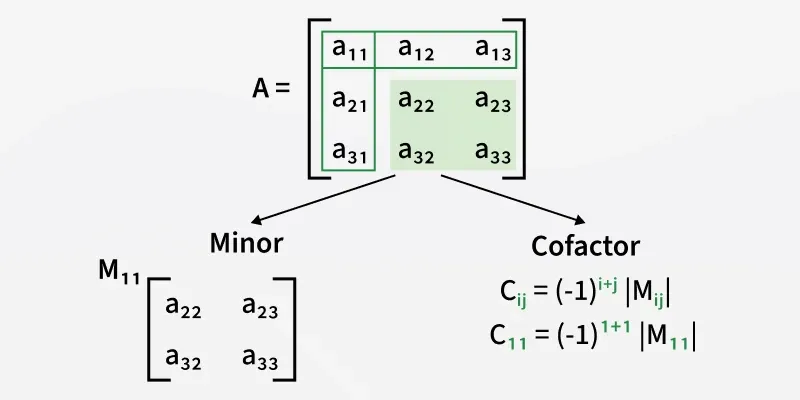
A Minor is a smaller part of the larger matrix obtained for a particular element of the matrix by deleting the terms of the row and column to which the element belongs.
In simpler terms:
Choose an element of the matrix.
Remove the row and column containing that element.
The minor is the determinant of the remaining matrix.
Cofactors:
A cofactor is closely related to the minor.
It is calculated by multiplying the minor by (−1)i+j, where i and j are the row and column indices of the element.
The sign factor (−1)i+j accounts for the position of the element within the matrix.
Minor of a Matrix
Minor of an element aijof a determinant is a determinant obtained by deleting the ith row and jth column in which element aijlies. Minor of an element aijis denoted by Mij.a
How to Find a Minor of a Matrix?
Use the following steps to find the minor of any given matrix:
Step 1: Hide the ith row and jth column of the matrix A, where the element aij lies.
Step 2: Now compute the determinant of the matrix after the row and column is removed using step 1.
Step 3: Result of Step 2 is the minor for he elelment of the ith row and jth column, then repeat the process for each element of the matrix to find the minor for all the elements of the matrix.
Sample Problems on Minor of a Matrix
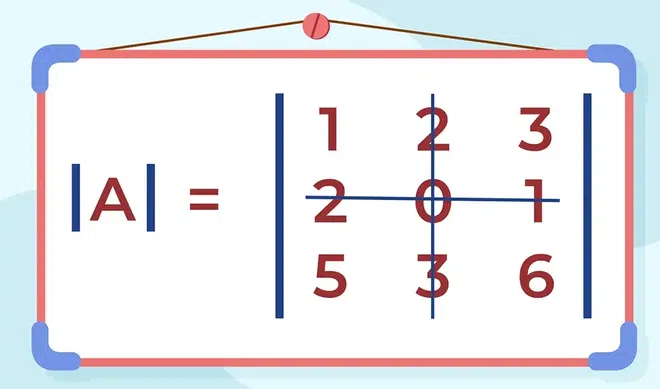
Problem 1: If the matrix \bold{A = \begin{bmatrix} 1&2&3\\ 2&0&1\\ 5&3&6 \end{bmatrix}}then find the minor of a22.
Solution:
In this question, we have to find out the minor of a22, the element present at a22 is 0. As we learn from our definition of a minor we have to delete the ith row and jth columns at which our asked element is present. Below image is demonstrating how to delete the ith row and jth column
After deletion, we write our left element as it is and do cross multiplication.
Minor of element a22 = \begin{vmatrix} 1&3\\ 5& 6 \end{vmatrix}
⇒ Minor of element a22 = 6 - 15 = -9
Note: Always remember, after the multiplication of the left diagonal element in the second-dimensional determinant, always put the -ve sign then do the multiplication of right diagonal elements and solve them out.
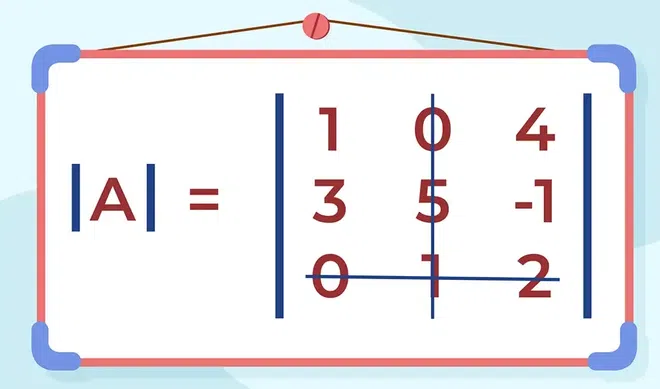
Problem 2: If the matrix \bold{A = \begin{bmatrix} 1 & 0 & 4\\ 3 & 5 &-1\\ 0 & 1 & 2 \end{bmatrix}}, then find the minor of a32.
Solution:
In the above question we have asked to find out the minor of a32 element which is 1. So as we did in this above problem same procedure we will follow. So firstly we have to delete the ith row and jth column at which our element is present.
So we had canceled the ith row and jth column at which our element is present. So write the elements which are left as it is.
Then do the cross multiplication and solve:
Minor of element a32 = \begin{vmatrix} 1&4\\ 3& -1 \end{vmatrix}
Minor of element a32 = -1 -12 = -13
Cofactor of a Matrix
Co-factor of an element aij of a determinant, denoted by Aij or Cij, and is defined as follows:
Cij = (-1)i+j Mij
Where,
Mij is the minor of the element aij, and
i and j respectively reprensent the number of row and column of the element (position).
How to Find Cofactors of a Matrix
Let's go step-by-step with an example to understand how to find the cofactor of a matrix.
Similary in this question, we are having determinant. So we have row and column given in the question. Here, a32 = 5 (second element of third row)
Given, Aij is the cofactor of the element aij of A . So now we can solve this question by putting the values in the formula of cofactor as discussed in above question.
Cofactor of elements(A32)= (-1)^{3+2}\begin{vmatrix}2 &5\\6&4 \end{vmatrix}
⇒ Cofactor of element (A32) = (-1)(8 - 30) = 22
a32 . A32 = 5 . 22 = 110
So, 110 is our required answer.
Application of Minors and Cofactors
Minors and Cofactors are used in the calculation of the following terms:
To calculate the adjoint of Matrix, you need to follow the following steps:
Step 1: Calculate the cofactors of each element of a given matrix. Step 2: Construct the matrix from the cofactor of elements. Step 3: Calculate the Transpose of the resultant matrix in Step 2. Step 4: Resulting matrix of Step 3 is the adjoint of the given matrix.
Example: Find the adjoint of the following matrix A;
Matrix of cofactors, C = \begin{bmatrix} -3&6&-3\\ 6&-6&3\\ -3&6&-3 \end{bmatrix}
Step 3: Transpose the matrix of cofactors.
C' = \begin{bmatrix} -3&6&-3\\ 6&-6&6\\ -3&3&-3 \end{bmatrix}
Step 4: The resulting matrix is the adjoint of A.
adj(A) = C' = \begin{bmatrix} -3&6&-3\\ 6&-6&6\\ -3&3&-3 \end{bmatrix}
Inverse of Matrix
To calculate the inverse of a matrix, you can use the following steps:
Step 1: Calculate the determinant of the given matrix.
Step 2: If the value of the determinant is zero, then the matrix has no inverse. Otherwise, calculate the adjoint of the matrix using the steps mentioned in the previous heading.
Step 3: Use the formula A^{-1} = \frac{adj(A)}{|A|}, to calculate the inverse of the given matrix.
Example: Find the inverse of the following matrix A: