
Multiplication of fractions is a mathematical operation that involves finding the product of two or more fractions.
To multiply fractions, you simply multiply the numerators (the top numbers of the fractions) together to get a new numerator, and you multiply the denominators (the bottom numbers of the fractions) together to get a new denominator. The result is a fraction that represents the product of the original fractions.
Example:
\frac{2}{7} \times \frac{5}{9} = \frac{2 \times 5}{7 \times 9} = \frac{10}{63}
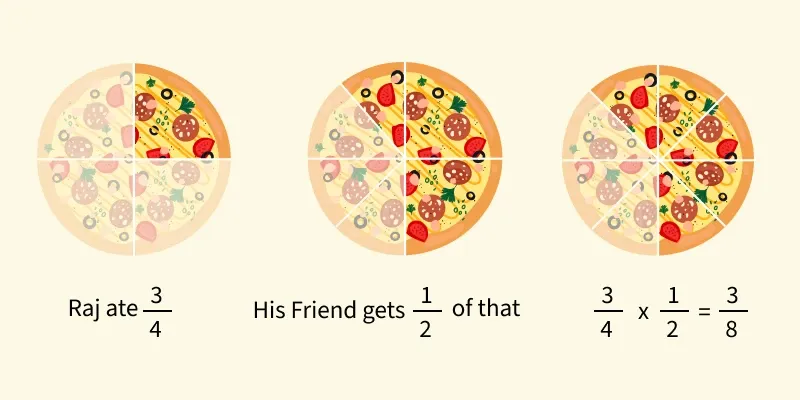
Multiplication of fractions is not similar to addition or subtraction of fractions. Multiplication of fractions does not depend on like or unlike fractions and we simply find the multiplication of the fractions by multiplying the numerators and the denominators of the fractions separately.
Both multiplication of like fractions and unlike fractions are attained by the same methods. To find the product of the two fractions, we should follow the steps added below,
Step 1: Multiply the numerator of both fractions separately.
Step 2: Multiply the denominator of both fractions separately.
Step 3: Write the result of the product of the fraction in the form
(Product of Numerators)/ (Product of Denominators)
a/b × c/d = (a × c )/ (b × d)
Example: Find the multiplication of 7/6 × 4/5.
Solution:
7/6 × 4/5
= (7×4)/(6×5)
= 28/30 [Simplifying it further]
= 14/15
Multiplication of Fractions with Whole Numbers
Multiplication of fractions with whole numbers can be easily achieved by converting the whole number into a proper fraction by taking the denominator of the whole number as one and then multiplying the fraction normally as in the denominator part the multiplication with one does not change the denominator part.
This is achieved as,
a × b/c = a/1 × b/c = (ab)/c
Multiplication of Fractions with Whole Numbers can be explained using these examples:
Example: Multiply 3 × 11/5
Solution:
3 × 11/5
= 3/1 × 11/5
= (3 × 11)/5
= 33/5
How to Multiply Mixed Fractions
Multiplication of mixed fraction with mixed fractions can be done by simply changing the mixed fractions into improper fractions and then multiplying them accordingly. A mixed fraction is written as, a(b/c)
a(b/c) = (ac + b)/c
Now changing the fractions into improper fractions we can easily multiply the mixed fractions. This is shown as,
a(b/c) × d(e/f) = (ac + b)/c × (df + e)/c
Now the mixed fractions are multiplied as normal fractions. This can be explained using the example as,
Example: Multiply 3(4/5) × 11(2/3)
Solution:
3(4/5) × 11(2/3)
Converting them into improper fractions
= (3×5 + 4)/5 × (11×3 + 2)/3Multiplying the obtained fractions
= 19/5 × 35/3
= (19 × 35) + (5 × 3)
= 665/15 [Simplifying it further]
= 133/3
Related Articles:
Solved Examples
Example 1: Find the product of the unlike fractions 2/5 and 3/4.
Solution:
2/5 × 3/4
= (2×3)/(5×4)
= 6/20 [Simplifying it further]
= 3/10
Example 2: Find the product of the like fractions 11/5 and 3/5.
Solution:
11/5 × 3/5
= (11 × 3)/(5 × 5)
= 33/25
Example 3: Find the fraction to be multiplied by 5/6 to get a product equal to 3/2.
Solution:
Let the fraction to be multiplied by 5/6 be y.
y × 5/6 = 3/2
⇒ y = 3/2 ÷ 5/6
⇒ y = 3/2 × 6/5
⇒ y = (3 × 6)/( 2 × 5)
⇒ y = 18/10 = 9/5Thus, 9/5 should be multiplied by 5/6 to get a product of 3/2.
Example 4: Divide the fractions 21/9 and 7/9.
Solution:
21/9 ÷ 7/9
= 21/9 × 9/7
= (21 × 9)/(9 × 7)
= 189/63 [Simplifying it further]
= 3/1 = 3