
Division means distributing something equally. For example, if we distribute 20 sweets equally among 5 children, each child will get 4 sweets. Similarly, division of fractions means dividing a fraction into equal parts.
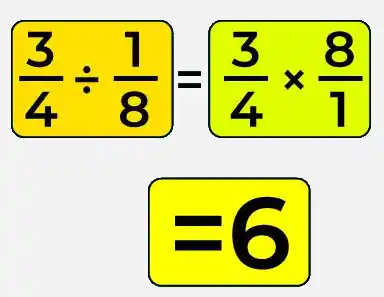
For Example: If we want to divide 2/3 of the cake among 6 people, each person will get 2/3 ÷ 6 = 1/9 part of the cake. For division in fractions, we multiply the first fraction with the reciprocal of the second fraction.
We can simply find the reciprocal of a fraction by interchanging its numerator and denominator.
- 1 is the only positive number whose reciprocal is the number itself.
- The number 0 does not have any reciprocal as division of 0 is not possible.
Steps for Division of Fraction
Keep-Switch-Flip is the basic rule for dividing fractions, which means Keep the first fraction, switch the division sign to the multiplication sign, and flip the other fraction. To divide a fraction, we can also say that the following steps are involved:
- Find the reciprocal of the second fraction (or number).
- Reduce both fractions to their lowest term.
- Multiply the first fraction by the second fraction.
Example: Divide 3/5 by 15/6.
Solution:
Step 1: Find the reciprocal of 15/6, which is 6/15
Step 2: Reduce both fractions to their lowest term.
3/5 is already in its lowest term and the lowest term of 6/15 = 2/5Step 3: Find the product of 3/5 and 6/15:
3/5 × 2/5 = 6/25.Step 4: Reduce the result to its lowest term
6/25 is already in its lowest term.Hence, 3/5 ÷ 15/6 = 6/25.
Division of a Fraction by a Mixed fraction
In this case, we first convert the mixed fraction to an improper fraction, and then we can divide normally by following the steps for division of a fraction with a fraction.
Question: Divide 2/5 by
Solution:
Step 1: Convert mixed fraction to improper fraction
1\frac{5}{6} .= 11/6Step 2: Find the reciprocal of 11/6, which is 6/11
Step 3: Reduce both fractions to their lowest term.
2/5 and 6/11 are already in their lowest termStep 4: Find the product of 2/5 and 6/11:
2/5 × 6/11 = 12/55.Step 5: Reduce the result to its lowest term
12/55 is already in its lowest termHence, 2/5 ÷
1\frac{5}{6} . = 12/55.
Division of a Whole Number by a Fraction
While dividing a whole number with a fraction, we can follow these simple steps:
Steps for division of a whole number with a fraction
- First, find the reciprocal of the fraction.
- Then multiply the whole number with the new divisor (i.e., the reciprocal of the fraction).
Question: Divide 8 by 4/14.
Solution:
Step 1: Find the reciprocal of 4/14, which is 14/4.
Step 2: Reduce the fraction to its lowest term.
The lowest term of 14/4 is 7/2Step 3: Find the product of 8 and 7/2:
8 × 7/2 = 56/2.Step 4: Reduce the result to its lowest term
The lowest term of 56/2 is 28/1 = 28Hence, 8 ÷ 4/14 = 28.
Division Of Fractions by Decimal
For the division of decimals and fractions, we first convert the decimal number into a fraction and then multiply the reciprocal of the divisor with the dividend.
Steps for division of a fraction with a decimal
- First, convert the decimal into a fraction.
- Then, find the reciprocal of the divisor (or the second fraction).
- Reduce both fractions to their lowest term.
- Then, multiply the dividend with the new divisor.
Question: Divide 6/20 by 0.12
Solution:
Step 1: Convert the decimal into a fraction
0.12 = 12/100Step 2: Find the reciprocal of 12/100, which is 100/12
Step 3: Reduce both fractions to their lowest term.
The lowest term of 6/20 is 3/10 and the lowest term of 100/12 is 25/3.Step 4: Find the product of 3/10 and 25/3:
3/10 × 25/3 = 75/30.Step 5: Reduce the result to its lowest term
The lowest term of 75/30 is 5/2.Hence, 6/20 ÷ 0.12 = 5/2.
Also Check
Solved Examples on Division of Fraction
Example 1: Divide
Solution:
First, convert mixed fraction to improper fraction
2 1/5 = 11/5 and 3 1/5 = 16/5Now we have, 11/5 ÷ 16/5
= 11/5 × 5/16
= 55/80
= 11/16 (by reducing in its lowest term).Hence, 2 1/5 ÷ 3 1/5 = 11/16
Example 2: Divide 7/10 by 14/15.
Solution:
We have, 7/10 ÷ 14/15
= 7/10 × 15/14
= 105/140
= 3/4 (by reducing in its lowest term)Hence, 7/10 ÷ 14/15 = 3/4.
Example 3: Divide 1.2 by 0.6.
Solution:
First converting 1.2 and 0.6 in fraction, we have, 12/10 and 6/10
Now, 12/10 ÷ 6/10
= 6/5 ÷ 3/5 (by reducing each in its lowest term)
= 6/5 × 5/3
= 30/15
=2 (by reducing in its lowest term)Hence, 0.12 ÷ 0.6 = 2.
Example 4: Divide 3 by 9/10.
Solution:
We have, 3 ÷ 9/10
= 3 × 10/9
= 30/9
=10/3 (by reducing in its lowest term)Hence, 3 ÷ 9/10 = 10/3.
Example 5: Divide 0.45 by 5.
Solution:
First, by converting 0.45 into a fraction, we get 45/100
Now we have, 45/100 ÷ 5
= 45/100 × 1/5
= 9/20 × 1/5 (by reducing in its lowest term)
= 9/100
= 0.09Hence, 0.45 ÷ 5 = 0.09
Word Problems on Division of Fraction
Example 1: A recipe requires 3/4 cup of flour for 15 cupcakes. How much flour is needed for one cupcake?
Solution:
Flour required for 15 cupcakes = 3/4th cup
Flour required for 1 cupcake = 3/4 ÷ 15= 3/4 ÷ 15/1
= 3/4 × 1/15
= (3 × 1) / (4 × 15)
= 3/60
= 1/20Hence, flour required for 1 cupcake is 1/20th cup.
Example 2: A car can travel 44 km using 11/4 liters of petrol. How much distance can it travel using 1 liter of petrol?
Solution:
Distance travelled by a car in 11/4 litres of petrol = 44 km
Distance travelled by a car in 1 litre of petrol = 44 ÷ 11/4= 44/1 × 4/11
= (44 × 4)/ (1 × 11)
= 176/11
= 16Hence, the car can travel 16 km in 1 litre of petrol.
Example 3: A jug contains 4/5 liter of orange juice; it is poured equally into 8 glasses. How much juice is in each glass?
Solution:
Quantity of orange juice in the jug = 4/5 litre
Number of glasses to be filled = 8
Quantity of juice in each glass = 4/5 ÷ 8= 4/5 × 1/8
= (4 × 1) / (5 × 8)
= 4/40
= 1/10Hence, each glass will have 1/10 litre of juice.
Example 4: The breadth of the rectangular park of area 5 1/4 m2 is 1 2/5 m. Find the length of the park.
Solution:
Area of rectangular park = 5 1/4 m2 = 21/4 m2
Breadth of rectangular park = 1 2/5 m = 7/5 m
Length of rectangular park = 21/4 ÷ 7/5= 21/4 × 5/7
= (21 × 5)/(4 × 7)
= 105/28
= 15/4
= 3 (3/4) (in mixed fraction)Hence, the length of the park is 3 (3/4) m.
Example 5: The product of two numbers is 11/18; if one number is 2/9, find the other number.
Solution:
The product of two numbers = 11/18
The first number = 2/9
The other number = 11/18 ÷ 2/9= 11/18 × 9/2
= (11 × 9) / (18 × 2)
= 99/36
= 11/4Hence, the other number is 11/4.