
Vulnerability Scanning is a type of security testing that uses automated tools to detect known security weaknesses in systems, networks, and applications. It helps organizations identify issues early and improve overall system security.
- It detects known vulnerabilities such as outdated software, misconfigurations, and open ports using automated tools.
- Supports continuous monitoring to identify security risks regularly in systems and applications.
- Helps organizations reduce security risks by finding weaknesses before attackers can exploit them.
Types of Vulnerability Scanning
It includes techniques such as network, host, web application, database, wireless, and cloud scanning to identify and mitigate security vulnerabilities.
- Network-Based Scanning: Identifies vulnerabilities in network infrastructure, including open ports, weak protocols, and unauthorized access points.
- Host-Based Scanning: Analyzes individual systems (servers or computers) to detect missing patches, outdated software, and insecure configurations.
- Web Application Scanning: Detects security flaws in web applications such as SQL injection, Cross-Site Scripting (XSS), and authentication weaknesses.
- Database Scanning: Examines databases for misconfigurations, weak access controls, and potential exposure of sensitive data.
- Wireless Network Scanning: Identifies security issues in wireless networks such as weak encryption, rogue access points, and unauthorized connections, and also evaluates Wi-Fi security standards like WPA2 and WPA3 to ensure secure communication.
- Cloud Vulnerability Scanning: Evaluates cloud environments for misconfigurations, insecure APIs, and compliance or security risks.
Authenticated vs Unauthenticated Scanning
Vulnerability scanning can be performed with or without system login credentials, depending on the depth of analysis required.
- Authenticated Scanning: Performed with valid user credentials, allowing the scanner to access internal system data, configurations, and installed software for deeper and more accurate vulnerability detection.
- Unauthenticated Scanning: Performed without login access, simulating an external attacker’s view to identify publicly exposed vulnerabilities such as open ports and weak services.
Vulnerability Scanning Process
A structured method used to systematically identify, assess, and remediate security vulnerabilities in systems, networks, and applications.
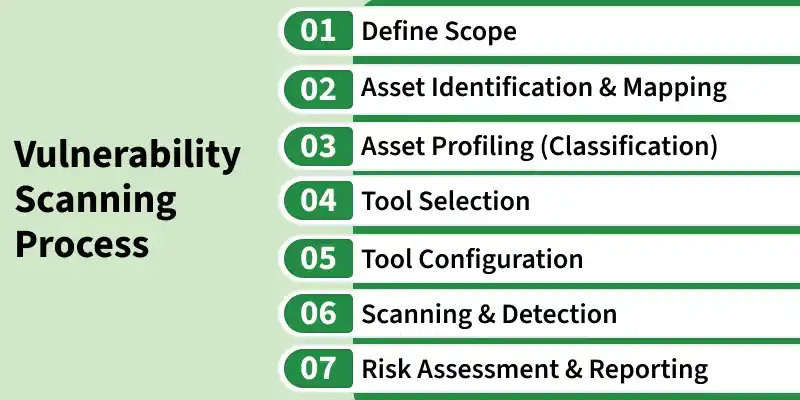
- Define Scope: Identify the systems, networks, and applications to be scanned, and set clear objectives based on organizational priorities.
- Asset Identification & Mapping: Locate and map all assets within the defined scope, including servers, databases, applications, and network devices.
- Asset Profiling (Classification): Analyze assets to understand their configuration, operating systems, and services for accurate scanning.
- Tool Selection: Choose an appropriate vulnerability scanning tool based on organizational needs and system requirements.
- Tool Configuration: Configure the scanner by setting parameters, targets, and authentication details for accurate results.
- Scanning & Detection: Run the scan to detect vulnerabilities by comparing system data with updated vulnerability databases.
- Risk Assessment & Reporting: Evaluates vulnerabilities based on severity (low, medium, high, critical) and generate reports for remediation.
Vulnerability Scanning Tools
Software applications used to automatically detect, analyze, and report security vulnerabilities in systems, networks, and applications.
- Nessus: Widely used tool for identifying vulnerabilities and configuration issues.
- OpenVAS: Open-source scanner for detecting network security issues.
- Qualys: Cloud-based tool for continuous vulnerability monitoring and management.
- Nmap: Network scanning tool used for discovering hosts and open ports.
- Nikto: A web server scanner that detects vulnerabilities and misconfigurations.
Common Vulnerabilities Found in Vulnerability Scanning
Vulnerability scanning helps identify common security weaknesses in systems and applications before attackers can exploit them.
- Outdated Software and Patch Levels: Failure to update software leaves vulnerabilities unaddressed, risking exploitation by attackers.
- Default Credentials: Using default usernames and passwords increases the risk of unauthorized access to systems and applications.
- Missing Security Updates: Neglecting to apply security updates exposes systems to known vulnerabilities that could be exploited by attackers.
- SQL Injection (SQLi): Exploiting vulnerabilities in database queries to manipulate or retrieve unauthorized information from a database.
- Cross-Site Scripting (XSS): Injecting malicious scripts into web pages, which are then executed by unsuspecting users' browsers.
- Cross-Site Request Forgery (CSRF): Forcing users to perform unwanted actions without their consent by exploiting their authenticated sessions on a different site.
- File and Directory Permissions: Inadequate or misconfigured file and directory permissions may allow unauthorized access to sensitive data or system files.
- Open Ports and Services: Unnecessary open ports and services increase the attack surface and expose systems to potential exploits if not properly secured.
Advantages of Vulnerability Scanning
Vulnerability scanning helps organizations improve their security posture by continuously identifying and managing system weaknesses.
- Enables early detection of vulnerabilities in systems, networks, and applications before they can be exploited by attackers.
- Uses automated tools to quickly scan large environments, making the process faster and more efficient compared to manual testing.
- Helps prioritize security risks by categorizing vulnerabilities based on severity levels such as low, medium, high, and critical.
- Supports compliance with security standards and regulations by ensuring regular identification and tracking of vulnerabilities.
- Reduces the overall attack surface by continuously identifying and fixing weak points in the system infrastructure.
- Improves long-term security management by enabling regular monitoring and timely remediation of security issues.
Limitations of Vulnerability Scanning
Vulnerability scanning is effective for identifying security weaknesses, but it also has certain limitations.
- May generate false positives, leading to unnecessary analysis and effort.
- Can detect only known vulnerabilities and may miss zero-day threats.
- Does not provide complete insight into real-world exploitation impact.
- Requires regular database updates for accurate detection.
- May fail to identify complex vulnerabilities, logic flaws, or misconfigurations.
Vulnerability Scanning Vs Penetration Testing
| Basis | Vulnerability Scanning | Penetration Testing |
|---|---|---|
| Definition | Automated process to identify known vulnerabilities in systems | A simulated cyberattack to exploit vulnerabilities and test security |
| Nature | Passive / Non-intrusive | Active / Intrusive |
| Approach | Uses automated tools | Uses manual techniques + tools |
| Goal | Find and list vulnerabilities | Exploit vulnerabilities to assess real risk |
| Depth | Surface-level detection | Deep, real-world attack simulation |
| Accuracy | May produce false positives | More accurate, fewer false positives |
| Skill Required | Low to moderate | High (requires security experts/ethical hackers) |
| Time & Cost | Faster and cheaper | Time-consuming and expensive |
| Output | List of vulnerabilities with severity | Detailed report with exploited paths and impact |
| Frequency | Done regularly (weekly/monthly) | Done occasionally (quarterly/yearly) |