
The Agile Manifesto is a foundational document in software development that defines four core values and twelve guiding principles. It was created in 2001 as an alternative to traditional, rigid development approaches, focusing on flexibility, collaboration, and continuous value delivery.
- Emphasizes collaboration, adaptability, and continuous improvement.
- Focuses on delivering value through working software.
- Encourages flexibility in responding to changing requirements.
4 Agile Values of Agile Manifesto
The Agile Manifesto defines four core values that guide modern software development by focusing on collaboration, flexibility, and continuous delivery of value.
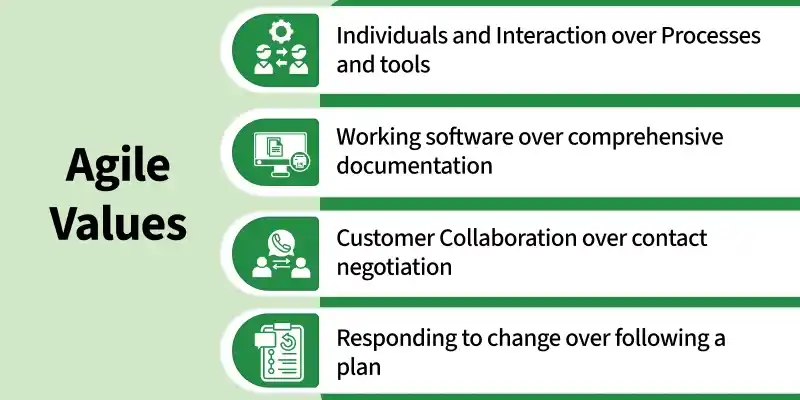
1. Individuals and Interactions over Processes and Tools
This value highlights the importance of communication and teamwork over rigid processes and tools.
- Effective communication among team members helps in faster problem-solving and better coordination.
- Collaboration enables teams to adapt quickly and work more efficiently toward common goals.
- Tools and processes are helpful, but they cannot replace strong human interaction and teamwork.
Example: A cross-functional team (developers, testers, designers) works closely through daily discussions instead of relying only on tools or documentation, leading to faster issue resolution.
2. Working Software over Comprehensive Documentation
Agile focuses on delivering functional software rather than spending excessive time on documentation.
- Regular delivery of working software allows early validation and feedback from users.
- Continuous releases help identify issues quickly and improve product quality.
- Documentation is still important but should support development, not delay it.
Example: Instead of writing extensive documentation, a team releases a basic version of a feature and improves it based on real user feedback.
3. Customer Collaboration over Contract Negotiation
Agile promotes continuous involvement of customers throughout the development process.
- Customers provide regular feedback, ensuring the product aligns with their expectations.
- Continuous interaction reduces misunderstandings and minimizes project risks.
- Collaboration helps in building solutions that deliver real business value.
Example: A product team regularly interacts with customers during development to refine features instead of relying only on initial requirements.
4. Responding to Change over Following a Plan
Agile encourages flexibility and the ability to adapt to changing requirements.
- Teams can modify plans based on new requirements, feedback, or market changes.
- Flexible planning ensures the product remains relevant and up to date.
- Adapting to change leads to better outcomes compared to strictly following a fixed plan.
Example: If market needs change, the team quickly updates the product roadmap instead of strictly following the original plan.
Benefits of Agile Values
Adopting Agile values helps organizations improve collaboration, adaptability, and overall software delivery efficiency.
- Encourages open interaction among team members and stakeholders, leading to better understanding, faster decision-making, and reduced misunderstandings.
- Focuses on delivering working software in small increments, allowing teams to release features quickly and provide continuous value.
- Continuous customer involvement and feedback ensure that the product aligns closely with user needs and expectations.
- Helps teams respond quickly to changing requirements, market conditions, or feedback without disrupting the entire development process.
Agile Values vs Traditional Approach
Agile values differ significantly from traditional development approaches by emphasizing flexibility, collaboration, and continuous delivery.
- Agile focuses on flexibility, while traditional methods follow rigid planning.
- Agile encourages continuous feedback, while traditional models rely on fixed requirements.
- Agile delivers software in small increments, while traditional approaches deliver at the end.
Relevance of the Agile Manifesto Today
The Agile Manifesto remains highly relevant even today as it provides a flexible and principle-driven approach to modern development practices.
- It is widely used not only in software development but also in fields like marketing, HR, and product management.
- It focuses on values and principles rather than strict rules, making it adaptable to different industries.
- Organizations that adopt Agile values benefit from improved collaboration, flexibility, and faster delivery.