
Unit Testing in DevOps is a practice where small units of code are tested continuously as part of the development pipeline to ensure software quality and reliability. It integrates testing with development and deployment processes, enabling early bug detection, automation, and faster delivery of high-quality software.
- Continuous testing ensures early detection of bugs and quick resolution.
- Integrated with CI/CD pipelines to automate testing on every code change.
- Improves code quality, reliability, and overall development efficiency.
Example: A developer implements a login feature and writes unit tests. When the code is pushed, the CI pipeline automatically runs all tests to ensure existing functionality remains unaffected.
Workflow of Unit Testing
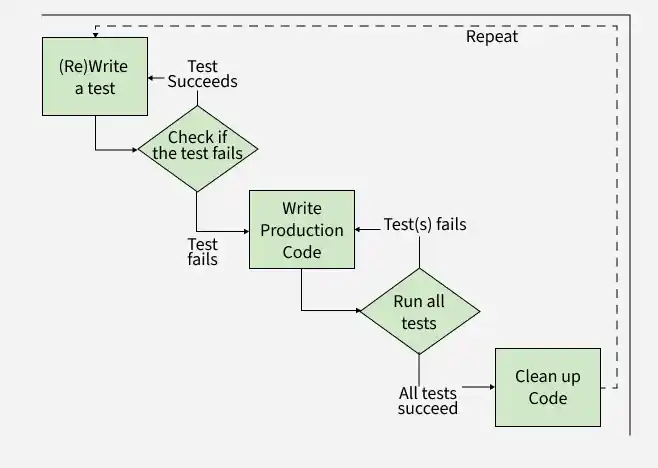
Test-Driven Development (TDD) follows an iterative cycle where tests are written before the actual code. The process ensures continuous validation and clean, reliable code.
Steps in the Workflow
- (Re)Write a Test: Start by writing a new test case or updating an existing one based on the required functionality.
- Check if the Test Fails: Execute the test to verify it fails initially (since the functionality is not yet implemented). If the test unexpectedly succeeds, rewrite or refine the test.
- Write Production Code: Write the minimal amount of code required to make the failing test pass.
- Run All Tests: Execute all test cases to ensure the new code works correctly without breaking existing functionality. If any test fails, go back and fix the production code.
- Clean Up Code (Refactoring): Once all tests pass, improve and refactor the code without changing its behavior.
- Repeat the Cycle: Continue this cycle for every new feature or change to maintain code quality.
CI Integration
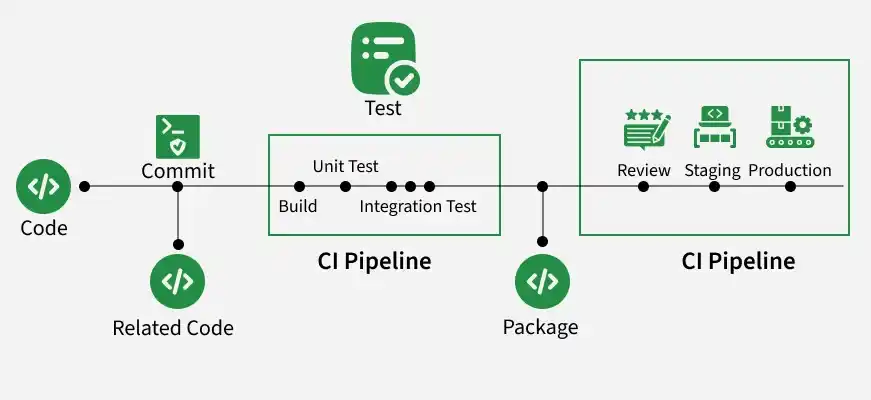
Unit testing in a CI pipeline ensures that every code change automatically triggers build and test execution, helping detect issues early and maintain software quality. It improves reliability by automating the process of building, testing, and validating code continuously.
- Automatically runs unit tests on every code commit or change.
- Ensures early detection of bugs and maintains code quality.
- Supports reliable and faster development with continuous feedback.
Steps
- Choose a CI tool (Jenkins, GitHub Actions, GitLab CI/CD).
- Use version control system like Git.
- Create build scripts to compile and run tests.
- Set up unit testing frameworks (JUnit, pytest, NUnit).
- Configure pipeline to trigger tests on every commit.
- Use parallel testing for faster execution.
- Notify developers about test results.
- Add code coverage to track tested code.
- Extend pipeline to deployment after successful tests.
Tools for Unit Testing
Various tools are used in DevOps to implement unit testing efficiently and support automation and continuous testing.
- JUnit: A widely used Java testing framework for writing and executing unit tests.
- Mocha: A JavaScript testing framework that supports asynchronous testing.
- NUnit: A testing framework for .NET applications similar to JUnit.
- Mockito: A framework used to create mock objects for testing.
- Selenium: Used for automated testing of web applications and UI.
Importance of Unit Testing
Unit testing is essential in DevOps as it supports continuous integration and delivery by ensuring that code changes are reliable and error-free. It helps teams maintain quality while delivering software quickly.
- Early defect detection: Identifies bugs in the initial stages, reducing fixing cost and effort.
- CI/CD integration: Automatically runs tests on every commit or pull request.
- Improved quality: Ensures each unit functions correctly and reliably.
- Easier maintenance: Simplifies debugging and updating of code.
- Continuous feedback: Provides instant feedback to developers about code quality.
Best Practices
Following best practices ensures effective and reliable unit testing in DevOps environments and improves overall software quality.
- Automate Unit Tests: Automation allows teams to focus on essential tasks and reduces human intervention. It also ensures that tests are consistently executed with every code change, reducing the likelihood of introducing bugs.
- Run Tests in Isolation: Ensure that unit tests are independent of each other and can run in isolation. This helps identify the exact source of failures and prevents cascading failures in other tests
- Continuous testing: Continuous testing is essential for organizations that use DevOps in this the code is tested continuously so whenever there is a change in the code or any new part is integrated into the code bugs and errors can be identified easily
- Write Clear and Descriptive Tests: Write test cases with clear and descriptive names, making it easy for developers to understand the purpose of each test. This improves the maintainability of the test suite.
Limitation
Despite its advantages, unit testing in DevOps has certain limitations that need to be considered during implementation.
- Writing and maintaining unit tests can be time-consuming.
- Does not detect all issues, especially integration-related problems.
- It is not effective for testing user interface components.
- Unit tests require frequent updates when code changes occur.
- It cannot cover non-functional aspects like performance and scalability.