
Types of Relations describe the different ways in which the elements of one set can be connected to the elements of another set. These types are determined based on how elements in the domain (first set) are associated with elements in the range (second set).
For example:
- In a classroom, the relation can be "is the friend of."
- In numbers, the relation can be "is greater than" or "is equal to."
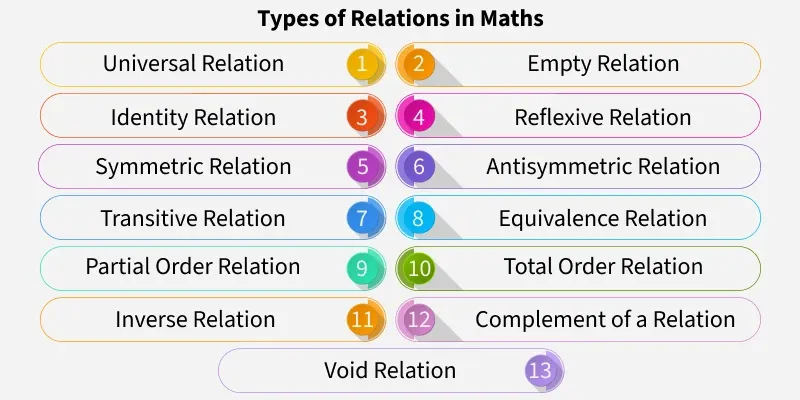
Some of the common types of relations in maths are:
Universal Relation
A universal relation on a set A is one in which every element is related to every other element, including itself. In other words, the relation contains all possible ordered pairs that can be formed from A × A.
Example: For set A = {1, 2}, R = A × A = {(1, 1), (1, 2), (2, 1), (2, 2)}.
Here, every element of A is related to every element, so R is a universal relation.
Empty Relation
An empty relation (or void relation) contains no ordered pairs at all. This means that no element in the set is related to any other element, not even to itself.
Example: For A = {1, 2}, R = ∅.
This means that 1 and 2 are not related in any way.
Identity Relation
An identity relation on a set A is one in which every element is related only to itself. It includes all pairs of the form (a, a).
Example: For A = {1, 2, 3}, R = {(1, 1), (2, 2), (3, 3)}.
Each element is related only to itself, not to others.
Reflexive Relation
A relation R on a set A is a reflexive relation if every element is related to itself. That means (a, a) ∈ R for every a ∈ A.
Example: For A = {1, 2}, R = {(1, 1), (2, 2), (1, 2)}.
then R is reflexive because each element (1 and 2) is related to itself.
Symmetric Relation
A relation R is a symmetric relation if whenever (a, b) ∈ R, then (b, a) ∈ R as well. In simple words, if one element is related to another, the second is also related to the first.
Example: If R = {(1, 2), (2, 1)}, R is symmetric.
then R is symmetric because 1 is related to 2 and 2 is related to 1.
Anti-Symmetric Relation
A relation R is anti-symmetric if whenever (a, b) ∈ R and (b, a) ∈ R, then a = b. That means both (a, b) and (b, a) can exist only if they are the same element.
Example: If R = {(1, 2)}, R is anti-symmetric because there is no pair (2, 1) where a ≠ b.
Transitive Relation
A relation R is a transitive relation if whenever (a, b) ∈ R and (b, c) ∈ R. This means the relation “passes through” — if a is related to b and b is related to c, then a must be related to c.
Example: If R = {(1, 2), (2, 3), (1, 3)}, R is transitive because 1 → 2 and 2 → 3 implies 1 → 3.
Equivalence Relation
A relation is called an equivalence relation if it is reflexive, symmetric, and transitive — all three at once. Equivalence relations group elements into “classes” of items that are equivalent in some way.
Example: The relation “has the same age” among people is an equivalence relation, since it’s reflexive (a person has the same age as themselves), symmetric (if A has the same age as B, then B has the same age as A), and transitive (if A and B have the same age, and B and C have the same age, then A and C have the same age).
Partial Order Relation
A relation R is a partial order if it is reflexive, anti-symmetric, and transitive. Such relations show a kind of “ordering,” though not all elements must be comparable.
Example: The relation “≤” (less than or equal to) on the set of integers is a partial order, since it satisfies all three conditions.
Total Order Relation
A total order is a special type of partial order in which every pair of elements is comparable — for any two elements a and b, either a ≤ b or b ≤ a.
Example: The relation “≤” on the set of real numbers R is a total order since any two real numbers can be compared.
Inverse Relation
The inverse of a relation reverses the order of every pair. If (a, b) ∈ R, then (b, a) ∈ R−1.
Example: If R = {(1, 2), (3, 4)}, then R−1 = {(2, 1), (4, 3)}.
Complement of a Relation
The complement of a relation R on a set A includes all pairs that are not in R but are in A × A.
Example: For A = {1, 2}, R = {(1, 1)}, Rc = {(1, 2), (2, 1), (2, 2)}.
Void Relation
A void relation is another name for an empty relation, meaning it contains no ordered pairs at all. This shows that no elements are related.
Example: For any set A, R = ∅ is void.
Other Types of Relations
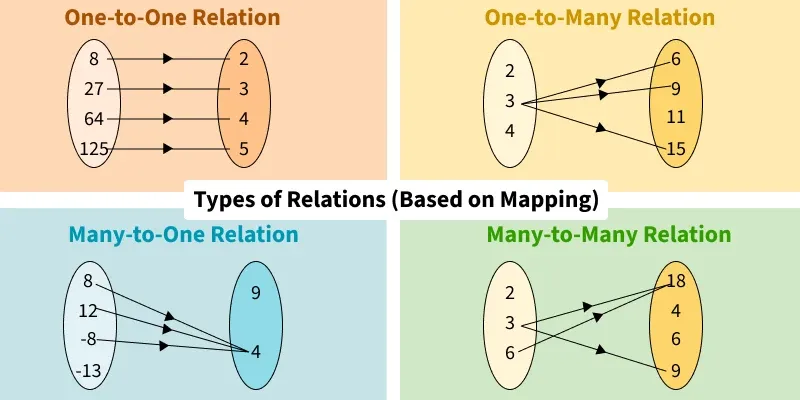
Apart from the property-based relations like reflexive or symmetric, relations can also be classified according to how elements from one set are mapped to elements of another set.
1. One-to-One Relation
A relation is a one-to-one relation if each element of the first set is paired with a unique element of the second set, and no two elements from the first set share the same image.
Example:
Let A = {1, 2, 3} and B = {4, 5, 6}
R = {(1, 4), (2, 5), (3, 6)} is one-to-one.
2. One-to-Many Relation
A relation is one-to-many if a single element of the first set is paired with more than one element of the second set.
Example:
Let A = {1} and B = {4, 5, 6},
R = {(1, 4), (1, 5), (1, 6)} is one-to-many.
3. Many-to-One Relation
A relation is many-to-one if two or more different elements of the first set are paired with the same element of the second set.
Example:
Let A = {1, 2, 3} and B = {4},
R = {(1, 4), (2, 4), (3, 4)} is many-to-one.
4. Many-to-Many Relation
A relation is many-to-many if one or more elements of the first set are paired with multiple elements of the second set.
Example:
Let A = {1, 2} and B = {4, 5},
R = {(1, 4), (1, 5), (2, 4), (2, 5)} is many-to-many.