
A Transitive Relation is one of the necessary conditions for an equivalence relation, as for any relation to be that needs to to Transitive at first.
In a Transitive Relation, if element A is related to element B and element B is related to element C, then there must also be a relationship between element A and element C, following the same rule or relation. In other words, if A relates to B and B relates to C, then A must relate to C.
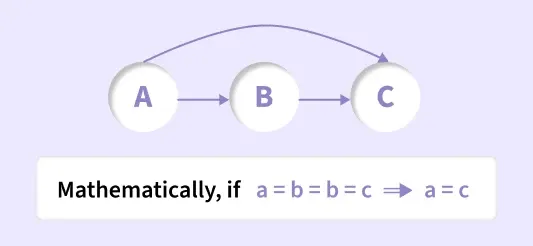
Representation of a Transitive Relation:
If (a, b) ∈ R and (b, c) ∈ R, then (a, c) ∈ R.
Properties of Transitive Relations
Some properties of Transitive Relations are discussed as follows:
Inverse of a Transitive Relation
The inverse of a transitive relation is itself a Transitive Relation
- For example, if "is older than" is a relationship that works in a certain way, then "is younger than" (its opposite) also works the same way.
Union of Two Transitive Relations
- The union of two transitive relations may or may not be a transitive relation.
- Think of it like having two sets of friends. Sometimes, when you bring those two sets together, the way they interact doesn't follow the same patterns as when they're separate.
Intersection of Two Transitive Relations
The intersection of two transitive relations is itself a transitive relation.
- For example, if one group of people likes both chocolate and vanilla ice cream, the fact that they like both flavors still fits the same pattern as when they just liked chocolate or vanilla individually.
Transitive Relation Example
Some examples of transitive relationships are:
- A is a Subset of B
- x is Divisible by y
- A is Equal to B
- △1 is Congruent to △2
- This Implies that
Example: Consider a set of natural numbers and define a relation R as follows: (1, 2), (2, 3), (1, 3). Check if relation R is transitive.
Solution:
(1, 2) and (2, 3) we must verify if (1, 3) also belongs to R.
In this relation:
- (1, 2) implies that 1 is related to 2.
- (2, 3) implies that 2 is related to 3.
- (1, 3) implies that 1 is related to 3.
Since (1, 3) is indeed part of R, we conclude that relation R is transitive.
Other Relations Related to Transitive Relation
Some of the other types of relations related to the concept of transitive relations are:
- Anti-Transitive Relation
- Intransitive Relation
Anti-Transitive Relation
An anti-transitive relationship works differently. If A is connected with B and B is connected with C, then A can't be connected with C. It's the opposite of transitivity and is useful in various mathematical contexts.
Let's define a set of people: {A, B, C, D, E}.
Now, let's define the "is a parent of" relation:
- A is a parent of B.
- B is a parent of C.
In this relation:
- A is related to B because A is the parent of B.
- B is related to C because B is the parent of C.
However, this relation is anti-transitive because it doesn't follow the transitive property:
- A is not related to C. A is not the parent of C.
Intransitive Relation
Intransitive relations don't follow the clear chain rule. If A is connected with B and B is connected with C, then it doesn't guarantee that A is connected with C. Such relations often appear in complex real-world situations.
Consider a relation "feeds on" among animal and their food:
- A feeds on B.
- B feeds on C.
Now, in this relation:
- A is related to B because A feeds on B.
- B is related to C because B feeds on C.
From all this we can't say for sure that A feeds on C, thus this relation is an example of Intransitive Relation.
Solved Examples of Transitive Relation
Example 1: Imagine a set of students and define a relation "is taller than" as follows:
- Alice is taller than Bob.
- Bob is taller than Carol.
We want to know if this relation is transitive.
Solution:
To check for transitivity, we ensure that if A is connected with B and B is connected with C then A must also be connected with C.
Given our relation:
- Alice is taller than Bob.
- Bob is taller than Carol.
According to the transitive property, since Alice is taller than Bob and Bob is taller than Carol, it must be the case that Alice is also taller than Carol for the relation to be transitive.
In this case, Alice is indeed taller than Carol and the is taller than relation is transitive among these students.
Example 2: Let's consider a set of numbers and define a relation "is divisible by" as follows:
- 12 is divisible by 3.
- 3 is divisible by 1.
We want to determine if this relation is transitive.
Solution:
To check for transitivity, we need to ensure that if A is divisible by B and B is divisible by C, then A must also be divisible by C for the relation to be transitive.
Given our relation:
- 12 is divisible by 3.
- 3 is divisible by 1.
According to the transitive property, since 12 is divisible by 3 and 3 is divisible by 1, it must be the case that 12 is also divisible by 1 for the relation to be transitive.
In this case, 12 is indeed divisible by 1 (12 divided by 1 equals 12), and the is divisible by relation is transitive among these numbers.
Example 3: Let's consider a group of animals and define a relation "is a predator of" as follows:
- Animal X is a predator of Animal Y.
- Animal Y is a predator of Animal Z.
We want to determine if this relation is transitive.
Solution:
To check for transitivity, we need to ensure that if Animal X is a predator of Animal Y and Animal Y is a predator of Animal Z, then it must be the case that Animal X is also a predator of Animal Z.
Given our relation:
- Animal X is a predator of Animal Y.
- Animal Y is a predator of Animal Z.
According to the transitive property, for this relation to be transitive, Animal X should also be a predator of Animal Z.
However, this is not always true in real situations. For example, if a snake is a predator of a frog and the frog is a predator of an insect, the snake is not necessarily a predator of the insect.Therefore, the "is a predator of" relation is not transitive among these animals.
Practice Problems on Transitive Relation
Problem 1: Let R be a relation on the set of all integers defined as follows: For any integers a and b, (a, b) is in R if and only if a is a multiple of b. Determine whether R is a transitive relation.
Problem 2: Consider the set A = {1, 2, 3, 4, 5} and define a relation R on A such that (x, y) is in R if and only if x is greater than y. Determine whether R is a transitive relation.
Problem 3: Let S be a set of all people, and define a relation R on S as follows: (x, y) is in R if and only if x is a sibling of y. Determine whether R is a transitive relation.
Problem 4: Given a set A = {a, b, c, d, e}, define a relation R on A such that (x, y) is in R if and only if the sum of the ASCII values of the characters in x is greater than the sum of the ASCII values of the characters in y. Determine whether R is a transitive relation.
Problem 5: Consider a relation R on the set of real numbers defined as follows: (x, y) is in R if and only if |x - y| ≤ 1. Determine whether R is a transitive relation.