
A line is a one-dimensional geometric shape whose sides extend to infinity. There are different types of lines in geometry, based on shape, orientation, and intersection. It is generally represented by a straight line with arrowheads on both ends. The arrowhead represents the indefinite extension.
There are various types of lines in geometry, having various properties and characteristics.
1. Types of Line Based on Shape
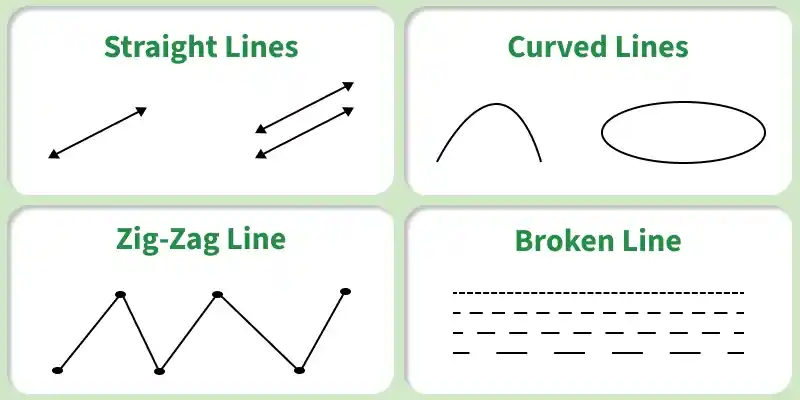
Straight Line
Straight lines are those lines that do not deviate from a linear path even after extending to infinity. These lines are characterized by having the same direction and no curvature at all. We can extend straight lines indefinitely in both directions. A line has the same constant slope (the angle from the positive x-axis).
Curved Line
Curved lines are those lines that have a gradual change in their direction. Their slope changes gradually between different values. Unlike straight lines, they do not follow a linear path. Curved Lines when closed can form various different geometric objects such as circles and ellipses, and when not closed make curvatures like spirals, arcs, parabolas, etc.
Zigzag Line
Zig-zag lines are sharply pointed collections of line segments that have a sudden change in their slope. These lines are made up of a series of connected line segments that have a positive and negative slope in alternate order. These lines resemble a sequence of "Z" or "N" shapes and form a jagged line. The major use case of zigzag lines is in art and graphic design, where these lines are used to represent sudden rapid change or dynamic movement.
Broken Line
Broken lines are a collection of many tiny line segments that are arranged in a straight line, where the length of each line segment can vary depending on the use case. They are also called dashed lines, as these line segments look like dashes.
2. Types of Lines Based on Orientation
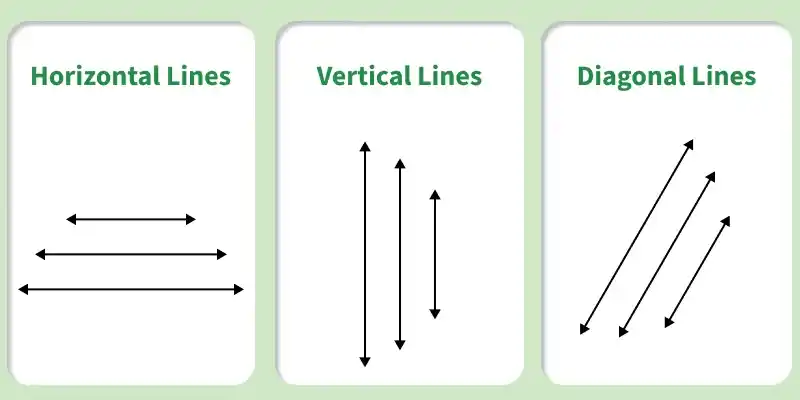
Horizontal Line
Horizontal lines are those lines that are parallel to the horizontal axis, i.e., the x-axis or the ground level. In algebra, we can represent the horizontal lines using the equation y = constant.
Vertical Line
Vertical lines are the opposite of the horizontal lines and are parallel to the vertical axis, i.e., the y-axis. In other words, those lines that are perpendicular to the ground level are called vertical lines. These lines go in the up and down direction and we can see these lines in the real world as poles, multi-floor buildings, columns to support structures, etc.
Diagonal Line
Diagonal lines are lines that go neither in a horizontal direction nor in a vertical direction, as these lines are at that slant whose slope lies between horizontal and vertical. They are also called oblique lines.
3. Types of Lines Based on Intersection
Intersecting Lines
Intersecting lines are two or more lines that meet or cross or intersect at a common point. The point where these lines meet is called the "intersection point."
Bisecting Lines
Bisecting lines are those lines that divide a line segment into two equal parts. That object can be an angle, a triangle, any polygon, or a line segment. They pass through the midpoint of the object. Bisecting lines are commonly used in geometry to divide angles or line segments equally.
Perpendicular Lines
Perpendicular lines are those intersecting lines that make a right angle with each other. One such pair of perpendicular lines is vertical and horizontal lines if they intersect. When two lines are perpendicular, the slope of one line is the negative reciprocal of the slope of the other. In algebra, perpendicular lines have different equations, but their slopes are related through this negative reciprocal relationship. For example, the lines
Parallel Lines
Parallel lines are the opposite of intersecting lines, i.e., they never intersect, no matter how far they are extended. All the parallel lines have the same slope but different y-intercepts. In algebra, all the parallel lines have similar equations except for the constant part. For example, the lines
Transversal Lines
Transversal lines are those lines that intersect two or more other lines. For two lines, transversal lines form 8 angles, and in the case of parallel lines, these 8 angles show various properties and relationships. Some of these angles are corresponding angles, alternate interior angles, alternate exterior angles, and consecutive interior angles.
Special Types of Lines
There are various special types of lines in geometry, which are: