
Intersecting lines are those lines that interact with each other at one point, forming an intersection point. Also, at the intersection of two lines, four angles are formed. These angles form pairs of equal angles, i.e., vertical opposite angles.
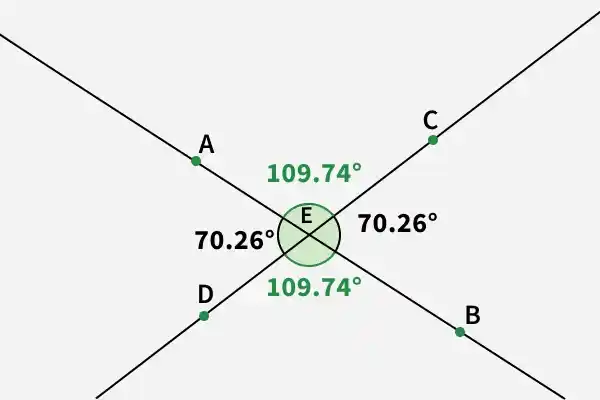
In everyday life, intersecting lines can be easily seen. For instance, the spokes of a bicycle wheel intersect at the hub, and the lines of latitude and longitude on a map intersect to pinpoint locations.
- Shape of a plus sign (+)
- Corners of a rectangular windowpane
- Crisscrossing roads on a city map
- X marks on a treasure map
- The structure of a tic-tac-toe game board
- Railway tracks crossing each other at junctions
- Gridlines on graph paper where they intersect.
Properties of Intersecting Lines
- Intersecting lines share a common point called the point of intersection.
- They create four angles at the point of intersection, i.e., two pair of opposite angles or two pairs of adjacent angles
- Intersecting lines can meet at any angle, from 0° to 180°, and they can only meet at one common point.
- No two straight lines can meet at more than one point.
- When two lines intersect each other, they form a pair of vertical angles that share a common vertex, or the point of intersection, and are faced opposite to each other. The vertical angles are always equal to each other.
Mathematical Representation of Intersecting Lines
For a1x + b1y = c1 and a2x + b2x = c2, the graphs of both lines will intersect at one point, i.e., point of intersection, if
\frac{a_1}{a_2} ≠ \frac{b_1}{b_2}
Note: If a1/a2 = b1/b2, then we can check c1/c2 to verify further that the lines are parallel or coincident.
Types of Intersecting Lines
Intersecting lines can be classified into different types based on their orientation and relationship to each other.
- Perpendicular Lines: Lines that intersect at a 90-degree angle.
- Non-Perpendicular Lines: Any two pairs of lines that are intersecting each other but the angle between them is not 90° are called non-perpendicular lines.
Other than these, there can some other relationships between two lines, i.e.,
- Skew Lines: Skew lines refer to pairs of non-parallel straight lines in three-dimensional space that do not lie within a common plane.
- Coincident Lines: Those lines that lie on top of each other, i.e., have the same slope and same intercepts.
Intersection of Three Lines
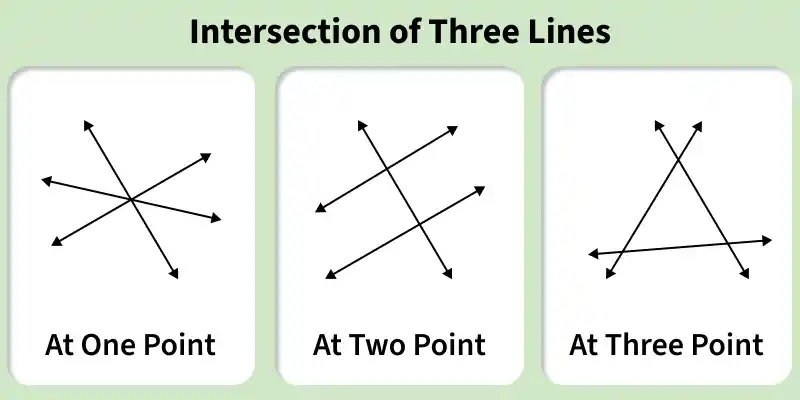
The intersection of three lines can result in different configurations ranging from a single point of intersection to the formation of closed shapes like triangles. There are three possibilities of intersection of three lines:
- Intersection At One Point
- Intersection at Two Points
- Intersection at Three Points
Theorems Related to Intersecting Lines
Some theorems that are related to the intersecting lines are
Vertical Angles Theorem
Vertical Angles Theorem states that when two lines intersect, the vertical (opposite) angles are always equal (congruent) to each other.
Note: When two lines intersect, they form four angles. Among these, there are two pairs of nonadjacent angles known as vertical angles.
Alternate Interior Angles Theorem
When a transversal intersects two parallel lines, it creates several angles. Among these, the alternate interior angles are the ones formed on the opposite sides of the transversal but inside the parallel lines.
According to alternate interior angle theorem,
If a transversal crosses a set of parallel lines, the alternate interior angles are congruent.
Non-Intersecting Lines
Non-intersecting lines are lines that do not cross or meet each other at any point. In geometry, such lines are called parallel lines.
Some of the most common properties of non-intersecting or parallel lines are
- Non-intersecting lines never meet each other at any point, no matter how far they are extended in either direction.
- The perpendicular distance between two non-intersecting (parallel) lines is always the same.
- When a transversal line intersects two non-intersecting (parallel) lines, several pairs of angles are formed:
Note: Corresponding angles, Alternate interior angles and Alternate exterior angles are always equal.
Parallel and Intersecting Lines
Parallel and intersecting lines are two distinct types of lines in geometry. Parallel lines never intersect with each other, while intersecting lines meet at a common point.
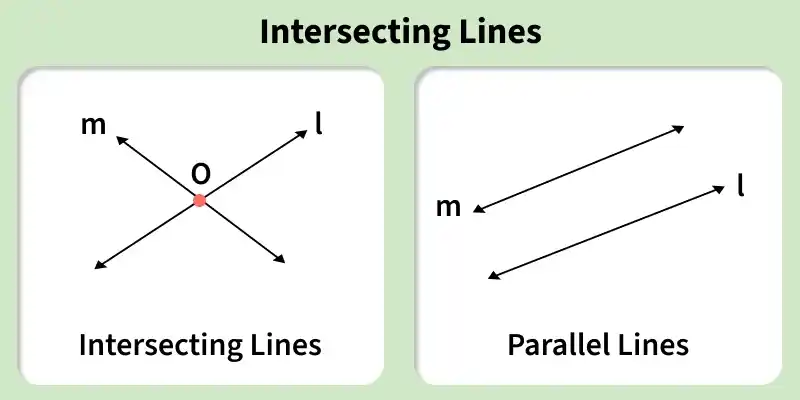
Some other differences between parallel and intersecting lines include
| Parallel Lines | Intersecting Lines |
|---|---|
| Two or more lines that are equidistant from each other and never intersect. | Lines that meet or intersect at a common point. |
| Railway tracks, notebook lines, zebra crossings. | Crossing roads, intersecting lines on graphs. |
|
|
| If two line equations are y = mx + c1 and y = mx + c2, then both lines have the same slope. Thus, both are parallel. | For a1x + b1y = c1 and a2x + b2x = c2, If a1/a2 ≠ b1/b2, then both lines have one point of intersection. |