
SOHCAHTOA (pronounced as "soh-kah-toe-ah") is a simple way to remember the trigonometry rules for a right-angled triangle. The trigonometry ratios are: sine(sin), cosine(cos), and tangent (tan).
The calculation simply involves one side of a right-angle triangle divided by another side. We need to know which side, and that is where SOHCAHTOA helps.
Below is the visual representation of the SOHCAHTOA triangle:
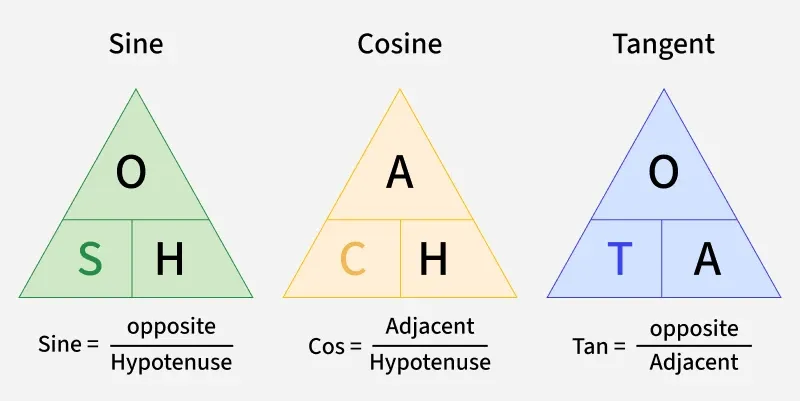
Table of Content
SOHCAHTOA Formula
- SOH: Sine(sin) = Opposite / Hypotenuse
- CAH: Cosine(cos) = Adjacent / Hypotenuse
- TOA: Tangent(tan) = Opposite / Adjacent
This helps you easily remember which sides of the triangle correspond to each trigonometric function. Here’s a breakdown:
- Sine uses the opposite side and the hypotenuse.
- Cosine uses the adjacent side and the hypotenuse.
- Tangent uses the opposite side and the adjacent side.
How to label the sides of a right-angle triangle?
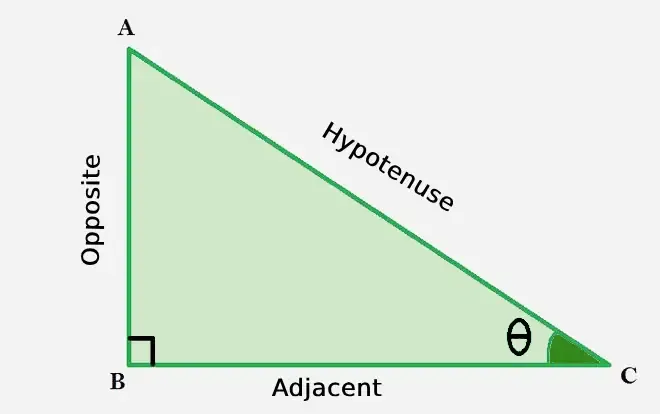
- The hypotenuse (AC) is the longest side of the triangle. It is the opposite side of a right angle.
- The opposite side (AB) is the side opposite side to the angle.
- The adjacent side (BC) is next to the angle.
When to use SOHCAHTOA?
To use SOHCAHTOA, we need to know certain measures of a right-angle triangle:
- We can use SOHCAHTOA if we know two sides of the triangle.
- We can use SOHCAHTOA if we know one side and one angle of a right angle.
SOHCAHTOA Memory Summary:
- Students Our Homework Can Help To Overcome Algebra.
- Silly Owls Hide Cake And Honey Till October Arrives.
Find Unknown angles using SOHCAHTOA.
Calculate the side of the right angle labeled as x.
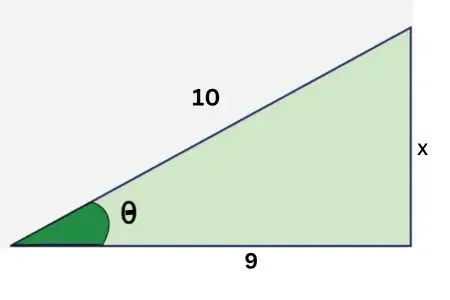
Step 1: Label the sides of the right triangle with respect to one of the acute angles.
- The side marked as 9 cm is next to angle, so it is adjacent side.
- The side marked as 10 cm is hypotenuse because it is across from the right angle.
Step 2: Finding the angle θ using trigonometry:
To find angle θ, we will use the cosine function.
- According to SOHCAHTOA, the cosine function (C) is the ratio of the Adjacent side (A) to the Hypotenuse(H):
cos θ = Adjacent (A) / Hypotenuse (H)- As we are finding angle ,use the inverse cosine function.
θ = cos -1 = ( A / H)- Substitute the two known side length into the formula.
θ = cos -1 ( 9/ 10 )- Using a calculator to find the inverse cosine:
θ = cos-1 ( 9/ 10 ) = 25.84So, the missing angle θ is approximately 25.84°.
Finding the missing side
Calculate the side of the right angle labeled as x.
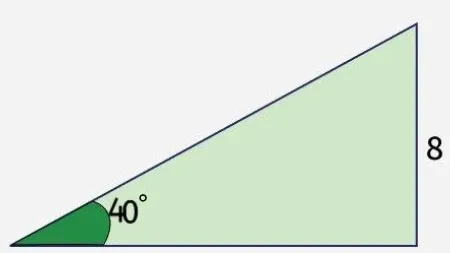
Step 1: Label the sides of the right triangle with respect to one of the acute angles.
- The hypotenuse (H) is given as 8 cm.
- The opposite side (O) is the side that we need to find, labeled as x.
- The adjacent side is not relevant to this calculation.
Step 2: Determine the trigonometric ratio to use and write the formula with the correct subject.
- Since we are dealing with the opposite side and the hypotenuse, we will use the sine function from SOHCAHTOA.
- The sine function is sin θ = Opposite (O) / Hypotenuse (H)
- To find the opposite side( O ), rearrange the formula by covering up the opposite side:
O = H × sin θStep 3: Substitute known values into the formula.
- The hypotenuse (H) is 8 cm, and the angle (θ) is 40°.
- Now substitute these values into the fromula:
O = 8 × sin (40°)- Using a calculator to find sin(40∘):
sin(40∘) ≈ 0.6428- Now calculate O:
O = 8 × 0.6428 = 5.14 cmSo, the missing opposite side x is approximately 5.14 cm.
SOHCAHTOA Inverse
The inverse trigonometric functions are used to find angles when you know the ratios of the sides of a right triangle. Here's how to apply the inverse functions based on SOHCAHTOA:
- Inverse sine (sin−1: θ = sin−1
( \dfrac{\text{Opposite}}{\text{Hypotenuse}}) - Inverse cosine (cos−1: θ = cos−1
( \dfrac{\text{Adjacent}}{\text{Hypotenuse}}) - Inverse tangent (tan−1: θ = tan−1
( \dfrac{\text{Opposite}}{\text{Adjacent}})
Mistakes to Avoid
- Use the incorrect mode of calculator- When calculating side or angle measurement using one of the trigonometric ratios, be sure that the calculator is in degree mode, not in radian mode.
- Using SOHCAHTOA for non-right angle - if a triangle does not have a 90-degree angle, try to use the cosine and sine rule rather than SOHCAHTOA.
- Forgetting to use the inverse trigonometric function for angles - if solving for angles, always use the inverse trigonometric function instead of the regular trigonometric ratio.
Solved Examples on SOHCAHTOA
Question 1: Given a right-angled triangle, with base equals 6cm, perpendicular equals 8cm and hypotenuse equals 10cm. Find the value of sinθ, cosθ, and tanθ.
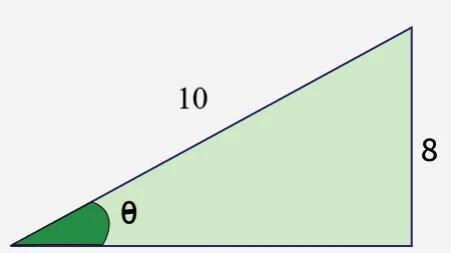
Solution:
Given,
Opposite = 6 cm
Adjacent = 8 cm
Hypotenuse = 10 cmsinθ = Opposite / Hypotenuse
sinθ = 6 / 10 = 0.6
cosθ = Adjacent/ Hypotenuse
cosθ = 8 / 10 = 0.8
tanθ = Opposite / Adjacent
tanθ = 6 / 8 = 0.75The values are 0.6 , 0.8 and 0.75.
Question 2: Use the triangle below to find the values of sinθ, cosθ, tanθ, secθ, cotθ, and cosecθ.
Solution:
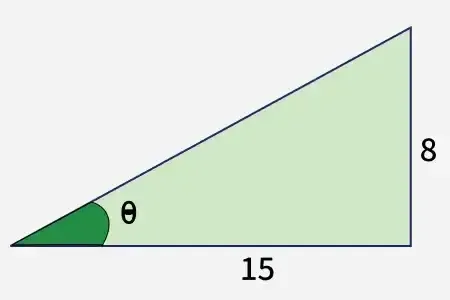
First we need to find length of hypotenuse through pythagorean theorem,
(Hypotenuse) 2 = (Perpendicular) 2 + (Base) 2
C 2 = ( 15 ) 2+ ( 8 ) 2
C 2 = 225 + 64
C 2 = 289
C 2 = √ 17
C = 17sin θ = Opposite / Hypotenuse
sin θ = 15 / 17
cos θ = Adjacent/ Hypotenuse
cos θ = 8 / 17
tan θ = Opposite / Adjacent
tan θ = 15 / 8
sec θ = Hypotenuse /Adjacent
sec θ = 17 /8
cosec θ = Hypotenuse / Opposite
cosec θ = 17 /15
cot θ = Adjacent / Opposite
cot θ = 8 / 15
Related article