
Sine, Cosine, and Tangent are the building blocks of trigonometry, providing essential tools for understanding the relationships between the angles and sides of a right-angle triangle.
Sine, Cosine, and Tangent are more than just mathematical concepts; they are the foundation of countless applications in science, engineering, and everyday problem-solving. Whether you're calculating heights or solving triangles, understanding sine, cosine, and tangent is crucial.
It is also used in astronomy to find the distance between stars or planets and is widely used in physics, architecture, and GPS navigation systems. Trigonometry is based on the principle that "If two triangles have the same set of angles, then their sides are in the same ratio". Side length can be different, but side ratios are the same.
Understanding the Right Angle Triangle
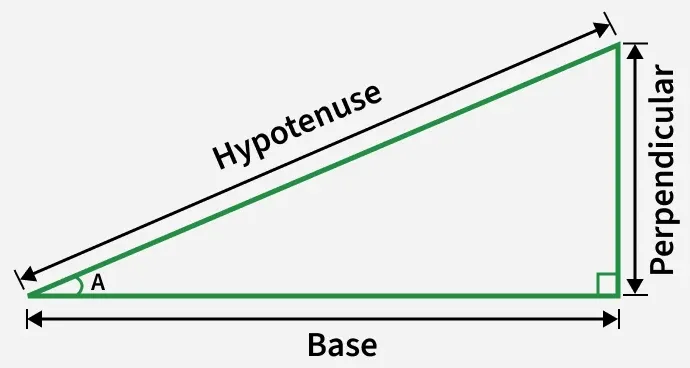
Trigonometric ratios are defined only for a right-angle triangle. In a right-angled triangle, there is a 90° angle and the other two angles are less than 90°, concerning these angles each side is named perpendicular base and hypotenuse. Let's see what the Perpendicular, base, and hypotenuse of a right-angled triangle are,
- Hypotenuse: It is a side opposite to 90°. it is the largest side.
- Perpendicular: The side in front of the angle or opposite to an angle is perpendicular.
- Base: A base is one of the sides which touches an angle.
Note Hypotenuse can never be considered as base or perpendicular.
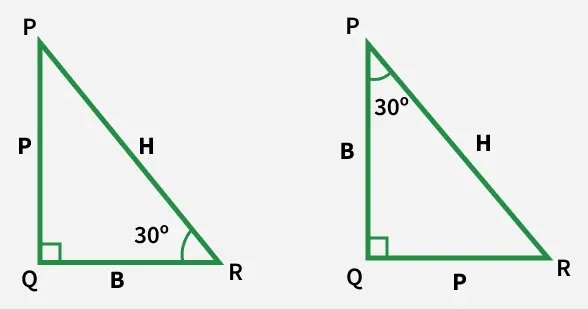
As shown in the above diagram for the same triangle if considered angle 30° the perpendicular is the side PQ, but if considered angle 60° the perpendicular is side QR.
In a right angle triangle, for angle other than 90° is formed by two sides of which one is the hypotenuse. the other side which contains or touches the angle is the base and the side which do not touches the angle is perpendicular.
Trigonometric Ratios
Trigonometric functions are also called circular functions or trigonometric ratios. are the ratios of the side of a right-angle triangle, They show the relationship between angle and sides, and they are the base of trigonometry. There are six trigonometric functions Sine, Cosine, Tangent, Cosecant, Secant, Cotangent. The sides representations for the six ratios are,
- sin A = Perpendicular / Hypotenuse
- cos A = Base / Hypotenuse
- tan A = Perpendicular / Base
- cot A = Base / Perpendicular
- sec A = Hypotenuse / Base
- cosec A = Hypotenuse / Perpendicular.
Trigonometric Ratios for Some Important Angles
To calculate these ratios find the length of the sides of the triangle and then take ratios respectively. In order to find length if one of the sides and angle is known, one can easily find the rest of the sides through sine, cos and tan angle. Below is the trigonometric angle values of some important angles.
Sin, Cos and Tan Chart
| Angles (in degrees) | 0° | 30° | 45° | 60° | 90° |
|---|---|---|---|---|---|
| Sin θ | 0 | 1/2 | 1/√2 | √3/2 | 1 |
| Cos θ | 1 | √3/2 | 1/√2 | 1/2 | 0 |
| Tan θ | 0 | 1/√3 | 1 | √3 | ∞ |
| Cot θ | ∞ | √3 | 1 | 1/√3 | 0 |
| Sec θ | 1 | 2/√3 | √2 | 2 | ∞ |
| Cosec θ | ∞ | 2 | √2 | √3/2 | 1 |
Related Articles:
Sample Problems
Question 1: Consider the following triangle and answer the question below?
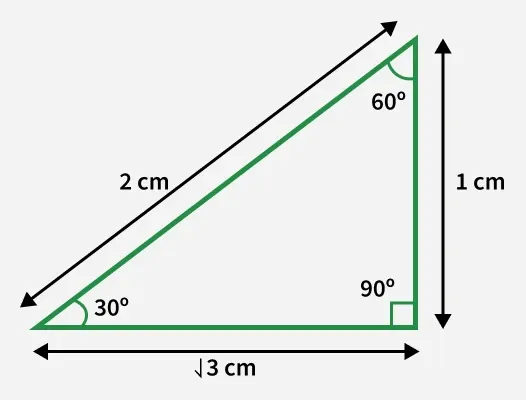
Find the value of sin, cos, and tan for angle 30°
Solution:
For angle 30°
perpendicular = 1cm, base = √3cm, hypotenuse = 2cm.
Sin(30°) = (p/h) = 1/2.
Cos(30°) = (b/h) = √3/2.
tan(30°) = (p/b) = 1/√3.
Question 2. For the same figure in question 1, find the value of sin, cos, and tan for angle 60°
Solution:
For angle 60°
perpendicular = √3cm, base = 1cm, hypotenuse = 2cm.
Sin(60°) = (p/h) = √3/2.
Cos(60°) = (b/h) = 1/2.
tan(60°) = (p/b) = √3/1.
Question 3: In a right-angled triangle, the side opposite to the angle 30° is 14m. Find the length of the Hypotenuse.
Solution:
Given: Perpendicular = 14m
Sin 30 = 1/2
P/H = 1/2
14/H = 1/2
H = 14 × 2
H = 28m.
Question 4: In a right-angled triangle, the base to the angle 30° is 18m. Find the length of the Hypotenuse.
Solution:
Given: Base = 18m
Cos = √3/2
B/H = √3/2
18/H = √3/2
H = (18 × 2) / √3
H = 12√3m