
An Involutory Matrix is defined as a matrix that follows self self-inverse function, i.e., the inverse of the Involutory matrix is the matrix itself.
- A square matrix "P" is said to be an involutory matrix if its inverse is the original matrix itself, i.e., P = P-1.
- A square matrix is said to be an involutory matrix that, when multiplied by itself, gives an identity matrix of the same order. i.e P × P = I
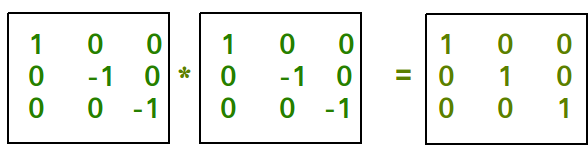
Only square and invertible matrices can be Involutory Matrices.
- The inverse of the matrix is defined as the matrix that, when multiplied by the original matrix, gives the identity matrix. i.e A × A-1 = I.
- A square matrix is a matrix that has the same number of rows and columns (dimension: m × m).
Examples of Involutory Matrix
- The matrix given below is an involutory matrix of order "2 × 2."
P_{22} = \left[\begin{array}{cc} 2 & 1\\ -3 & -2 \end{array}\right]
- The matrix given below is an involutory matrix of order "3 × 3."
Q_{33} = \left[\begin{array}{ccc} 1 & 0 & 0\\ 0 & 0 & 1\\ 0 & 1 & 0 \end{array}\right]
Involutory Matrix Formula
Let us consider a "2 × 2" square matrix
A = \left[\begin{array}{cc} a & b\\ c & d \end{array}\right] . The given matrix is said to be an involutory matrix if satisfies the condition A2 = I
A^{2} = \left[\begin{array}{cc} a & b\\ c & d \end{array}\right] \times \left[\begin{array}{cc} a & b\\ c & d \end{array}\right] = \left[\begin{array}{cc} 1 & 0\\ 0 & 1 \end{array}\right]
A^{2} = \left[\begin{array}{cc} a^{2}+bc & ab+bd\\ ac+cd & bc+d^{2} \end{array}\right] = \left[\begin{array}{cc} 1 & 0\\ 0 & 1 \end{array}\right] Now, comparing the terms on each side, we get
a2 + bc = 1
ab + bd = 0
b (a + d) = 0
b = 0 or a + d = 0
d = −a
So, a square matrix
A = \left[\begin{array}{cc} a & b\\ c & d \end{array}\right] is said to be an involutory matrix if
- a2 + bc = 1
- d = −a
Properties of Involutory Matrix
The following are some important properties of an involutory matrix:
- A square matrix "A" of any order is said to be involutory if and only if A2 = I or A = A-1.
- If A and B are two involutory matrices of the same order and AB = BA, then AB is also an involutory matrix.
- The determinant of an involutory matrix is always either -1 or +1.
- If "A" is an involutory matrix of any order, then An = I if n is even and An = A if n is odd, where n is an integer.
- If a block diagonal matrix is derived from an involutory matrix, then the obtained matrix is also involutory.
- The eigenvalues of an involutory matrix are always either -1 or +1.
- A symmetric involutory matrix is orthogonal, and vice versa.
- An involutory matrix "A" can also be an idempotent matrix if "A" is an identity matrix.
- The following is the relationship between idempotent and involutory matrices: A square matrix "A" is said to be an involutory matrix if and only if A = ½ (B + I), where B is an idempotent matrix.
Related Articles
Solved Examples on Involutory Matrix
Example 1: Verify whether the matrix given below is involutory or not.
Solution:
To prove that the given matrix is involutory, we have to prove that A2 = A.
A^{2} = \left[\begin{array}{ccc} 2 & 0 & 1\\ 0 & -1 & 0\\ -3 & 0 & -2 \end{array}\right] \times\left[\begin{array}{ccc} 2 & 0 & 1\\ 0 & -1 & 0\\ -3 & 0 & -2 \end{array}\right]
A^{2} = \left[\begin{array}{ccc} (4+0-3) & (0+0+0) & (2+0-2)\\ (0+0+0) & (0+1+0) & (0+0+0)\\ (-6+0+6) & (0+0+0) & (-3+0+4) \end{array}\right]
A^{2} = \left[\begin{array}{ccc} 1 & 0 & 0\\ 0 & 1 & 0\\ 0 & 0 & 1 \end{array}\right] = I Hence, verified.
So, the given matrix A is an involutory matrix.
Example 2: Give an example of an involutory matrix of order 2 × 2.
Solution:
A matrix
A = \left[\begin{array}{cc} a & b\\ c & d \end{array}\right] is said to be an involutory matrix, if a2 + bc = 1.Let us consider that a = 3, b = 4, c = −2 such that a2 + bc = 1.
(3)2 + (4) × (−2) = 9 − 8 = 1
We know that d = −a.
So, the involutory matrix is
A = \left[\begin{array}{cc} 3 & 4\\ -2 & -3 \end{array}\right] .
Example 3: Prove that the matrix given below is involutory.
Solution:
To prove that the given matrix is involutory, we have to prove that B = B-1.
B-1 = Adj B/ |B|
Adj B = \left[\begin{array}{cc} -7 & -6\\ 8 & 7 \end{array}\right] |B| = −49 − (−48) = −1
B^{-1} = \frac{1}{-1}\left[\begin{array}{cc} -7 & -6\\ 8 & 7 \end{array}\right] = \left[\begin{array}{cc} -(-7) & -(-6)\\ -8 & -7 \end{array}\right]
B^{-1} = \left[\begin{array}{cc} 7 & 6\\ -8 & -7 \end{array}\right] = B Hence, the given matrix is involutory.
Example 4: Prove that the determinant of the involutory matrix given below is always ±1.
Solution:
Let us consider of an involutory matrix "P" of order "n × n" to prove that its determinant is always ±1.
We know that a square matrix "P" is said to be involutory if and only if P2 = I.
P × P = I
Now, |P| × |P| = |I|
We know that the determinant of an identity matrix of any order is 1.
(|P|)2 = 1
|P| = √1 = ±1
Thus, the determinant of an involutory matrix of any order is always ±1.
Hence proved.