
The determinant of a matrix is a scalar value that can be calculated for a square matrix (a matrix with the same number of rows and columns).
- It serves as a scaling factor that is used for the transformation of a matrix.
- It is a single numerical value that plays a key role in various matrix operations, such as calculating the inverse of a matrix or solving systems of linear equations.
- The determinant of a matrix A is denoted by ∣A∣ or sometimes as det(A).
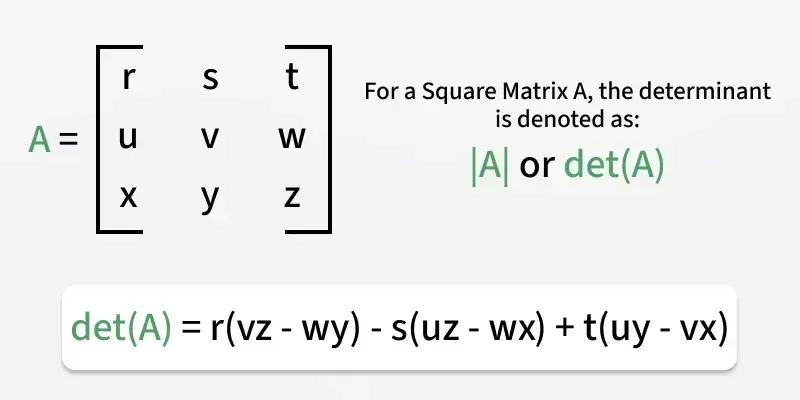
The determinant is defined only for square matrices of any order 2×2, 3×3, 4×4, or n×n, where n is the number of rows or the number of columns. (For a square matrix, the number of rows and columns is equal.)
Determinant of Matrix Calculator
A Determinant of Matrix calculator is a tool used to compute the determinant of a matrix quickly and accurately.
Determinants of Different Types of Matrices
To understand how determinants are evaluated, let us go through the process step by step, starting from the simplest 1×1 matrix and gradually moving to more complex and special cases.
1×1 Matrix
Let X = [a] be the matrix of order one, then its determinant is given by det(X) = a.
2×2 Matrix
The determinant of any 2×2 square matrix A = \begin{bmatrix}a
|A| = ad - bc.
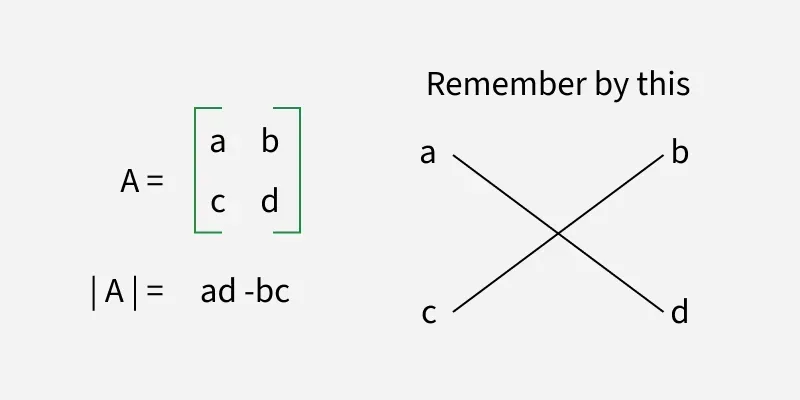
Example: Find the Determinant of A =
Solution:
Determinant of A =
\begin{bmatrix}3 & 2\\2 & 3\end{bmatrix}_{2\times2} is calculated as,| A | =
\begin{vmatrix}3 & 2\\2 & 3\end{vmatrix} | A | = 3 × 3 - 2 × 2
= 9 - 4
= 5
3×3 Matrix
The determinant of a 3x3 Matrix is determined by expressing it in terms of 2nd-order determinants. It can be expanded either along rows(R1, R2 or R3) or column(C1 , C2 or C3).

Similarly, in this way, we can expand it along any row and any column.
Example: Evaluate the determinant det(A) =
Solution:
We see that the third column has most number of zeros, so it will be easier to expand along that column.
det(A) =
(-1)^{1 + 3}0\begin{vmatrix}4 & 1 \\ 2 & 0 \end{vmatrix} + (-1)^{2 + 3}0\begin{vmatrix}1 & 3 \\ 2 & 0 \end{vmatrix} + (-1)^{1 + 3}1\begin{vmatrix}1 & 3 \\ 4 & 1 \end{vmatrix} \\ = -11
Sarrus' Rule
There is a simple trick to find the determinant of a 3×3 matrix, which is given in the image below:
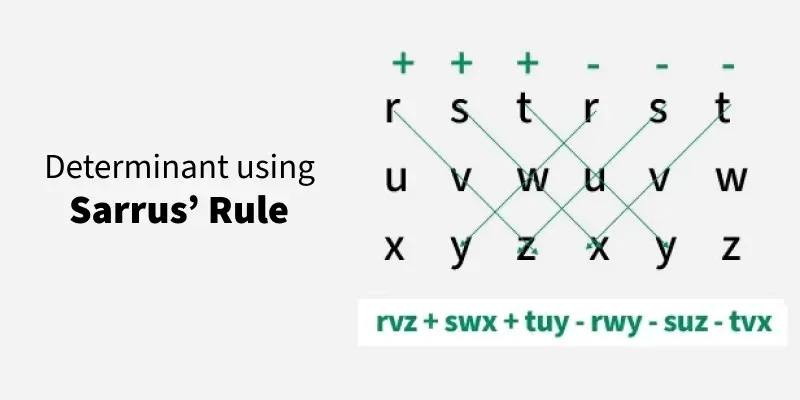
- Sarrus’ Rule is a straightforward and visual method for calculating the determinant of a 3×3 matrix.
- It is only applicable to 3×3 matrices and provides a quick alternative to row or column expansion methods.
Subtract the sum of the upward diagonal products from the sum of the downward diagonal products:
det(A) rvz + swx + tuy − rwy − suz − tvx
Example: Find the Determinant of the matrix using Sarrus' Rule only.
Matrix A =
Upon applying Sarru's Rule:
\begin{bmatrix} + & + & + & - & - & - \\ 1 & 2 & 3 & 1 & 2 & 3\\ 4 & 5 & 6 & 4 & 5 & 6\\ 7 & 8 & 9 & 7 & 8 & 9 \\ \end{bmatrix} = (1×5×9) + (2×6×7 )+ (3×4×8) - (1×6×8) - 2×4×9 - 3×5×7
= 45 + 84 + 96 - 48 - 72 - 105
= 225 - 225
= 0
This method is specifically for 3×3 matrices and provides a quick way to find the determinant.
4×4 Matrix
Determining the determinant of a 4 × 4 matrix involves more complex methods, such as expansion by minors or Gaussian elimination. These techniques require breaking down the matrix into smaller submatrices and recursively finding their determinants. While there isn't a direct formula like Sarrus' Rule for 3x3 matrices, the process involves systematic calculations based on the properties of determinants.

Identity Matrix
An identity matrix is a square matrix in which all the elements of the main diagonal are ones, and all other elements are zeros. For example, a 3x3 identity matrix looks like this:
I = \begin{vmatrix} 1 & 0 & 0 \\ 0 & 1 & 0 \\ 0 & 0 & 1 \end{vmatrix}
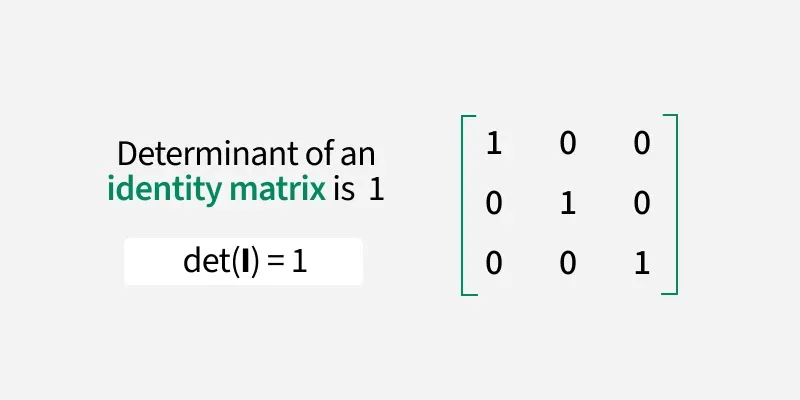
The determinant of an identity matrix of any size is always 1. This property can be understood intuitively by considering that the identity matrix represents a transformation that leaves vectors unchanged when multiplied by it. Since the determinant measures how a matrix scales the space, the determinant of an identity matrix, which doesn't scale the space at all, is 1.
Mathematically, we can express this as:
det (𝜤) = 1
Symmetric Matrix
A symmetric matrix is a square matrix that is equal to its transpose. In other words, if A is a symmetric matrix, then A = Aᵀ.
Symmetric matrices have several interesting properties, one of which is that their determinants remain unchanged under transpose.
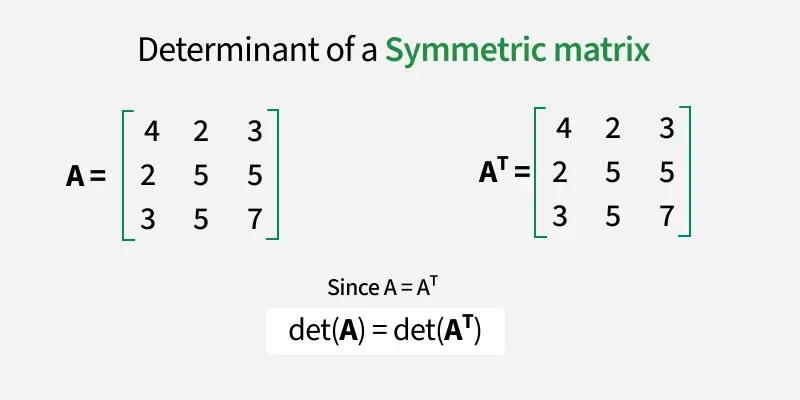
Hence, for a symmetric matrix A, we have:
det(A) = det( A T )
This property simplifies the computation of determinants for symmetric matrices since you can work with either the original matrix or its transpose, whichever is more convenient.
Skew-Symmetric Matrix
A skew-symmetric (or antisymmetric) matrix is a square matrix whose transpose is equal to its negative. In other words, if A is a skew-symmetric matrix, then A = −AT. Skew-symmetric matrices have interesting properties, one of which is that their determinants have specific values based on the order of the matrix.
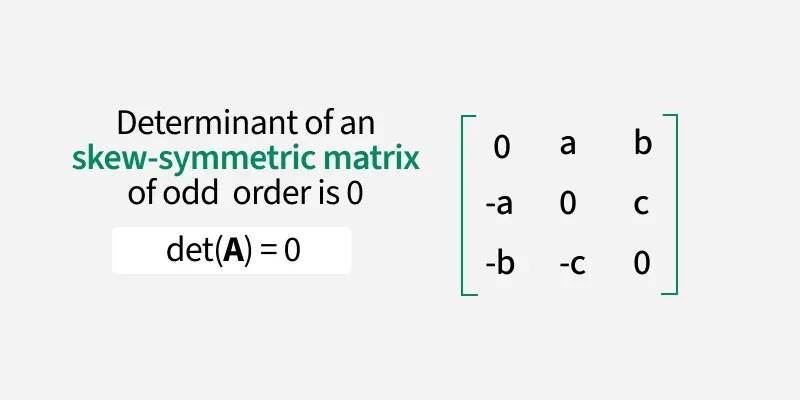
For skew-symmetric matrices of odd order, the determinant is always 0. This is because the determinant of a skew-symmetric matrix is always the square of its eigenvalues, and a non-zero square is always positive. Since the order of the matrix is odd, at least one eigenvalue must be zero, resulting in a determinant of 0.
For skew-symmetric matrices of even order, the determinant is a non-zero value, which can be calculated based on the elements of the matrix. However, determining the exact value typically involves more complex methods such as cofactor expansion or using properties of determinants.
Inverse Matrix
To understand the determinant of the inverse matrix, let's first define the inverse of a matrix
The inverse of a square matrix A, denoted as A⁻¹, is a matrix such that when it's multiplied by A, the result is the identity matrix I. Mathematically, if A⋅A⁻¹ = I, then A⁻¹ is the inverse of A.
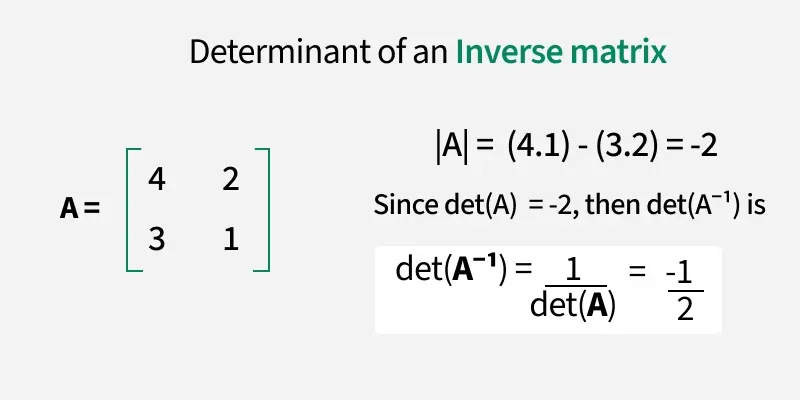
Now, the determinant of the inverse matrix, denoted as det(A−1), is related to the determinant of the original matrix A. Specifically, it can be expressed by the formula:
det(A −1) = 1/det(A)
This formula illustrates an important relationship between the determinants of a matrix and its inverse. If the determinant of A is non-zero, meaning det(A) ≠ 0, then the inverse matrix exists, and its determinant is the reciprocal of the determinant of A. Conversely, if (A) = 0, then the matrix A is said to be singular, and it does not have an inverse.
Here are some key points about the determinant of the inverse matrix:
- Non-Singular Matrices: For non-singular matrices (those with non-zero determinants), their inverses exist, and the determinant of the inverse is the reciprocal of the determinant of the original matrix.
- Singular Matrices: Singular matrices (those with zero determinants) do not have inverses. Attempting to find the inverse of a singular matrix results in an undefined or non-existent inverse.
- Geometric Interpretation: The Determinant of the Matrix measures how it scales the space. Similarly, the determinant of the inverse matrix measures the scaling effect of the inverse transformation. If the original transformation expands the space, its inverse contraction will be inversely proportional, and vice versa.
Orthogonal Matrix
An orthogonal matrix is a square matrix whose rows and columns are orthonormal vectors, meaning that the dot product of any two distinct rows or columns equals zero, and the dot product of each row or column with itself equals one. Mathematically, if A is an orthogonal matrix, then Aᵀ ⋅ A = I, where Aᵀ denotes the transpose of A and I represents the identity matrix.
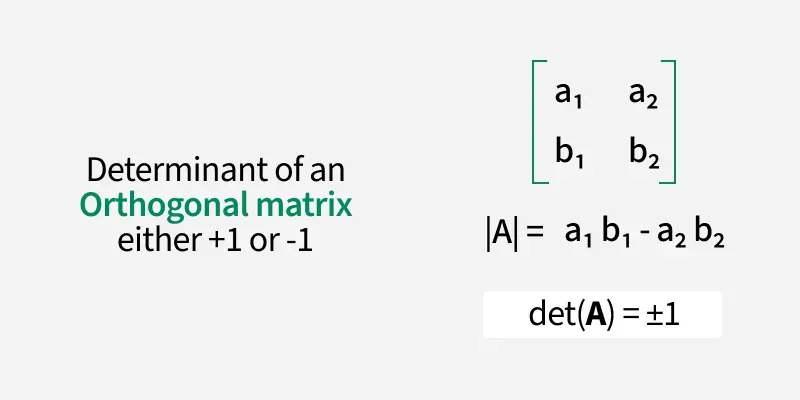
The determinant of an orthogonal matrix has a special property:
det ( A ) = ±1
The determinant of an orthogonal matrix is either +1 or −1. This property arises from the fact that the determinant represents the scaling factor of the matrix transformation. Since orthogonal transformations preserve lengths, the determinant must be either positive (for preserving orientation) or negative (for reversing orientation).
The determinant of an orthogonal matrix being +1 implies that the transformation preserves orientation, while a determinant of −1 indicates a transformation that reverses orientation.
Triangular Matrix
A triangular matrix is a special type of square matrix in which all the elements above or below the main diagonal are zero.

There are two main types:
1) Lower Triangular Matrix:
- A square matrix in which all elements above the main diagonal are zero.
- Example:
\begin{bmatrix} a_{11} & 0 & 0 \\ a_{21} & a_{22} & 0 \\ a_{31} & a_{32} & a_{33} \end{bmatrix}
2) Upper Triangular Matrix:
- A square matrix in which all elements below the main diagonal are zero.
- Example:
\begin{bmatrix} a_{11} & a_{12} & a_{13} \\ 0 & a_{22} & a_{23} \\ 0 & 0 & a_{33} \end{bmatrix}
Physical Significance of Determinant
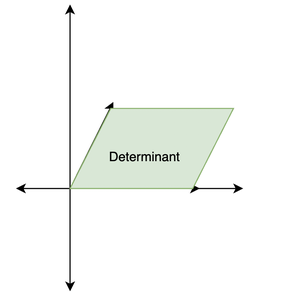
Consider a 2D matrix; each column of this matrix can be considered as a vector on the x-y plane. So, the determinant between two vectors on a 2d plane gives us the area enclosed between them. If we extend this concept, in 3D the determinant will give us the volume enclosed between two vectors.
Laplace Formula for Determinant
Laplace’s formula is used to express the Determinant of a Matrix in terms of the minors of the matrix.
If An×n is the given square matrix and Cij is the cofactor of Aij, the solution for any row i or column j
det (A) =
\sum_{i =1}^{n}A_{ij}C_{ij}
Properties of Determinants of a Matrix
Various Properties of the Determinants of the square matrix are discussed below:
- Reflection Property: The Value of the determinant remains unchanged even after rows and columns are interchanged. The Determinant of a Matrix and its transpose remain the same.
- Switching Property: If any two rows or columns of a determinant are interchanged, then the sign of the determinant changes.
- Scalar Multiplication Property: If one row (or one column) of a matrix A is multiplied by a scalar k, then the determinant is multiplied by k. That is, if B is obtained from A by multiplying all entries of one row or one column by k, then det(B) = k det(A).
- Multiplicative Property: The determinant of the product of two matrices A and B is equal to the product of their determinants.
Symbolically, det(AB) = det(A)⋅det(B). However, this property holds true only for square matrices.
- Determinant of Transpose: The Determinant of Matrix A is equal to the determinant of its transpose. A T. Mathematically, det(A) = det(Aᵀ).
Example:
Solution:
det. A = [3 × {(1 × 1) - (0 × 1)}] - [3 × {(2 × 1) - (5 × 1)}] + [0 × {(2 × 0) - (5 × 1)}]
= {3 × (1 - 0)} - {3 × (2 - 5) + 0
= [3 - {3(-3)} + 0]
= (3 + 9)
=12Now, Interchanging Row 1 with Row 2, determinant will be:
\begin{vmatrix} 2 & 1 & 1 \\ 3 & 3 & 0 \\ 5 & 0 & 1 \end{vmatrix} det. A = [2 × {(3 × 1) - (0 × 0)}] - [1 × {(3 × 1) - (5 × 0)}] + [1 × {(3 × 0) - (5 × 3)}]
= (6 - 3 - 15)
= -12
- Repetition Property/Proportionality Property: If any two rows or any two columns of a determinant are identical, then the value of the determinant becomes zero.
- Scalar Multiple Property: If each element of a row (or a column) of a determinant is multiplied by a constant k, then its value gets multiplied by k
\begin{vmatrix} ka & kb \\ c & d \end{vmatrix} = k\begin{vmatrix} a & b \\ c & d \end{vmatrix}
- Sum Property If some or all elements of a row or column can be expressed as the sum of two or more terms, then the determinant can also be expressed as the sum of two or more determinants.
\begin{vmatrix} a_{1} + \lambda_{1} & a_{2} + \lambda_{2} & a_{3} + \lambda_{3} \\ b_{1} & b_{2} & b_{3} \\ c_{1} & c_{2} & c_{3} \end{vmatrix} = \begin{vmatrix} a_{1} & a_{2} & a_{3} \\ b_{1} & b_{2} & b_{3} \\ c_{1} & c_{2} & c_{3} \end{vmatrix} + \begin{vmatrix} \lambda_{1} & \lambda_{2} & \lambda_{3} \\ b_{1} & b_{2} & b_{3} \\ c_{1} & c_{2} & c_{3} \end{vmatrix}
Solved Question
Question 1: If x, y, and z are different. and A = \begin{vmatrix}
Solution:
Using Sum Property
\begin{vmatrix} x & x^{2} & 1 + x^{3} \\ y & y^{2} & 1 + y^{3} \\ z & z^{2} & 1 + z^{3} \end{vmatrix} = \begin{vmatrix} x & x^{2} & 1 \\ y & y^{2} & 1\\ z & z^{2} & 1 \end{vmatrix} + \begin{vmatrix} x & x^{2} & x^{3} \\ y & y^{2} & y^{3} \\ z & z^{2} & z^{3} \end{vmatrix} \text{} \\ = (-1)^{2}\begin{vmatrix} 1 & x & x^{2} \\ 1 & y & y^{2}\\ 1 & z & z^{2} \end{vmatrix} + xyz\begin{vmatrix} 1 & x & x^{2} \\ 1 & y & y^{2}\\ 1 & z & z^{2} \end{vmatrix} \\ = (1 + xyz) \begin{vmatrix} 1 & x & x^{2} \\ 1 & y & y^{2}\\ 1 & z & z^{2} \end{vmatrix} = 0 On solving this determinant and expanding it,
A = (1 + xyz)(y- x)(z-y)(z-x)
Since it's given in the question, that all x, y and z have different values and A =0. So the only term that can be zero is 1 + xyz.
Hence, 1 + xyz = 0
Question 2: Evaluate the
Solution:
Using Scalar Multiple Property and Repetition Property
\begin{vmatrix} 102 & 18 & 36 \\ 1 & 3 & 4 \\ 17 & 3 & 6 \\ \end{vmatrix} = \begin{vmatrix} 17(6) & 6(3) & 6(6) \\ 1 & 3 & 4 \\ 17 & 3 & 6 \\ \end{vmatrix} \\ = 6\begin{vmatrix} 17 & 3 & 6 \\ 1 & 3 & 4 \\ 17 & 3 & 6 \\ \end{vmatrix} = 0 \text{}
Question 3: Evaluate the determinant
Solution:
Using Proportionality Property
Two of the rows of the matrix are identical.So,
A = \begin{vmatrix} 2 & 3 & 1 \\ 1 & 0 & 5 \\ 2 & 3 & 1 \end{vmatrix} \\ = 0 \text{}
Question 4: Given Matrix:
Solution:
Given the matrix:
A = \begin{bmatrix}3 & 5 & 2 \\0 & 4 & 1 \\0 & 0 & 6\end{bmatrix}
Identify the Diagonal Elements
a11 = 3, a22 = 4, a33 = 6
Apply the Determinant Formula for Triangular Matrices
det(A) = a11 × a22 × a33
det(A) = 3× 4 × 6 = 72
Practice Problems
Question 1: Calculate the determinant of the following matrix:
A =
Question 2: Find the determinant of the matrix:
B =
Question 3: Determine the determinant of the matrix:
C =
Question 4: Calculate the determinant of the following matrix:
D =