
In a right-angled triangle, the hypotenuse is the longest side. It is located opposite to the 90° angle in right angle triangle. It forms the basis for the Pythagorean theorem, which relates the lengths of the triangle's sides, stating that the square of the hypotenuse is equal to the sum of the squares of the other two sides (base and height).
Suppose you have a right-angled triangle where the lengths of sides are 3 units, 4 units, and 5 units. In this triangle, as we know the longest side is known as hypotenuse. Thus, side with 5 unit length is hypotenuse here.
In this article, we will explore the concept of the hypotenuse in a right-angled triangle.
Table of Content
Hypotenuse in Right Triangle
Hypotenuse refers to the longest side of a right angled triangle and is drawn opposite the right angled side. In other words, in any given triangle if there is a triangle with a 90° angle, the side opposite to that angle is referred to as hypotenuse.
Imagine a ladder leaning against a wall. The wall and the ground form the right angle, and the ladder is the hypotenuse—the longest side that connects the top of the wall to the ground.
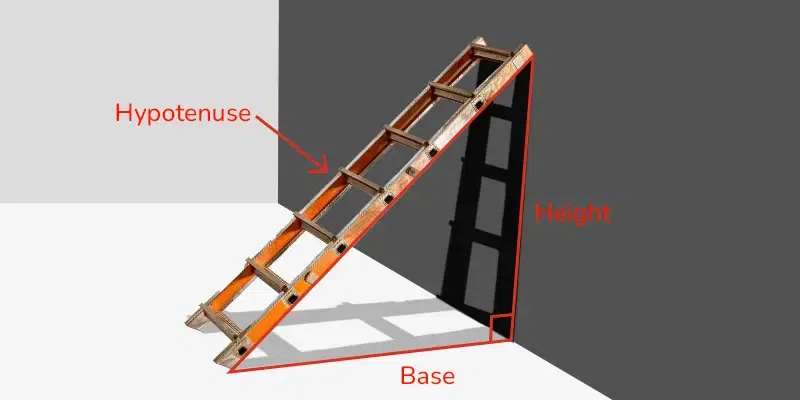
Hypotenuse or Pythagorean Theorem
Pythagoras theorem sometimes referred to as hypogenous theorem. In math, the Pythagorean Theorem helps you find the length of the hypotenuse. It says if you know the lengths of the other two sides (the shorter ones), you can square them, add the squares together, and then take the square root to get the length of the hypotenuse.
Pythagoras theorem states "In a right-angled triangle, the square of the length of the hypotenuse is equal to the sum of the squares of the lengths of the other two sides."
Mathematically, it can be written as:
c2 = a2 + b2
Where:
- c is the length of the hypotenuse (the longest side).
- a and b are the lengths of the other two sides (called the legs of the triangle).
Hypotenuse in Trigonometric Ratios
Trigonometric ratios like sine, cosine, and tangent are closely connected to the hypotenuse. These ratios relate the angles of a triangle to its sides, specifically:
- Sine (sin):
\sin(\theta) = \frac{\text{opposite}}{\text{hypotenuse}} - Cosine (cos):
\cos(\theta) = \frac{\text{adjacent}}{\text{hypotenuse}} - Tangent (tan):
\tan(\theta) = \frac{\text{opposite}}{\text{adjacent}}
These ratios are essential in trigonometry and help in calculating unknown angles and sides of right triangles.
Applications of Hypotenuse in Triangle
Some applications of Hypotenuse in triangle are as follows:
- Architecture and Construction: Pythagorean theorem is essentially used to measure distances in the construction of a building in an effort to achieve harmony in construction.
- Trigonometry in Physics: It is applied in solving problems of force, vector and angles.
- Navigation: Many of people like sailors and pilots need to find the distance between two points which the Pythagorean theorem provides in the shortest way.
- Computer Graphics: Hypotenuse is a very significant component when determining distance, especially for images in 2D and 3D planes.
- Medical Imaging: In technologies like MRI, the hypotenuse helps in calculating distances within the human body for accurate imaging.
Fun Facts about Hypotenuse
Some of the interesting facts about hypotenuse are:
- The term “hypotenuse” comes from the Greek word hypoteinousa, which means “stretching under,” referring to how the hypotenuse "stretches" across the triangle.
- The hypotenuse represents the shortest distance between two non-adjacent corners of a square or rectangle, meaning it’s a diagonal “shortcut” between two points.
- The hypotenuse is famous because of the Pythagorean Theorem, named after the ancient Greek mathematician Pythagoras. However, the theorem was known to ancient Babylonian mathematicians long before him.
- In three-dimensional geometry, the concept of the hypotenuse extends to finding the diagonal of a cube or rectangular box. The diagonal across the cube's space is similar to the hypotenuse in a right triangle, but in three dimensions.
Solved Examples on Hypotenuse
Example 1: A right-angled triangle has legs of length 6 units and 8 units. Find the hypotenuse.
Solution:
We can use the Pythagorean theorem to find the hypotenuse (c).
c^2=a^2+b^2
⇒c^2=6^2+8^2
⇒c^2=36+64=100
⇒ c = √100 = 10Thus, the hypotenuse is 10 units.
Example 2: In a right-angled triangle, the hypotenuse is 13 units, and one leg is 12 units. Find the length of the other leg.
Solution:
Using the Pythagorean theorem, where c=13 and a=12, we solve for b.
c^2=a^2+b^2
⇒13^2=12^2+b^2
⇒169=144+b^2
⇒b^2=169−144=25
⇒b=√25=5 So, the length of the other leg is 5 units.
Example 3: In a right-angled triangle, one angle is 30°, and the hypotenuse is 10 units. Find the length of the side opposite the angle.
Solution:
We use the sine function:
sin(30°) = opposite/hypotenuse
⇒ sin(30°) = a/10
⇒ 0.5 = a/10
⇒ a = 0.5 × 10 = 5Thus, the length of the side opposite the 30° angle is 5 units.
Practice Problems on Hypotenuse in Triangle
Q1: A right-angled triangle has legs of lengths 9 units and 12 units. Find the hypotenuse.
Q2: In a right triangle, the hypotenuse is 15 units, and one leg is 9 units. Find the length of the other leg.
Q3: Find the distance between the points (2,3) and (7,8).
Q4: In a right triangle, one angle is 45°, and the hypotenuse is 10 units. Find the length of the side adjacent to the angle.
Q5: The area of a right-angled triangle is 24 square units, and one leg is 6 units. Find the hypotenuse.
Answer Key
- 15 units
- 12 units
- 5√2 units or approximately 7.07 units
- 5√2 units or approximately 7.07 units
- 10 units
Conclusion
In conclusion, the hypotenuse is the longest side of a right-angled triangle, and it's always opposite the right angle. You can find its length using the Pythagorean Theorem, which says that the square of the hypotenuse equals the sum of the squares of the other two sides.
Read More,