
Differentiation of Trigonometric Functions is the derivative of Trigonometric Functions such as sin, cos, tan, cot, sec, and cosec. Differentiation is an important part of the calculus. It is defined as the rate of change of one quantity with respect to some other quantity. The differentiation of the trigonometric functions is used in real life in various fields like computers, electronics, and mathematics.
The differentiation of a function is the rate of change of a function with respect to any variable. The derivative of f(x) is denoted as f'(x) or (d /dx)[f(x)].
The procedure of differentiating the trigonometric functions is called the differentiation of trigonometric functions. In other words, finding the rate of change of trigonometric functions with respect to the angles is called trigonometric function differentiation.
The six basic trigonometric functions are sin, cos, tan, cosec, sec, and cot. We will find the derivatives of all the trigonometric functions with their formulas and proof.
Differentiation Rule For Trigonometric Functions
The differentiation of six basic trigonometric functions is as follows:
Function | Derivative of Function |
|---|---|
sin x | cos x |
cos x | -sin x |
tan x | sec2 x |
cosec x | -cosec x cot x |
sec x | sec x tan x |
cot x | -cosec2 x |
Note: The abbreviation "csc" is often interchangeably used with "cosec" in trigonometry; they are the same and both represent the cosecant function.
Proof of Differentiation of Trigonometric Functions Formula
As discussed above the formulas for all the trigonometric functions, now we will prove the above formulas of the differentiation of the trigonometric functions using the first principle of derivative, quotient rule, and chain rule with the help of limits.
Differentiation of sin(x)
To prove the derivative of sin x we will use the first principle of the differentiation and some basic trigonometric identities and limits formula. The trigonometric identities and limits formula which are used in the proof are given below:
- sin (X + Y) = sin X cos Y + sin Y cos X
- lim x→0 [sinx / x] = 1
- lim x→ 0 [(cos x - 1) / x] = 0
Let's start the proof for the differentiation of the trigonometric function sin x
By the first principle of differentiation
(d/dx) sin x = lim h→0 [{sin (x + h) - sin x} / {(x + h) - x}]
⇒ (d/dx) sin x = lim h→0 [{sin x cos h + sin h cos x - sin x} / h]
⇒ (d/dx) sin x = lim h→0 [{((cos h - 1) / h) sin x} + {(sin h / h) cos x}]
⇒ (d/dx) sin x = lim h→0 [{(cos h - 1) / h} sin x] + lim h→0 [(sin h / h) cos x]
⇒ (d/dx) sin x = 0.sin x + 1.cos x [By using 2 and 3]⇒ (d/dx) sin x = cos x
Therefore, differentiation of sin x is cos x.
Differentiation of cos(x)
To prove the derivative of cos x we will use the first principle of the differentiation and some basic trigonometric identities and limits formula. The trigonometric identities and limits formula which are used in the proof are given below:
- cos (X + Y) = cos X cos Y - sin X sin Y
- lim x→0 [sinx / x] = 1
- lim x→ 0 [(cos x - 1) / x] = 0
Let's start the proof for the differentiation of the trigonometric function cos x
By the first principle of differentiation
(d/dx) cos x = lim h→0 [{cos (x + h) - cos x} / {(x + h) - x}]
⇒ (d/dx) cos x = lim h→0 [{cos x cos h - sin h sin x - cos x} / h]
⇒ (d/dx) cos x = lim h→0 [{((cos h - 1) / h) cos x} - {(sin h / h) sin x}]
⇒ (d/dx) cos x = lim h→0 [{(cos h - 1) / h} cos x] - lim h→0 [(sin h / h) sin x]
⇒ (d/dx) cos x = 0.cos x - 1.sin x [By using 2 and 3]⇒ (d/dx) cos x = -sin x
Therefore, differentiation of cos x is -sin x.
Differentiation of tan(x)
To prove the derivative of tan x we will use the quotient rule and some basic trigonometric identities and limits formula. The trigonometric identities and limits formula which are used in the proof are given below:
- tan x = sin x / cos x
- sec x = 1 / cos x
- cos2 x + sin2 x = 1
- (d/dx) sin x = cos x
- (d/dx) cos x = -sin x
Let's start the proof for the differentiation of the trigonometric function tan x
Since, by (1)
tan x = sinx / cos x
⇒ (d/dx) tan x = (d/dx)[sinx / cos x]By using quotient rule
(d/dx) tan x = [{(d/dx)sinx} cosx - {(d/dx) cos x} sinx] / cos2x
⇒ (d/dx) tan x = [cos x cos x - (-sin x) sin x] / cos2x [By 4 and 5]
⇒ (d/dx) tan x = [cos2x + sin2x] / cos2x
⇒ (d/dx) tan x = 1 / cos2x [By 3]⇒ (d/dx) tan x = sec2x [By 2]
Therefore, differentiation of tan x is sec2 x.
Differentiation of cosec(x)
To prove the derivative of cosec x we will use the chain rule and some basic trigonometric identities and limits formula. The trigonometric identities and limits formula which are used in the proof are given below:
- cot x = cos x / sin x
- cosec x = 1 / sin x
- (d/dx) sin x = cos x
Let's start the proof for the differentiation of the trigonometric function cosec x
(d/dx) cosec x = (d/dx) [1 / sin x] [By 2]
Using chain rule
(d/dx) cosec x = [-1 / sin2x] (d/dx) sin x
⇒ (d/dx) cosec x = [-1 / sin2x] cos x
⇒ (d/dx) cosec x = -[1 / sinx] [cos x / sin x]
⇒ (d/dx) cosec x = - cosec x cot x [By 1 and 2]Therefore, the differentiation of cosec x is - cosec x cot x.
Differentiation of sec(x)
To prove the derivative of sec x we will use the quotient rule and some basic trigonometric identities and limits formula. The trigonometric identities and limits formula which are used in the proof are given below:
- tan x = sin x / cos x
- sec x = 1 / cos x
- (d/dx) cos x = -sin x
Let's start the proof for the differentiation of the trigonometric function sec x
(d/dx) sec x = (d/dx) [1 / cos x] [By 2]
Using chain rule
(d/dx) sec x = [-1 / cos2x] (d/dx) cos x
⇒ (d/dx) sec x = [-1 / cos2x] (-sin x)
⇒ (d/dx) sec x = [1 / cos x] [sin x / cos x]
⇒ (d/dx) sec x = sec x tan x [By 1 and 2]Therefore, the differentiation of sec x is sec x tan x.
Differentiation of cot(x)
To prove the derivative of cot x we will use the quotient rule and some basic trigonometric identities and limits formula. The trigonometric identities and limits formula which are used in the proof are given below:
- cot x = cos x / sin x
- cosec x = 1 / sin x
- cos2 x + sin2 x = 1
- (d/dx) sin x = cos x
- (d/dx) cos x = -sin x
Let's start the proof for the differentiation of the trigonometric function cot x
Since, by (1)
cot x = cos x / sin x
(d/dx) cot x = (d/dx)[cosx / sin x]
By using quotient rule
(d/dx) cot x = [{(d/dx)cosx} sin x - {(d/dx) sin x} cos x] / sin2x
⇒ (d/dx) cot x = [(-sinx) sin x - (cosx) cos x] / sin2x [By 4 and 5]
⇒ (d/dx) cot x = [ -sin2x - cos2 x] / sin2x
⇒ (d/dx) cot x = -[ sin2x + cos2x] / sin2x
⇒ (d/dx) cot x = -1 / sin2x [By 3]⇒ (d/dx) cot x = -cosec2x [By 2]
Therefore, differentiation of cot x is -cosec2 x.
Some Other Trigonometric Function Derivatives
The differentiation of the trigonometric functions can be easily done using the chain rule. The complex trigonometric functions and composite trigonometric functions can be solved by applying the chain rule of differentiation. In the following headings we will further study the chain rule and composite trig functions differentiation in detail.
- Differentiation using Chain Rule
- Differentiation of Composite Trig Function
Let's discuss these topics in detail.
Chain Rule and Trigonometric Function
The chain rule states that if p(q(x)) is a function then, the derivative of this function is given by the product of the derivative of p(q(x)) and the derivative of q(x). The chain rule is used to differentiate composite functions. The chain rule is mostly used to differentiate the composite trig functions easily.
Example: Find the derivative of f(x) = tan 4x
Solution:
f(x) = tan 4x
⇒ f'(x) = (d/dx) [tan 4x]
By applying chain rule
f'(x) = (d/dx) [tan 4x](d/dx)[4x]
⇒ f'(x) = (sec2 4x)(4)
Differentiation of Composite Trigonometry Function
To evaluate the differentiation of the composite trig functions we apply the chain rule of differentiation. The composite trig functions are the functions in which the angle of the trigonometric function is itself a function. The differentiation of composite trigonometric functions can be easily evaluated by applying the chain rule and the differentiation formulas for trig functions.
Example: Find the derivative of f(x) = cos(x2 +4)
Solution:
f(x) = cos(x2 +4)
⇒ f'(x) = (d/dx) cos(x2 +4)By applying chain rule
f'(x) = (d/dx) [cos(x2 + 4)](d/dx)[x2 + 4]
⇒ f'(x) = -(2x)sin(x2 +4)
Differentiation of Inverse Trigonometric Functions
The inverse trigonometric functions are the inverse functions of the trigonometric functions. There are six inverse trigonometric functions: sin-1, cos-1, tan-1, cosec-1, sec-1, cot-1. The inverse trigonometric functions are also called as arc functions.
The derivatives of six inverse trigonometric functions are as follows:
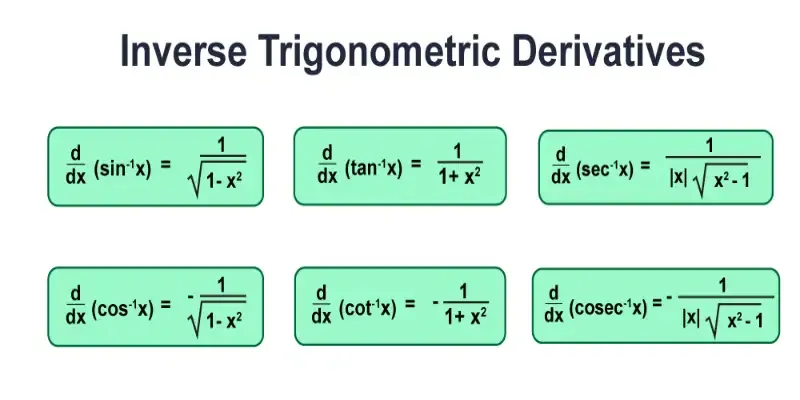
Example: Find the derivative of f(x) = 3sin-1x + 4cos-1x
Solution:
f'(x) = (d/dx) [3sin-1x + 4cos-1x]
⇒ f'(x) = (d/dx) [3sin-1x ]+ (d/dx) [4cos-1x]
⇒ f'(x) = 3(d/dx) [sin-1x ]+ 4(d/dx) [cos-1x]
⇒ f'(x) = 3[1 / √(1 - x2)] + 4[-1 / √(1 - x2)]
⇒ f'(x) = 3[1 / √(1 - x2)] - 4[1 / √(1 - x2)]
⇒ f'(x) = [1 / √(1 - x2)] (3- 4)
⇒ f'(x) = -[1 / √(1 - x2)]
Applications on Differentiation of Trigonometric Functions
There are many different applications of the differentiation of trigonometric functions in real life. The following are the applications of the differentiation of the trigonometric functions.
- The slope of the tangent and the normal line to the trigonometric curve can be determined using the differentiation of the trigonometric functions.
- It can be also used to determine the maxima and minima of the function.
- It is also used in the field of computers and electronics.
Sample Problems on Differentiation of Trig Functions
Problem 1: Find the derivative of f(x) = tan 2x.
Solution:
f(x) = tan 2x
⇒ f'(x) = (d/dx) tan 2xBy applying chain rule
f'(x) = (d/dx) [tan 2x](d/dx)[2x]
⇒ f'(x) = (sec22x)(2)
⇒ f'(x) = 2sec22x
Problem 2: Find the derivative of y = cos x / (4x2).
Solution:
y = cos x / (4x2)
Applying quotient rule
y' = [(d/dx)cosx(4x2) - cosx (d/dx)(4x2)] / (4x2)2
⇒ y' = [(-sinx)(4x2) - cosx (8x)] / (16x4)
⇒ y' = [-4x2sinx - 8xcosx] / (16x4)
⇒ y' = [-4x(xsinx + 2cosx)] / (16x4)
⇒ y' = - (x sinx + 2cosx) / (4x3)
Problem 3: Evaluate the derivative f(x) = cosec x + x tan x.
Solution:
f(x) = cosec x + x tan x
By applying formula and product rule
f'(x) = (d/dx) cosec x + (d /dx) [x tan x]
⇒ f'(x) = -cosec x cot x + (d /dx) x (tan x) + x (d /dx) (tan x)
⇒ f'(x) = -cosec x cot x + tan x + xsec2x
Problem 4: Find the derivative of the function f(x) = 6x4cos x.
Solution:
f(x) = 6x4cos x
By applying product rule
f'(x) = (d/dx) [6x4cos x]
⇒ f'(x) = 6[(d/dx) (x4)(cos x) + (x4) (d/dx)(cos x)]
⇒ f'(x) = 6[ 4x3cos x + x4(-sin x)]
⇒ f'(x) = 6[ 4x3cos x - x4sin x]
⇒ f'(x) = 6x3[ 4cos x - x sin x]
Problem 5: Evaluate the derivative: f(x) = (x + cos x) (1 - sin x).
Solution:
f(x) = (x + cos x) (1 - sin x)
By applying product rule
f'(x) = (d /dx) [(x + cos x) (1 - sin x)]
⇒ f'(x) = [(d /dx) (x + cos x)] (1 - sin x) + (x + cos x) [(d /dx) (1 - sin x)]
⇒ f'(x) = [(1 - sin x) (1 - sin x)] + [(x + cos x) (0 - cos x)]
⇒ f'(x) = (1 - sin x)2 - (x + cos x) cos x
⇒ f'(x) = 1 + sin2x - 2 sinx - x cosx - cos2x
Related Articles:
Practice Problems - Differentiation of Trigonometric Functions
Problem 1: Find the derivative of y = sin(x) + cos(x).
Problem 2: Calculate the derivative of y = 2sin(x) - 3cos(x).
Problem 3: Find the derivative of y = 2sin(3x).
Problem 4: Determine the derivative of y = tan(5x).
Problem 5: Find the derivative of y = sin(x) cos(x).
Problem 6: Calculate the derivative of f(x) = sin(x) + cos(x).
Problem 7: Determine the derivative of y = tan2(x).
Problem 8: Determine the derivative of f(x) = arcsin(x) + arctan(x).
Problem 9: Find the derivative of the function: f(x) = sin(cos(x2)).
Problem 10: Differentiate the following function using the product rule: f(x) = x ⋅ cos(x).