
A derivative is a concept in mathematics that measures how a function changes as its input changes. For example:
- If you're driving a car, the derivative of your position with respect to time is your speed. It tells you how fast your position is changing as time passes.
- If you're looking at a graph of a curve, the derivative at any point gives the slope of the tangent line to that curve at that point, indicating the rate of change.
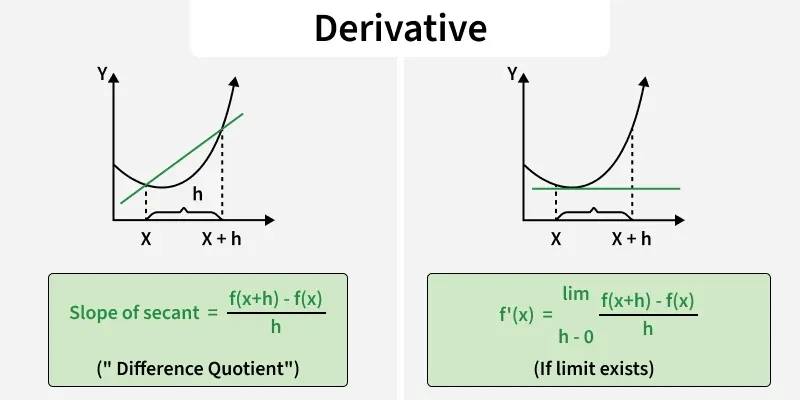
Mathematical Definition of Derivative
Derivative is defined as the rate of instantaneous change in a quantity with respect to another quantity.
Let's say f is a real-valued function and 'a' is a point in its domain of definition. The derivative of f at a is defined as,
f'(a) = \lim_{h \to 0} \frac{f(a + h) - f(a)}{h}
The above statement is subject to the condition that its limit exists.
This is also referred to as
\left. \frac{df}{dx} \right|_{x=a}
Derivative by First Principle
The derivative defined as the limit is called the Derivative by First Principle. Derivative by First Principle is also called Derivative by Delta Method. For any function f(x), its derivative is given as:
f'(x) = \frac{dy}{dx}= \lim_{h \to 0} \frac{f(x+h)-f(x)}{h}
Where,
- f′(x) represents the derivative of the function f(x) with respect to x.
- h represents the change in the x-values between the two points.
- f(x + h) − f(x) represents the change in the y-values between the two points.
- The limit as h approaches zero ensures that the secant line becomes the tangent line, providing the instantaneous rate of change of the function at the point x.
Types of Derivatives
- First Order Derivative
- Second Order Derivative
- nth-Order Derivative, based on the number of times they are differentiated.
First Order Derivative
It is defined as the rate of change of a dependent variable with respect to an independent variable.
- First Order Derivative gives the slope of the tangent drawn to the curve.
- It tells about the direction of function and explains if the function is increasing or decreasing in nature.
- The First Order Derivative can be explained in terms of Limit as follows.
f'(x) = limx→a f(x) - f(a) / x - a
- The other notations of First Order Derivative are given as dy/dx, D(y), d(f(x))/dx, and y'.
Second Order Derivative
It is the derivative of First Order Derivative of a function. It is also called Derivative of Derivative.
- It basically means differentiating a function twice successively.
- The Second Order derivative of a function tells about how the slope of the curve of a function changes.
- Second Order Derivative gives an idea about the local maxima and local minima of a curve.
- It is represented as d/dx{df(x)/dx} = d2y/dx2 = f''(x)
nth-Order Derivative
nth Order Derivative refers to finding successive differentiation of a function 'n' number of times. It is represented as dyn/dxn = fn(x).
Rules of Derivatives
| Rule | Formula |
|---|---|
| Constant Rule | d(c)/dx = 0 |
| Power Rule | d(xn)/dx = nxn-1 |
| Sum and Difference Rule | d(u ± v)/dx = du/dx ± dv/dx |
| Product Rule | d(u.v)/dx = u.dv/dx + v.du/dx |
| Quotient Rule | d(u/v)/dx = (v.du/dx - u.dv/dx)/v2 |
| Chain Rule | d[f(g(x))]/dx = f′(g(x)) ⋅ g′(x) |
Various Derivative Techniques
Implicit Differentiation: Implicit functions involve two or more variables and use the chain rule to differentiate the function.
Parametric Derivative: When x = f(t) and y = g(t), and both are differentiable with respect to t. Then, the parametric derivative is dy/dx = (dy/dt)/(dx/dt).
Partial Derivative: For a function f(x, y), the partial derivative with respect to x is 𝛛f(x, y)/𝛛x, and with respect to y is 𝛛f(x, y)/𝛛y
- When differentiating with respect to x, treat y as constant, and vice versa.
Logarithmic Derivative: This method simplifies the differentiation of complex functions using logarithmic rules.
Applications of Derivatives
Derivatives have got several applications, such as finding the concavity of a function, finding the slope of a tangent and normal, and finding the maxima and minima of a function.
Critical Point
Critical Point of a function is the point where the derivative of a function is either zero or not defined. Hence, if P is a critical point of the function then
dy/dx at P = 0 or dy/dx at P = Not Defined
Concavity of a Function
Concavity of a function simply means the opening of the curve of a function is upwards or downwards.
- If the opening of the curve is upwards, then it is called Concave Up and if downwards, it is called Concave Down.
- The condition for concave up is f''(x) > 0, and the condition for concave down is f''(x) < 0.
- The point at which the concavity of a function changes is called its Inflection Point.
Sample Problems on Derivatives
Question 1: Find the derivative of the function f(x) = x2 at x = 0 using the First Principle.
Solution:
f'(x)=\lim_{h \to 0} \frac{f(x+h)-f(x)}{h} ⇒
f'(x)=\lim_{h \to 0} \frac{(x+h)^2-x^2}{h} ⇒
f'(x)=\lim_{h \to 0} \frac{x^2+h^2+2hx-x^2}{h} ⇒
f'(x)=\lim_{h \to 0} \frac{h^2+2xh}{h} ⇒
f'(x)=\lim_{h \to 0} h+2x ⇒
f'(x)=2x Thus, f'(0) = 0
Question 2: Find the derivative of the function f(x) = x2 at x = 2 by Limit Definition.
Solution:
f'(x)=\lim_{h \to 0} \frac{f(x+h)-f(x)}{h} ⇒
f'(x)=\lim_{h \to 0} \frac{(x+h)^2-x^2}{h} ⇒
f'(x)=\lim_{h \to 0} \frac{x^2+h^2+2hx-x^2}{h} ⇒
f'(x)=\lim_{h \to 0} \frac{h^2+2xh}{h} ⇒
f'(x)=\lim_{h \to 0} h+2x ⇒
f'(x)=2x Thus, f'(2) = 4
Question 3: Find the derivative of the function f(x) = x + x + 1 at x = 0.
Solution:
f'(x)=\lim_{h \to 0} \frac{f(x+h)-f(x)}{h} ⇒
f'(x)=\lim_{h \to 0} \frac{((x+h)^2+(x+h)+1)-(x^2+x+1)}{h} ⇒
f'(x)=\lim_{h \to 0} \frac{((x^2+h^2+2hx+(x+h)+1)-(x^2+x+1)}{h} ⇒
f'(x)=\lim_{h \to 0} \frac{h^2+2xh+h}{h} ⇒
f'(x)=\lim_{h \to 0} (h+2x+1) ⇒
f'(x)=2x+1 Thus, f'(0) = 2(0) + 1 = 1
Question 4: Find the derivative of the function f(x) = ex at x = 0.
Solution:
f'(x)=\lim_{h \to 0} \frac{f(x+h)-f(x)}{h} ⇒
f'(x) = \lim_{h \to 0} \frac{e^{(x + h)} - e^{x}}{h} ⇒
f'(x) = \lim_{h \to 0} \frac{e^xe^h - e^{x}}{h} ⇒
f'(x) = \lim_{h \to 0} \frac{(e^h-1)}{h} This is 0/0 form of the limit. We know that
\lim_{h \to 0} \frac{(e^h-1)}{h}=1 ⇒
f'(x) = e^x \lim_{h \to 0} \frac{e^h}{1} ⇒
f'(x)= e^x(1) ⇒
f'(x)= e^x Thus, f'(0) = 1
Notice that the derivative of exponential function is exponential itself.
Practice Problems on Derivatives
Problem 1: Find the derivative of the function
Problem 2: Calculate the derivative of the function g(x) = sin(x) + cos(x)
Problem 3: Determine the derivative of the function
Problem 4: Find the derivative of the function k(x) = ln(x2 + 1)
Problem 5: Compute the derivative of the function m(x) = (3x+2)/(x-1)