
The cross product is a vector operation between two vectors that produces a new vector perpendicular to both vectors and the plane containing them. The magnitude of the resultant vector represents the area of the parallelogram formed by the two vectors, while its direction is determined by the right-hand rule.
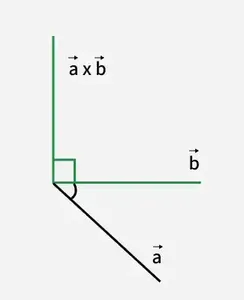
\vec A \times \vec B = |A||B|sin\theta
The cross product helps us find a vector that acts perpendicular to two given vectors. It also shows how much two vectors are spread apart and represents the area enclosed by them.
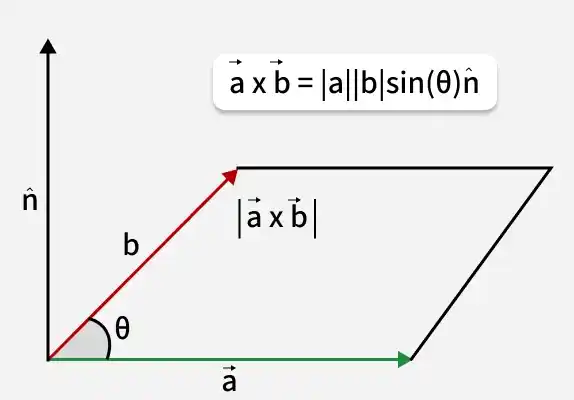
- The resultant vector c is perpendicular to both vectors a and b.
- The angle between a and c is always 90°.
- The angle between b and c is also 90°.
- The parallelogram in the figure shows the area formed by the two vectors.
- If the vectors are parallel (θ = 0°), the cross product becomes zero.
- The cross product becomes maximum when the vectors are perpendicular (θ = 90°).
Cross Product Formula
The cross product formula is used to find a vector that is perpendicular to two given vectors. The magnitude of the cross product represents the area of the parallelogram formed by the two vectors.
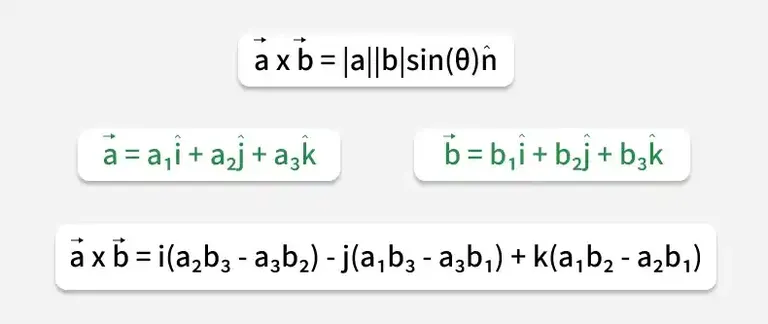
where,
- a and b are two vectors.
- θ is the angle between the two vectors.
- n̂ is the unit vector perpendicular to the plane containing both vectors.
- |a| and |b| represent the magnitudes of vectors a and b.
- The direction of the resultant vector is determined by the right-hand rule.
Consider two vectors:
- a = a₁i + a₂j + a₃k
- b = b₁i + b₂j + b₃k
The cross product can also be calculated using determinants and matrix notation.
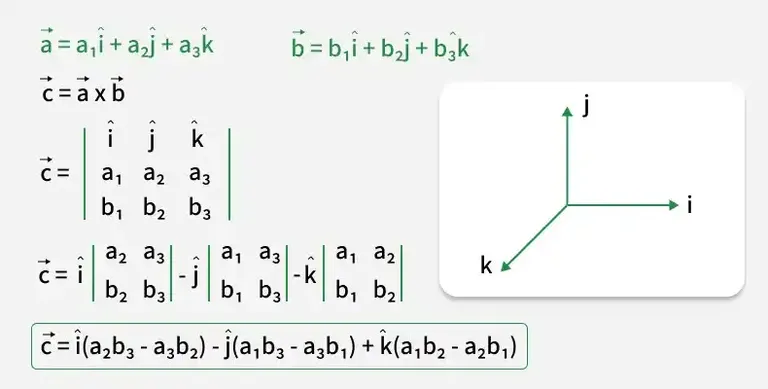
Note:
- i, j, and k are unit vectors along the x-axis, y-axis, and z-axis respectively.
- The resultant vector is always perpendicular to both given vectors.
Cross Product of Perpendicular Vectors
Cross product of two perpendicular vectors, the resulting vector perpendicular to both input vectors, and its magnitude is equal to the product of the magnitudes of the input vectors.
Mathematically, if the vectors (
Where,
|\vec{a}| and|\vec{b}| are the magnitudes of (\vec{a} ) and (\vec{b} ) respectively- (θ) isthe angle between the two vectors
- (
\vec{n} ) is a unit vector perpendicular to the plane formed by (\vec{a} ) and (\vec{b} )
For example, two perpendicular vectors (
Their cross product is:
\vec{a} \times \vec{b} = \begin{vmatrix} \hat{i} & \hat{j} & \hat{k} \\ 1 & 0 & 0 \\ 0 & 1 & 0 \end{vmatrix} = (
\hat{i} · (0 · 0) -\hat{j} · (1 · 0) +\hat{k} · (1 · 0))=
\hat{i} · 0 -\hat{j} · 0 +\hat{k} · 0= ❬0, 0, 0❭
The resulting vector (❬ 0, 0, 0 ❭) is a zero vector, indicating that it is perpendicular to both (
Cross Product of Parallel Vectors
The cross product of parallel vectors is always zero. This is because parallel vectors lie on the same line or are collinear, and the angle between them is either 0 or 180 degrees. In both cases, the sine of the angle is zero, resulting in a cross product of zero. Mathematically, if (
\vec{A} \times \vec{B} = |\vec{A}| \cdot |\vec{B}| \cdot \sin \theta = 0
where (θ) is the Angle Between Vectors
Therefore, the cross product of parallel vectors is the zero vector. When computing the cross product of parallel vectors, the resulting vector is a zero vector. This implies that its magnitude is zero.
For example, consider two parallel vectors (
This result shows that the cross product of parallel vectors is a zero vector, indicating that the vectors are parallel and do not create a plane.
Right-Hand Rule for Cross Product
Right-hand rule is a convention used to determine the direction of the resulting vector when performing a cross product.

- Align your right hand's index finger in the direction of the first vector (
\vec{A} ) and your middle finger in the direction of the second vector (\vec{B} ). - Your thumb will then point in the direction of the resulting vector (
\vec{A} \times \vec{B} ).
This convention ensures a consistent way to determine the direction of the resulting vector, especially when dealing with physical quantities like torque or magnetic fields.
If vector (
Properties of Cross Product
The various properties of cross product are listed below:
Orthogonality: The cross product of two non-zero vectors, (
Magnitude: The magnitude of the cross product, denoted as (
|\vec{A} \times \vec{B}| = |\vec{A}| \cdot |\vec{B}| \cdot \sin \theta
Direction: The direction of the cross product is determined by the right-hand rule, ensuring that the resultant vector is orthogonal to the plane formed by (
Anticommutativity: The cross product is anticommutative, meaning (
Linearity: The cross product follows the distributive law and is linear, satisfying (
Zero Cross Product for Parallel Vectors: If (
Cross product of the unit vectors:
\vec{i}×\vec{i}~=~\vec{j}×\vec{j}~=~\vec{k}×\vec{k}~=~0
Cross product of the unit vectors:
\vec{i}×\vec{j}~=~\vec{k}\\\vec{j}×\vec{k}~=~\vec{i}\\\vec{k}×\vec{i}~=~\vec{j}
Read More:Cross product and dot product
Application of Cross Product of Two Vectors
Application of cross product are as follow:
- Torque calculation in physics and engineering, where it's used to determine rotational force.
- Magnetic field calculation in electromagnetism, where it helps find the direction of magnetic fields around current-carrying wires.
- Angular momentum calculation in rotational motion problems, indicating the rotational motion's intensity.
- Essential in vector algebra for determining perpendicular vectors and calculating areas of parallelograms.
- Crucial in computer graphics for determining surface normals, aiding in realistic lighting effects in 3D rendering.
Results on Cross Product of Two Vectors
- Area of a Parallelogram with adjacent sides
\vec{a} and\vec{b} is|\vec{a}×\vec{b}|
- Area of a Triangle with adjacent sides
\vec{a} and\vec{b} is1/2|\vec{a}×\vec{b}|
Solved Examples
Example 1: Calculate the cross product of the vectors (
Solution:
To calculate cross product of two vectors (
\vec{A} ) and (\vec{B} ), denoted as (\vec{A} \times \vec{B} ) ,we can use the following formula:
\vec{A} \times \vec{B} = \begin{vmatrix} \hat{i} & \hat{j} & \hat{k} \\ A_x & A_y & A_z \\ B_x & B_y & B_z \end{vmatrix} Given (
\vec{A} = ❬ 2, -1, 3 ❭) and (\vec{B} = ❬ -3, 4, 1 ❭), we can substitute these values into the determinant:
\vec{A} \times \vec{B} = \begin{vmatrix} \hat{i} & \hat{j} & \hat{k} \\ 2 & -1 & 3 \\ -3 & 4 & 1 \end{vmatrix} Expanding determinant:
\vec{A} \times \vec{B} = \hat{i} \begin{vmatrix} -1 & 3 \\ 4 & 1 \end{vmatrix} - \hat{j} \begin{vmatrix} 2 & 3 \\ -3 & 1 \end{vmatrix} + \hat{k} \begin{vmatrix} 2 & -1 \\ -3 & 4 \end{vmatrix} Now, compute determinants:
\begin{vmatrix} -1 & 3 \\ 4 & 1 \end{vmatrix} = (-1)(1) - (3)(4) = -1 - 12 = -13
\begin{vmatrix} 2 & 3 \\ -3 & 1 \end{vmatrix} = (2)(1) - (3)(-3) = 2 + 9 = 11
\begin{vmatrix} 2 & -1 \\ -3 & 4 \end{vmatrix} = (2)(4) - (-1)(-3) = 8 - 3 = 5Finally, substitute the determinants into the cross product:
\vec{A} \times \vec{B} = \hat{i}(-13) - \hat{j}(11) + \hat{k}(5)
\vec{A} \times \vec{B} = -13\hat{i} - 11\hat{j} + 5\hat{k} So, cross product of (
\vec{A} ) and (\vec{B} ) is (\vec{A} \times \vec{B} = ❬ -13, -11, 5 ❭).
Example 2: Determine the area of the parallelogram formed by the vectors (
Solution:
To determine the area of the parallelogram formed by two vectors (
\vec{A} ) and (\vec{B} ), we can use the magnitude of their cross product (|\vec{A} \times \vec{B}| ). The formula for the magnitude of the cross product is:
|\vec{A} \times \vec{B}| = |\vec{A}| \cdot |\vec{B}| \cdot \sin(\theta) Where ( |
\vec{A} | ) and ( |\vec{B} | ) are the magnitudes of vectors (\vec{A} ) and (\vec{B} ) respectively, and (θ) is the angle between the two vectors.Given (
\vec{A} = ❬ 3, 1, -2 ❭) and (\vec{B} = ❬ 2, -1, 3 ❭), we can compute their magnitudes:
|\vec{A}| = \sqrt{3^2 + 1^2 + (-2)^2} = \sqrt{9 + 1 + 4} = √14
|\vec{B}| = \sqrt{2^2 + (-1)^2 + 3^2} = \sqrt{4 + 1 + 9} = √14Next, we calculate the cross product \( \vec{A} \times \vec{B} \) and its magnitude:
\vec{A} \times \vec{B} = \begin{vmatrix} \hat{i} & \hat{j} & \hat{k} \\ 3 & 1 & -2 \\ 2 & -1 & 3 \end{vmatrix} =
\hat{i} \begin{vmatrix} 1 & -2 \\ -1 & 3 \end{vmatrix} - \hat{j} \begin{vmatrix} 3 & -2 \\ 2 & 3 \end{vmatrix} + \hat{k} \begin{vmatrix} 3 & 1 \\ 2 & -1 \end{vmatrix}
= \hat{i}(1 \cdot 3 - (-2) \cdot (-1)) - \hat{j}(3 \cdot 3 - (-2) \cdot 2) + \hat{k}(3 \cdot (-1) - 1 \cdot 2)
= \hat{i}(3 - 2) - \hat{j}(9 + 4) + \hat{k}(-3 - 2)
= \hat{i} + \hat{j} - 5\hat{k} The magnitude of (
\vec{A} \times \vec{B} ) is:
|\vec{A} \times \vec{B}| = \sqrt{1^2 + 1^2 + (-5)^2} = \sqrt{1 + 1 + 25} = √27Now, we can calculate the area of the parallelogram:
Area = |
\vec{A} \times \vec{B} | = √27Therefore, the area of the parallelogram formed by the vectors (
\vec{A} ) and (\vec{B} ) is √27 square units.
Example 3: Given that the cross product of two vectors (
Solution:
To find the angle between two vectors (
\vec{A} ) and (\vec{B} ) given their magnitudes and the cross product (\vec{C} = \vec{A} \times \vec{B} ), we can use the formula for the magnitude of the cross product:
|\vec{A} \times \vec{B}| = |\vec{A}| \cdot |\vec{B}| \cdot \sin(\theta) Given that ( |
\vec{A} | = 2 ), (|\vec{B}| = 3 ), and (\vec{C} = ❬ 4, 5, -3 ❭), we can calculate the magnitude of (\vec{C} ):
|\vec{C}| = \sqrt{4^2 + 5^2 + (-3)^2} = \sqrt{16 + 25 + 9} = √50Now, we can substitute the given values into the formula for the magnitude of the cross product:
|\vec{A} \times \vec{B}| = |\vec{A}| \cdot |\vec{B}| \cdot \sin(\theta) √50 = 2 · 3 · sin(θ)
√50 = 6 · sin(θ)
To find (θ), we divide both sides by 6:
\sin(\theta) = \frac{\sqrt{50}}{6} Now, we can find ( θ ) by taking the inverse sine (arcsine) of both sides:
\theta = \arcsin\left(\frac{\sqrt{50}}{6}\right) Using a calculator, we find:
\theta \approx \arcsin\left(\frac{\sqrt{50}}{6}\right) \approx 57.19^\circ Therefore, the angle between vectors (
\vec{A} ) and (\vec{B} ) is approximately ( 57.19°).
Practice Questions
Q1: Given two vectors (
Q2: Find the area of the parallelogram formed by the vectors (
Q3: If (
Q4: Determine the cross product of the vectors (
Q5: Given that the cross product of two vectors (