
Chapter 30 of RD Sharma's Class 12 Mathematics textbook focuses on Linear Programming, a powerful optimization technique. Exercise 30.2 Set 1 introduces students to practical applications of linear programming. This set typically includes word problems that require students to formulate mathematical models, set up objective functions and constraints, and solve using graphical or algebraic methods. The problems often simulate real-world scenarios in business, manufacturing, and resource allocation.
Class 12 RD Sharma Solutions - Exercise 30.2 | Set 1
Question 1. Maximize Z = 5x + 2y,
Subject to
3x + 5y ≤ 15
5x + 2y ≤ 10
x, y ≥ 0
Solution:
Convert the given in equations into equations,
We will get the following equations:
3x + 5y = 15,
5x + 2y = 10,
x = 0 and
y = 0
Area represented by 3x + 5y ≤ 15:
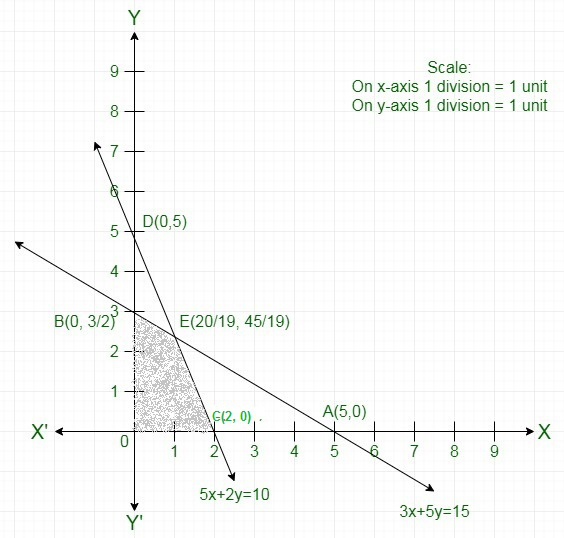
The line 3x + 5y = 15 connects the coordinate axes at A(5,0) and B(0,3) respectively.By connecting these points we will get the line 3x + 5y = 15.
Thus,
(0,0) assure the in equation 3x + 5y ≤ 15.
Hence,
The area having the origin shows the solution set of the in equation 3x + 5y ≤ 15.
Area shows by 5x + 2y ≤ 10:The line 5x + 2y = 10 connects the coordinate axes at C(2,0) and D(0,5) respectively.
By connecting these points we will get the line 5x + 2y = 10.
Thus,
(0,0) satisfies the in equation 5x + 2y ≤ 10.
Hence,
The area having the origin shows the solution set of the in equation 5x + 2y ≤ 10.
Area shows by x ≥ 0 and y ≥ 0:Here,
All the point in the first quadrant assures these in equations.
Thus,
The first quadrant is the area shows by the in equations x ≥ 0, and y ≥ 0.
The feasible area determined by the system of constraints, 3x + 5y ≤ 15, 5x + 2y ≤ 10, x ≥ 0, and y ≥ 0, are as follows.
The corner points of the feasible area are O(0, 0), C(2, 0), E
\left(\frac{20}{19},\ \frac{45}{19}\right) and B(0, 3).The values of Z at these corner points are as follows.
Corner point
Z = 5x + 3y
O(0, 0)
5 × 0 + 3 × 0 = 0
C(2, 0)
5 × 2 + 3 × 0 = 10
E
\left(\frac{20}{19},\ \frac{45}{19}\right)
5\times\frac{20}{19}+3\times\frac{45}{19}=\frac{235}{19} B(0, 3)
5 × 0 + 3 × 3 = 9
Hence,
The maximum value of Z
\frac{235}{19} at the point\left(\frac{20}{19},\ \frac{45}{19}\right) Hence,
x=
\frac{20}{19} and y =\frac{45}{19} is the best solution of the given LPP.Therefore,
The best value of Z is
\frac{235}{19} .
Question 2. Maximize Z = 9x + 3y
Subject to
2x + 3y ≤ 13
3x + y ≤ 5
x, y ≥ 0
Solution:
Convert the given in equations into equations,
We will get the following equations:
2x + 3y = 13,
3x +y = 5,
x = 0 and
y = 0
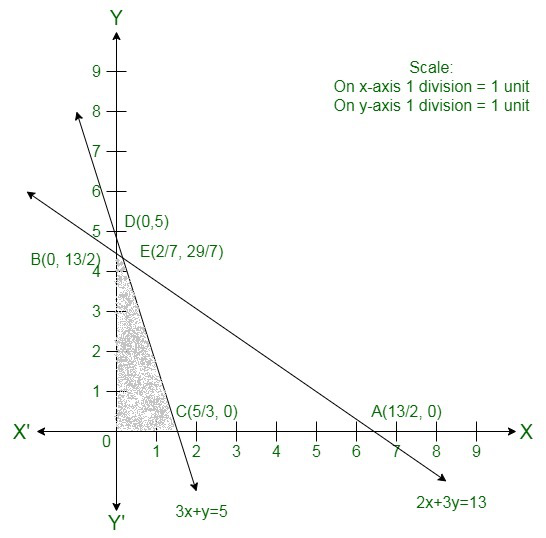
Area shown by 2x + 3y ≤ 13:The line 2x + 3y = 13 connects the coordinate axes at A
\left(\frac{13}{2},\ 0\right) and B\left(0,\ \frac{13}{3}\right) respectively.By connecting these points we will get the line 2x + 3y = 13.
Thus,
(0,0) assures the line equation 2x + 3y ≤ 13.
Thus, the area showing the origin represents the solution set of the in equation 2x + 3y ≤ 13.
The area shows by 3x + y ≤ 5:The line 5x + 2y = 10 connects the coordinate axes at C
\left(\frac{5}{3},\ 0\right) and D(0, 5) respectively.After connecting these points,
We will get the line 3x + y = 5.
Thus,
(0,0) assures the in equation 3x + y ≤ 5.
Thus,
The area having the origin represents the solution set of the in equation 3x + y ≤ 5.
Area shown by x ≥ 0 and y ≥ 0:Hence,
All the point in the first quadrant assures these in equations.
Thus,
The first quadrant is the area shown by the in equations x ≥ 0, and y ≥ 0.
The suitable area determined by the system of constraints,
2x + 3y ≤ 13,
3x + y ≤ 5,
x ≥ 0, and
y ≥ 0, are as follows.
The corner points of the suitable area are O(0, 0), C
\left(\frac{5}{3},\ 0\right) , E\left(\frac{2}{7},\ \frac{29}{7}\right) and B\left(0,\ \frac{13}{3}\right) .The values of Z at these corner points are as follows.
Corner point
Z = 9x + 3y
O(0, 0)
9 × 0 + 3 × 0 = 0
C
\left(\frac{5}{3},\ 0\right) 9 ×
\frac{5}{3} + 3 × 0 = 15E
\left(\frac{2}{7},\ \frac{29}{7}\right) 9 ×
\frac{2}{7} + 3 ×\frac{29}{7} = 15B
\left(0,\ \frac{13}{3}\right) 9 × 0 + 3 ×
\frac{13}{3} = 13Here,
We can see that the maximum value of the objective function Z is 15 which is at C
\left(\frac{5}{3},\ 0\right) and E\left(\frac{2}{7},\ \frac{29}{7}\right) .Thus,
The best value of Z is 15.
Question 3. Minimize Z = 18x + 10y
Subject to
4x + y ≥ 20
2x + 3y ≥ 30
x, y ≥ 0
Solution:
Convert the given in equations into equations,
We will get the following equations:
4x + y = 20,
2x +3y = 30,
x = 0 and
y = 0
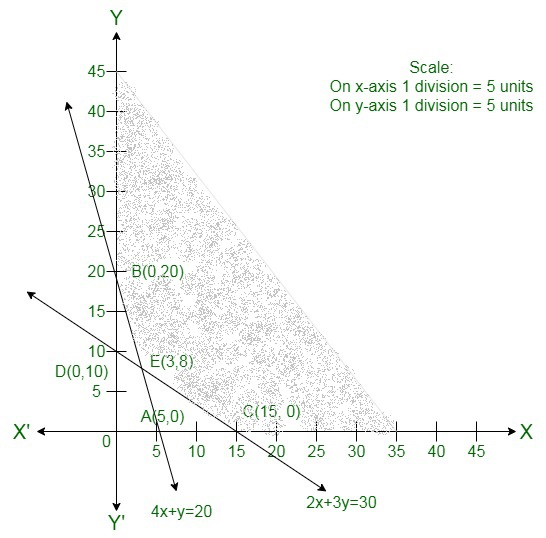
Area shown by 4x + y ≥ 20 :The line 4x + y = 20 connects the coordinate axes at A(5, 0) and B(0, 20) respectively.
By connecting these points we will get the line 4x + y = 20.
Thus,
(0,0) does not assure the in equation 4x + y ≥ 20.
Thus,
The area in xy plane which does not have the origin represents the solution set of the in equation 4x + y ≥ 20.
Area shown by 2x +3y ≥ 30:The line 2x +3y = 30 connects the coordinate axes at C(15,0) and D(0, 10) respectively.
By joining these points we will get the line 2x +3y = 30.
Thus, (0,0) does not assure the in equation 2x +3y ≥ 30.
Thus,
The area which does not have the origin shows the solution set of the in equation 2x +3y ≥ 30.
Area shown by x ≥ 0 and y ≥ 0:Hence,
Every point in the first quadrant assure these in equations.
Thus,
The first quadrant is the area shown by the in equations x ≥ 0, and y ≥ 0.
The suitable area determined by the system of constraints, 4x + y ≥ 20, 2x +3y ≥ 30, x ≥ 0, and y ≥ 0, are as follows.
The corner points of the suitable area are
B(0, 20),
C(15,0),
E(3,8) and
C(15,0).
The values of Z at these corner points are as follows.
Corner point
Z = 18x + 10y
B(0, 20)
18 × 0 + 10 × 20 = 200
E(3,8)
18 × 3 + 10 × 8 = 134
C(15,0)
18 × 15 + 10 ×0 = 270
Hence,
The minimum value of Z is 134 at the point E(3,8). Hence, x = 3 and y =8 is the best solution of the given LPP.
Therefore,
The best value of Z is 134.
Question 4. Maximize Z = 50x + 30y
Subject to
2x + y ≤ 18
3x + 2y ≤ 34
x, y ≥ 0
Solution:
Convert the given in equations into equations,
We will get the following equations:
2x + y = 18, 3x + 2y = 34
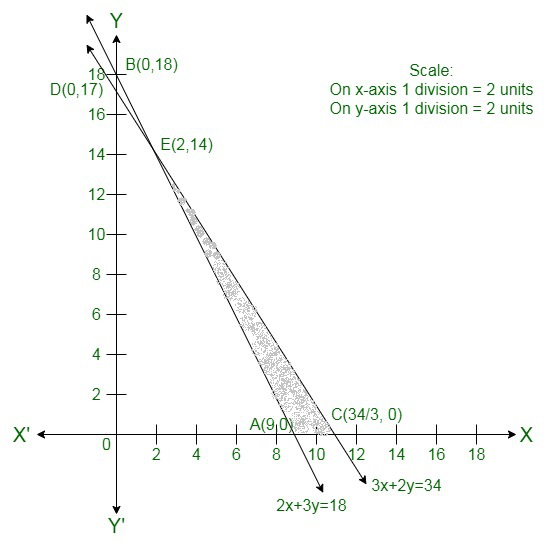
The area shown by 2x + y ≥ 18:The line 2x + y = 18 connects the coordinate axes at A(9, 0) and B(0, 18) respectively.
After connecting these points
We will get the line 2x + y = 18.
Thus,
(0,0) does not assure the in equation 2x + y ≥ 18.
Thus,
The region in xy plane which does not have the origin represents the solution set of the in equation 2x + y ≥ 18.
The area shown by 3x + 2y ≤ 34:The line 3x + 2y = 34 connects the coordinate axes at C
\left(\frac{34}{3},\ 0\right) , 0 and D(0, 17) respectively.After joining these points we will get the line 3x + 2y = 34.
Thus,
(0,0) assure the in equation 3x + 2y ≤ 34.
Thus,
The area having the origin shows the solution set of the in equation 3x + 2y ≤ 34.
The corner points of the suitable area areA(9, 0), C
\left(\frac{34}{3},\ 0\right) and E(2, 14).
The values of Z at these corner points are as follows.
Corner point
Z = 50x + 30y
A(9, 0)
50 × 9 + 3 × 0 = 450
C
\left(\frac{34}{3},\ 0\right) 50 ×
\frac{34}{3} + 30 × 0 =\frac{1700}{3} E(2, 14)
50 × 2 + 30 × 14 = 520
Hence,
The maximum value of Z is
\frac{1700}{3} at the point\left(\frac{34}{3},\ 0\right) .Hence,
x =
\frac{34}{3} and y = 0 is the best solution of the given LPP.Therefore,
The best value of Z is
\frac{1700}{3}
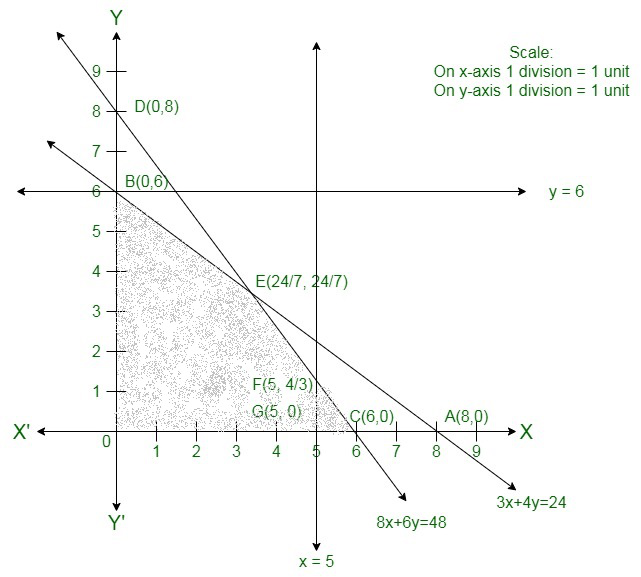
Question 5. Maximize Z = 4x + 3y
Subject to
3x + 4y ≤ 24
8x + 6y ≤ 48
x ≤ 5
y ≤ 6
x, y ≥ 0
Solution:
Here we have to maximize Z = 4x + 3y
Convert the given in equations into equations,We will get the following equations:
3x + 4y = 24,
8x + 6y = 48,
x = 5,
y = 6,
x = 0 and
y = 0.
The line 3x + 4y = 24 connects the coordinate axis at A(8, 0) and B(0,6).Connect these points to get the line 3x + 4y = 24.
Thus,
(0, 0) assure the in equation 3x + 4y ≤ 24.
Thus,
The area in xy-plane that have the origin showing the solution set of the given equation.
The line 8x + 6y = 48 connects the coordinate axis at C(6, 0) and D(0,8). Connect these points to get the line 8x + 6y = 48.Thus,
(0, 0) assures the in equation 8x + 6y ≤ 48.
Thus,
The area in xy-plane that have the origin shows the solution set of the given equation.
x = 5 is the line passing through x = 5 parallel to the Y axis.y = 6 is the line passing through y = 6 parallel to the X axis.
The area shown by x ≥ 0 and y ≥ 0:Hence,
All the point in the first quadrant assure these in equations.
Thus,
The first quadrant is the area shows by the in equations.
These lines are drawn using a suitable scale.
The corner points of the suitable area are O(0, 0), G(5, 0), F
\left(5,\ \frac{4}{3}\right) , E\left(\frac{24}{7},\ \frac{24}{7}\right) and B(0, 6).
The values of Z at these corner points are as follows.
Corner point
Z = 4x + 3y
O(0, 0)
4× 0 + 3 × 0 = 0
G(5, 0)
4 × 5 + 3 × 0 = 20
F
\left(5,\ \frac{4}{3}\right) 4 × 5 + 3 ×
\frac{4}{3} = 24E
\left(\frac{24}{7},\ \frac{24}{7}\right) 4 ×
\frac{24}{7} + 3 ×\frac{24}{7} =\frac{196}{7} = 24B(0, 6)
4 × 0 + 3 × 6 = 18
Here we can see that the maximum value of the objective function Z is 24Which is at F
\left(5,\ \frac{4}{3}\right) and ETherefore,
The best value of Z is 24.
Question 6. Maximize Z = 15x + 10y
Subject to
3x + 2y ≤ 80
2x + 3y ≤ 70
x, y ≥ 0
Solution:
Convert the given in equations into equations,
We will get the following equations:
3x + 2y = 80, 2x + 3y = 70, x = 0 and y = 0
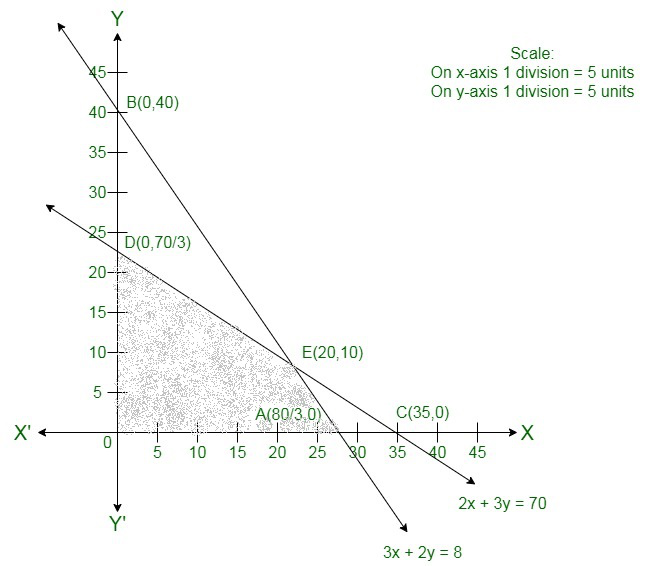
The area shown by 3x + 2y ≤ 80 :The line 3x + 2y = 80 connects the coordinate axes at A
\left(\frac{80}{3},\ 0\right) , 0 and B(0, 40) respectively.By connecting these points we will get the line 3x + 2y = 80.
Thus,
(0,0) assure the in equation 3x + 2y ≤ 80 .
Thus,
The area having the origin represents the solution set of the in equation 3x + 2y ≤ 80 .
The area shown by 2x + 3y ≤ 70:
The line 2x + 3y = 70 connects the coordinate axes at C(35, 0)C35, 0 and D(0, 703)D0, 703 respectively.
After connecting these points we will get the line 2x + 3y ≤ 70.
Thus,
(0,0) assure the in equation 2x + 3y ≤ 70.
Thus,
The area having the origin shows the solution set of the in equation 2x + 3y ≤ 70.
The area shown by x ≥ 0 and y ≥ 0:Hence,
Every point in the first quadrant assure these in equations.
Thus,
The first quadrant is the area shown by the in equations x ≥ 0 and y ≥ 0.
The suitable area determined by the system of constraints, 3x + 2y ≤ 80, 2x + 3y ≤ 70, x ≥ 0, and y ≥ 0 are as follows.
The corner points of the suitable area are O(0, 0), A
\left(\frac{80}{3},\ 0\right) , 0 ,E(20, 10) and D\left(0,\ \frac{70}{3}\right) .The values of Z at these corner points are as follows.
Corner point
Z = 15x + 10y
O(0, 0)
15 × 0 + 10 × 0 = 0
A
\left(\frac{80}{3},\ 0\right) 15 ×
\frac{80}{3} + 10 × 0 = 400E(20, 10)
15 × 20 + 10 × 10 = 400
D
\left(0,\ \frac{70}{3}\right) 15 × 0 + 10 ×
\frac{70}{3} =\frac{700}{3} Thus we can see that the maximum value of the objective function Z is 400 which is at A
\left(\frac{80}{3},\ 0\right) ,and E(20, 10).
Therefore,
The best value of Z is 400.
Question 7. Maximize Z = 10x + 6y
Subject to
3x + y ≤ 12
2x + 5y ≤ 34
x, y ≥ 0
Solution:
Convert the given in equations into equations,
We will get the following equations:
3x + y = 12, 2x + 5y = 34, x = 0 and y = 0
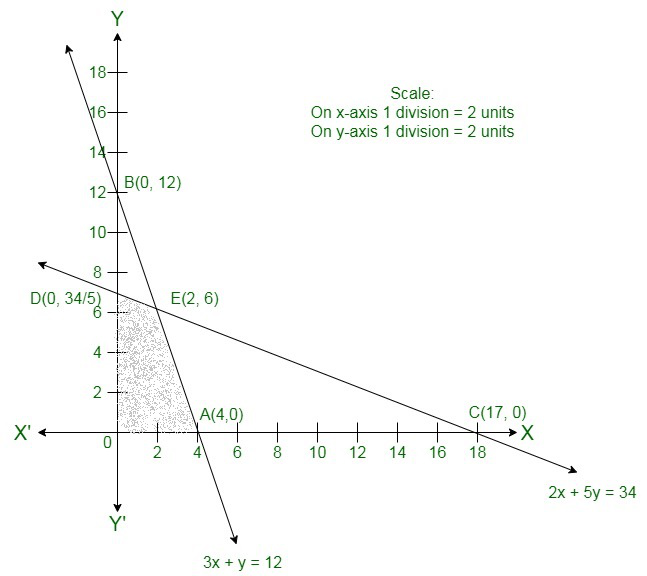
The area shown by 3x + y ≤ 12:The line 3x + y = 12 connects the coordinate axes at A(4, 0) and B(0, 12) respectively.
After connecting these points we will get the line 3x + y = 12.
Thus,
(0,0) assure the in equation 3x + y ≤ 12.
Thus,
The area having the origin represents the solution set of the in equation 3x + y ≤ 12.
The area shown by 2x + 5y ≤ 34:The line 2x + 5y = 34 connects the coordinate axes at C(17, 0) and D
(0,\ \frac{34}{5}) respectively.After connecting these points we will get the line 2x + 5y ≤ 34.
Thus,
(0,0) assure the in equation 2x + 5y ≤ 34.
Thus,
The area having the origin represents the solution set of the in equation 2x + 5y ≤ 34.
Area having by x ≥ 0 and y ≥ 0:Hence,
All the point in the first quadrant assure these in equations.
Thus,
The first quadrant is the area shown by the in equations x ≥ 0 and y ≥ 0.
The suitable area determined by the system of constraints, 3x + y ≤ 12, 2x + 5y ≤ 34, x ≥ 0, and y ≥ 0 are as follows.
The corner points of the suitable area are O(0, 0), A(4, 0) ,E(2, 6) and D
(0,\ \frac{34}{5}) .The values of Z at these corner points are as follows:
Corner point
Z = 10x + 6y
O(0, 0)
10 × 0 + 6 × 0 = 0
A(4, 0)A4, 0
10× 4 + 6 × 0 = 40
E(2, 6)E2, 6
10 × 2 + 6 × 6 = 56
D
(0,\ \frac{34}{5}) 10 × 0 + 6 ×
\frac{34}{5} =\frac{204}{3} Here we can see that the maximum value of the objective function Z is 56 which is at E(2, 6) that means at x = 2 and y = 6.
Therefore,
The best value of Z is 56.
Question 8. Maximize Z = 3x + 4y
Subject to
2x + 2y ≤ 80
2x + 4y ≤ 120
Solution:
Here we have to maximize Z = 3x + 4y
Convert the given in equations into equations, we will get the following equations:
2x + 2y = 80, 2x + 4y = 120
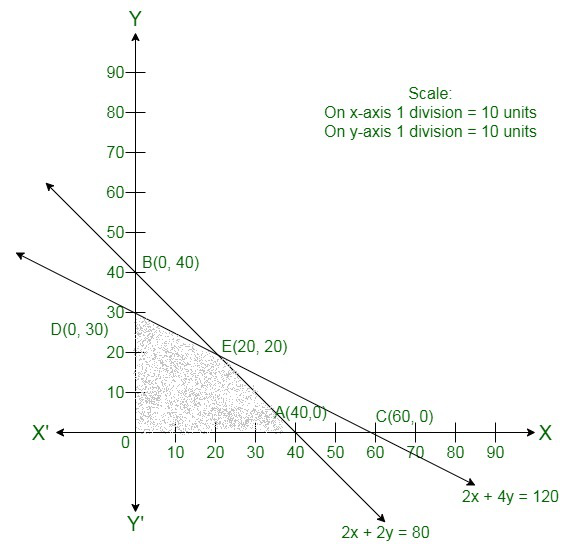
The area shown by 2x + 2y ≤ 80:The line 2x + 2y = 80 connects the coordinate axes at A(40, 0) and B(0, 40) respectively.
After connecting these points we will get the line 2x + 2y = 80.
Thus,
(0,0) assure the in equation 2x + 2y ≤ 80.
Thus,
The area having the origin represents the solution set of the in equation 2x + 2y ≤ 80.
The area shown by 2x + 4y ≤ 120:The line 2x + 4y = 120 connects the coordinate axes at C(60, 0) and D(0, 30) respectively.
After connecting these points we will get the line 2x + 4y ≤ 120.
Thus,
(0,0) assure the in equation 2x + 4y ≤ 120.
Thus,
The area having the origin represents the solution set of the in equation 2x + 4y ≤ 120.
The suitable area determined by the system of constraints, 2x + 2y ≤ 80, 2x + 4y ≤ 120 are as follows:The corner points of the suitable area are O(0, 0), A(40, 0), E(20, 20) and D(0, 30).
The values of Z at these corner points are as follows:
Corner point
Z = 3x + 4y
O(0, 0)
3 × 0 + 4 × 0 = 0
A(40, 0)
3× 40 + 4 × 0 = 120
E(20, 20)
3 × 20 + 4 × 20 = 140
D(0, 30)
10 × 0 + 4 ×30 = 120
Here we can see that the maximum value of the objective function Z is 140 which is at E(20, 20) that means at
x = 20 and y = 20.
Therefore,
The best value of Z is 140.
Question 9. Maximize Z = 7x + 10y
Subject to
x + y ≤ 30000
y ≤ 12000
x ≥ 6000
x ≥ y
x, y ≥ 0
Solution:
Here we have to maximize Z = 7x + 10y
Convert the given in equations into equations,
We will get the following equations:
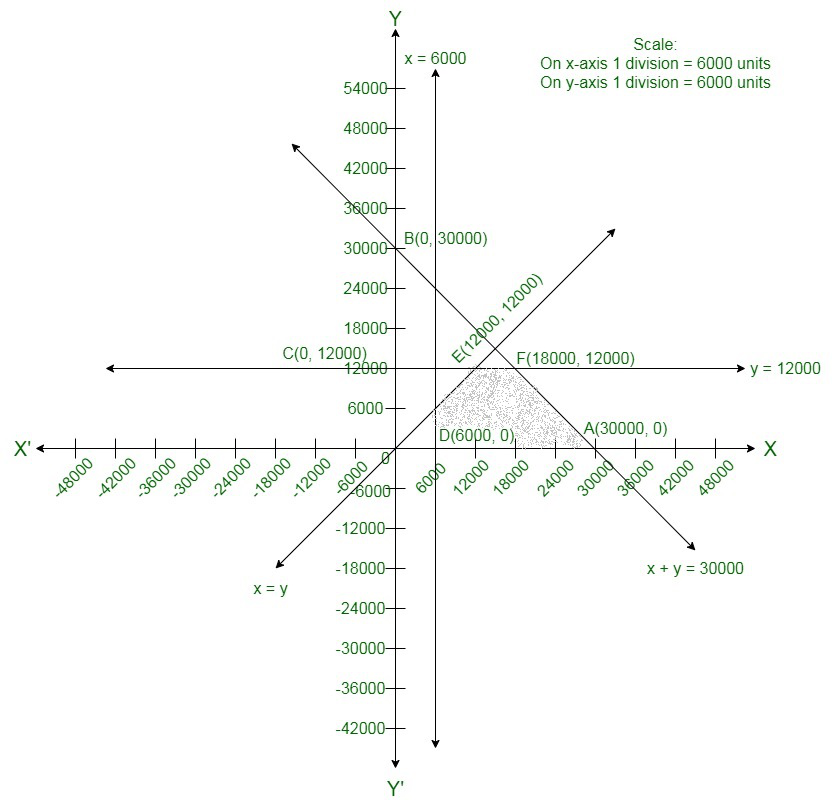
x + y = 30000,y = 12000, x = 6000, x = y, x = 0 and y = 0.
Region represented by x + y ≤ 30000:The line x + y = 30000 connects the coordinate axes at A(30000, 0) and B(0, 30000) respectively.
After connecting these points we will get the line x + y = 30000.
Thus, (0,0) assure the in equation x + y ≤ 30000.
Thus,
the area having the origin represents the solution set of the in equation x + y ≤ 30000.
The line y = 12000 is the line that passes through C(0,12000) and parallel to x axis.
The line x = 6000 is the line that passes through (6000, 0) and parallel to y axis.
The area shown by x ≥ yThe line x = y is the line that passes through origin.The points to the right of the line x = y assure the inequation x ≥ y.
Like by taking the point (−12000, 6000).
Here, 6000 > −12000 which implies y > x.
Hence,
the points to the left of the line x = y will not assure the given inequation x ≥ y.
The area shown by x ≥ 0 and y ≥ 0:Hence,
All the point in the first quadrant assure these inequations.
Thus,
the first quadrant is the area shown by the inequations x ≥ 0 and y ≥ 0.
The suitable area determined by the system of constraints, x + y ≤ 30000, y ≤ 12000, x ≥ 6000, x ≥ y , x ≥ 0 and y ≥ 0 are as follows:The corner points of the feasible region are
D(6000, 0),
A(3000,
F(18000, 12000) and
E(12000, 12000).
The values of Z at these corner points are as follows:
Corner point
Z = 7x + 10y
D(6000, 0)
7 × 6000 + 10 × 0 = 42000
A(3000, 0)A3000, 0
7× 3000 + 10 × 0 = 21000
F(18000, 12000)
7 × 18000 + 10 × 12000 = 246000
E(12000, 12000)
7 × 12000 + 10 ×12000 = 204000
Here we can see that the maximum value of the objective function Z is 246000 which is at F(18000, 12000) that means at
x = 18000 and y = 12000.
Therefore,
The best value of Z is 246000.
Question 10. Minimize Z = 2x + 4y
Subject to
x + y ≥ 8
x + 4y ≥ 12
x ≥ 3, y ≥ 2
Solution:
Convert the given in equations into equations, we will get the following equations:
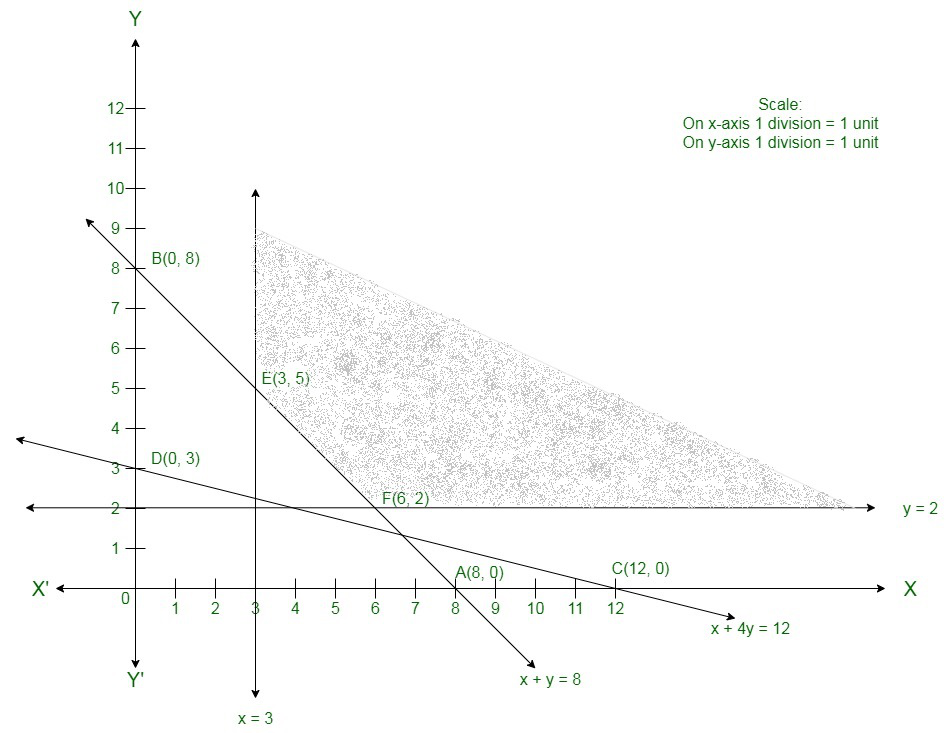
x + y = 8, x + 4y = 12, x = 3, y = 2
The area shows by x + y ≥ 8:The line x + y = 8 connects the coordinate axes at A(8, 0) and B(0, 8) respectively.
After connecting these points we will get the line x + y = 8.
Thus,
(0,0) does not assure the in equation x + y ≥ 8.
Thus,
The region in xy plane which does not contain the origin represents the solution set of the in equation x + y ≥ 8.
The area shown by x + 4y ≥ 12:The line x + 4y = 12 connects the coordinate axes at C(12, 0) and D(0, 3) respectively.
After connecting these points we will get the line x + 4y = 12.
Thus,
(0,0) assure the in equation x + 4y ≥ 12.
Thus,
the area in xy plane which having the origin represents the solution set of the in equation x + 4y ≥ 12.
The line x = 3 is the line that passes through the point (3, 0) and is parallel to Y axis.x ≥ 3 is the area to the right of the linex = 3.
The line y = 2 is the line that passes through the point (0, 12) and is parallel to X axis.y ≥ 2 is the area above the line y = 2.The corner points of the suitable region are E(3, 5) and F(6, 2).
The values of Z at these corner points are as follows.
Corner point Z = 2x + 4y
E(3, 5)
2 × 3 + 4 × 5 = 26
F(6, 2)
2 × 6 + 4 × 2 = 20
Therefore,
The minimum value of Z is 20 at the point F(6, 2).
Hence, x = 6 and y =2 is the best solution of the given LPP.
Therefore,
The best value of Z is 20.
Practice Questions on Linear Programming
Question 1. A factory produces two types of products, A and B. Product A requires 2 hours of machine time and 3 hours of labor, while product B needs 3 hours of machine time and 2 hours of labor. The factory has 100 hours of machine time and 90 hours of labor available. The profit on product A is Rs. 50 per unit and on product B is Rs. 60 per unit. Formulate this as a linear programming problem to maximize profit.
Question 2. A dietician needs to formulate a diet containing at least 50 units of vitamin A and 40 units of vitamin C. Two foods, X and Y, are available. Each unit of X contains 2 units of vitamin A and 3 units of vitamin C, while each unit of Y contains 4 units of vitamin A and 1 unit of vitamin C. If X costs Rs. 3 per unit and Y costs Rs. 4 per unit, formulate a linear programming problem to minimize the cost of the diet.
Question 3. A company manufactures two products, P and Q. Each unit of P requires 2 kg of raw material A and 3 kg of raw material B, while each unit of Q requires 4 kg of A and 1 kg of B. The company has 800 kg of A and 600 kg of B available. The profit per unit of P is Rs. 30 and per unit of Q is Rs. 50. Formulate this as a linear programming problem to maximize profit.
Question 4. A farmer has 100 hectares of land to plant wheat and barley. Each hectare of wheat requires 4 units of fertilizer and 6 units of insecticide, while each hectare of barley needs 3 units of fertilizer and 4 units of insecticide. The farmer has 400 units of fertilizer and 500 units of insecticide. If the profit per hectare of wheat is Rs. 2000 and per hectare of barley is Rs. 1500, formulate a linear programming problem to maximize the farmer's profit.
Question 5. A toy company produces two types of toys: dolls and cars. Each doll requires 2 hours in the carpentry shop and 1 hour in the finishing shop. Each car requires 1 hour in the carpentry shop and 3 hours in the finishing shop. The carpentry shop has 100 hours available and the finishing shop has 90 hours available. The profit on each doll is Rs. 30 and on each car is Rs. 20. Formulate this as a linear programming problem to maximize profit.
Question 6. A furniture maker produces tables and chairs. Each table requires 4 units of wood and 2 units of labor, while each chair requires 3 units of wood and 1 unit of labor. The furniture maker has 240 units of wood and 100 units of labor available. If the profit on a table is Rs. 60 and on a chair is Rs. 40, formulate a linear programming problem to maximize profit.
Question 7. An investment company wants to invest in two types of stocks, A and B. The company wants to invest at least Rs. 30,000 in A and at least Rs. 20,000 in B. The total investment should not exceed Rs. 100,000. If the expected return on stock A is 8% and on stock B is 12%, formulate a linear programming problem to maximize the total return.
Question 8. A bakery produces two types of cakes: chocolate and vanilla. Each chocolate cake requires 200g of flour and 25g of cocoa, while each vanilla cake requires 100g of flour and 50g of vanilla essence. The bakery has 20 kg of flour, 1 kg of cocoa, and 2 kg of vanilla essence. If the profit on a chocolate cake is Rs. 40 and on a vanilla cake is Rs. 30, formulate a linear programming problem to maximize profit.
Question 9. A company produces two types of juices, apple and orange. Each liter of apple juice requires 0.8 kg of apples and 0.3 kg of sugar, while each liter of orange juice requires 1 kg of oranges and 0.2 kg of sugar. The company has 800 kg of apples, 1200 kg of oranges, and 400 kg of sugar. If the profit per liter of apple juice is Rs. 20 and per liter of orange juice is Rs. 30, formulate a linear programming problem to maximize profit.
Question 10. A transport company uses two types of trucks, small and large. Each small truck can carry 30 boxes and requires 10 liters of fuel per trip. Each large truck can carry 50 boxes and requires 16 liters of fuel per trip. The company needs to transport at least 300 boxes and has 160 liters of fuel available. If the cost of operating a small truck is Rs. 500 per trip and a large truck is Rs. 800 per trip, formulate a linear programming problem to minimize the total cost.
Also Read,
Conclusion
Exercise 30.2 Set 1 in RD Sharma's Linear Programming chapter provides students with a foundational set of problems to apply their understanding of linear programming concepts to real-world scenarios. This exercise set is designed to bridge the gap between theoretical knowledge and practical application, challenging students to translate complex word problems into mathematical models. By working through these problems, students develop crucial skills in problem formulation, including identifying decision variables, constructing objective functions, and determining appropriate constraints. The problems likely cover a range of applications, from production planning and inventory management to resource allocation and profit maximization.