
This exercise set is a continuation of the linear programming problems presented in RD Sharma's Class 12 Mathematics textbook. Linear programming is a powerful optimization technique used to find the best possible solution in a mathematical model whose requirements are represented by linear relationships. In this set, students will encounter a variety of word problems that require them to Identify decision variables, Formulate the objective function, Determine constraints, Express the problem in standard mathematical form.
Class 12 RD Sharma Mathematics Solutions - Exercise 30.2 | Set 2
Question 11. Minimize Z = 5x + 3y
Subject to
2x + y ≥ 10
x + 3y ≥ 15
x ≤ 10
y ≤ 8
x, y ≥ 0
Solution:
Convert the given in equations into equations, we will get the following equations:
2x + y = 10, x + 3y = 15, x = 10, y = 8
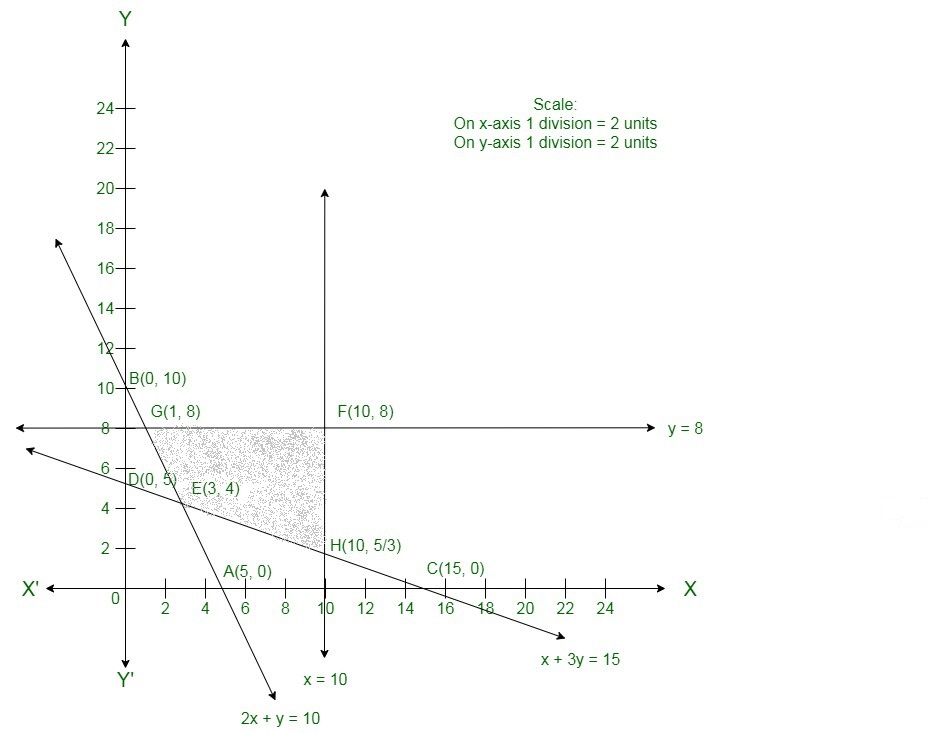
Area shown by 2x + y ≥ 10:The line 2x + y = 10 meets the coordinate axes at A(5, 0) and B(0, 10) respectively.
After connecting these points we will get the line 2x + y = 10.
Thus,
(0,0) does not assure the in equation 2x + y ≥ 10.
Thus,
The area in xy plane which does not have the origin represents the solution set of the in equation 2x + y ≥ 10.
The area represented by x + 3y ≥ 15:The line x + 3y = 15 connects the coordinate axes at C(15, 0) and D(0, 5) respectively.
After connecting these points we will get the line x + 3y = 15.
Thus,
(0,0) assure the in equation x + 3y ≥ 15.
The area in xy plane which does not have the origin represents the solution set of the in equation x + 3y ≥ 15.
The line x = 10 is the line that passes through the point (10, 0) and is parallel to Y axis.x ≤ 10 is the area to the left of the linex = 10.
The line y = 8 is the line that passes through the point (0, 8) and is parallel to X axis.y ≤ 8 is the area below the line y = 8.
The area shows by x ≥ 0 and y ≥ 0:Thus,
All point in the first quadrant assure these in equations.
Thus,
The first quadrant is the area shows by the in equations x ≥ 0 and y ≥ 0.
The suitable area determined by the system of constraints, 2x + y ≥ 10, x + 3y ≥ 15, x ≤ 10, y ≤ 8, x ≥ 0 and y ≥ 0 are asfollows.
The corner points of the suitable region areE(3, 4),
H
(10,\ \frac{5}{3}) ,F(10, 8) and
G(1, 8).
The values of Z at these corner points are as follows.
Corner point Z = 5x + 3y
E(3, 4)
5 × 3 + 3 × 4 = 27
H(10,53)
5 × 10 + 3×
\frac{5}{3} = 55F(10, 8)
5 × 10 + 3 × 8 = 74
G(1, 8)
5 × 1 + 3 × 8 = 29
Hence,
The minimum value of Z is 27 at the point F(3, 4).
Therefore,
x = 3 and y =4 is the best solution of the given LPP.
Hence, the best value of Z is 27.
Question 12. Minimize Z = 30x + 20y
Subject to
x + y ≤ 8
x + 4y ≥ 12
5x + 8y = 20
x, y ≥ 0
Solution:
Convert the given in equations into equations, we will get the following equations:
x + y = 8, x + 4y = 12, x = 0 and y = 0
5x + 8y = 20 is already an equation.
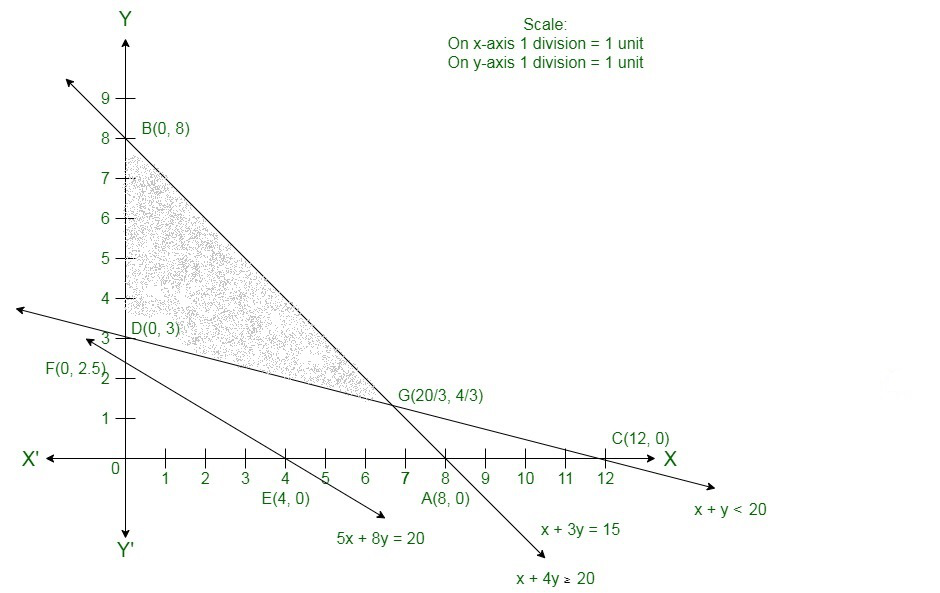
The area shows by x + y ≤ 8:The line x + y = 8 connects the coordinate axes at A(8, 0) and B(0, 8) respectively.
After connecting these points we will get the line x + y = 8.
Thus,
(0,0) assures the in equation x + y ≤ 8.
Thus,
The area in xy plane which have the origin represents the solution set of the in equation x + y ≤ 8.
The area shows by x + 4y ≥ 12:The line x + 4y = 12 connects the coordinate axes at C(12, 0) and D(0, 3) respectively.
After connecting these points we will get the line x + 4y = 12.
Thus,
(0,0) assure the in equation x + 4y ≥ 12.
Thus,
The area in xy plane which does not have the origin shows the solution set of the in equation x + 4y ≥ 12.
The line 5x + 8y = 20 is the line that passes through E(4, 0) and F(0,\ \frac{5}{2}) .
The area shows by x ≥ 0 and y ≥ 0:Thus,
All point in the first quadrant assure these in equations.
Thus,
The first quadrant is the area shows by the in equations x ≥ 0 and y ≥ 0.
The suitable area determined by the system of constraints, x + y ≤ 8, x + 4y ≥ 12, 5x + 8y = 20, x ≥ 0 and y ≥ 0 are as follows.The corner points of the suitable area are B(0,8), D(0,3), G
\left(\frac{20}{3},\ \frac{4}{3}\right) .
The values of Z at these corner points are as follows.
Corner point Z = 30x + 20y
B(0,8)
160
D(0,3)
60
G
\left(\frac{20}{3},\ \frac{4}{3}\right) 266.66
Hence,
The minimum value of Z is 60 at the point D(0,3).
Therefore,
x = 0 and y =3 is the best solution of the given LPP.
Therefore,
The best value of Z is 60.
Question 13. Maximize Z = 4x + 3y
Subject to
3x + 4y ≤ 24
8x + 6y ≤ 48
x ≤ 6000
x ≤ y
x, y ≥ 0
Solution:
Here, we need to maximize Z = 4x + 3y
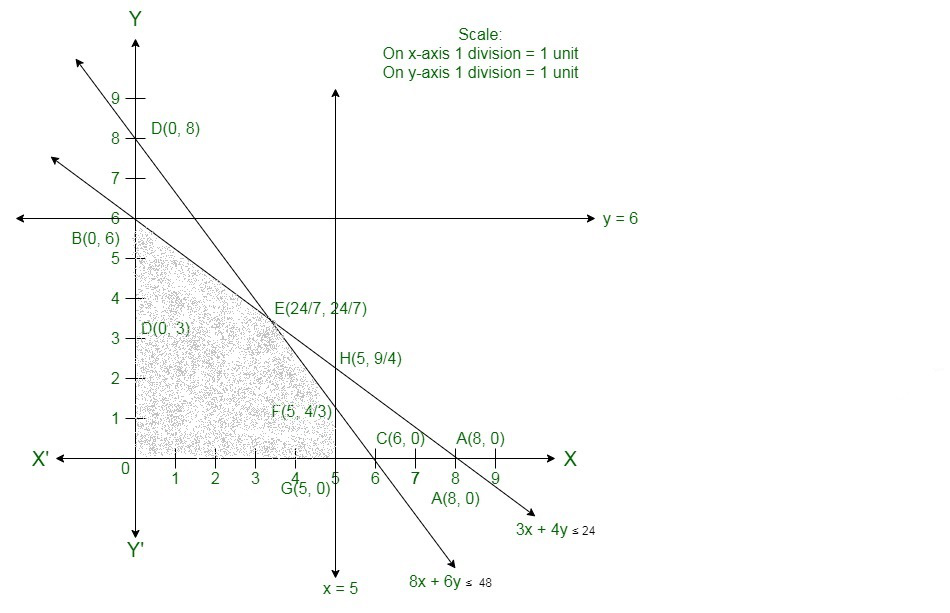
Convert the given in equations into equations, we will get the following equations:3x + 4y = 24, 8x + 6y = 48, x = 5 , y = 6, x = 0 and y = 0.
The line 3x + 4y = 24 connects the coordinate axis at A(8, 0) and B(0,6).Connects these points to get the line 3x + 4y = 24.
Thus,
(0, 0) assure the in equation 3x + 4y ≤ 24.
Thus,
The area in xy-plane that have the origin represents the solution set of the given equation.
The line 8x + 6y = 48 connects the coordinate axis at C(6, 0) and D(0,8).Connect these points to get the line 8x + 6y = 48.
Thus,
(0, 0) assure the in equation 8x + 6y ≤ 48.
Thus,
The area in xy-plane that have the origin represents the solution set of the given equation.
x = 5 is the line passing through x = 5 parallel to the Y axis.y = 6 is the line passing through y = 6 parallel to the X axis.
The area shown by x ≥ 0 and y ≥ 0:Hence,
All the points in the first quadrant assure these in equations.
Thus,
The first quadrant is the area shown by the in equations.
These lines are drawn using a suitable scale.
The corner points of the feasible region are O(0, 0), G(5, 0), F
(5,\ \frac{4}{3}) , E(\frac{24}{7},\ \frac{24}{7}) and B(0, 6).The values of Z at these corner points are as follows.
Corner point
Z = 4x + 3y
O(0, 0)
4× 0 + 3 × 0 = 0
G(5, 0) G5, 0
4 × 5 + 3 × 0 = 20
F
(5,\ \frac{4}{3}) 4 × 5 + 3 ×
\frac{4}{3} = 24E
(\frac{24}{7},\ \frac{24}{7}) 4 ×
\frac{24}{7} + 3 ×\frac{24}{7} =\frac{168}{7} = 24B(0, 6)B0, 6
4 × 0 + 3 × 6 = 18
Here we can see that the maximum value of the objective function Z is 24 which is at F(5,\ \frac{4}{3}) and E(\frac{24}{7},\ \frac{24}{7}) .Therefore,
The best value of Z is 24.
Question 14. Minimize Z = x - 5y + 20
Subject to
x - y ≥ 0
-x + 2y ≥ 2
x ≥ 3
y ≤ 4
x, y ≥ 0
Solution:
Convert the given in equations into equations, we will get the following equations:
x − y = 0, − x + 2y = 2, x = 3, y = 4, x = 0 and y = 0.
The area shown by x − y ≥ 0 or x ≥ y:The line x − y = 0 or x = y passes through the origin.The area to the right of the line x = y will assure the given in equation.
Now we will check by taking an example like if we take a point (4, 3) to the right of the line x = y .
Here, x ≥ y.
Thus,
It assure the given in equation.
Take a point (4, 5) to the left of the line x = y. Here, x ≤ y. That means it does not assure the given in equation.
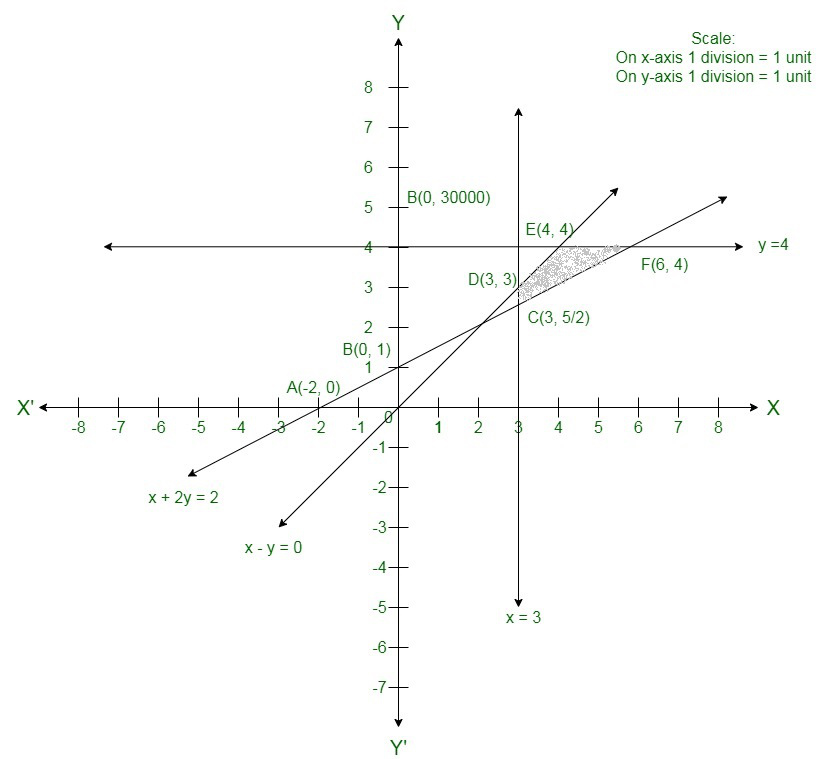
The area shown by − x + 2y ≥ 2:The line − x + 2y = 2 connects the coordinate axes at A(−2, 0) and B(0, 1) respectively.
After connecting these points we will get the line − x + 2y = 2.
Thus,
(0,0) does not assure the in equation − x + 2y ≥ 2.
Thus,
The area in xy plane which does not have the origin represents the solution set of the in equation − x + 2y ≥ 2 .
The line x = 3 is the line that passes through the point (3, 0) and is parallel to Y axis. x ≥ 3 is the area to the right of theline x = 3.
The line y = 4 is the line that passes through the point (0, 4) and is parallel to X axis. y ≤ 4 is the area below the line y = 4.
The area shown by x ≥ 0 and y ≥ 0:Hence,
All point in the first quadrant assure these in equations.
Thus, the first quadrant is the area shown by the in equations x ≥ 0 and y ≥ 0.
The suitable area determined by the system of constraints x − y ≥ 0,− x + 2y ≥ 2, x ≥ 3, y ≤ 4, x ≥ 0 and y ≥ 0 are as follows.
The corner points of the suitable area are C
(3,\ \frac{5}{2}) , D(3, 3), E(4, 4) and F(6, 4).The values of Z at these corner points are as follows.
Corner point
Z = x − 5y + 20
C
(3,\ \frac{5}{2}) 3 − 5 ×
\frac{5}{2} + 20 =\frac{21}{2} D(3, 3)D3, 3
3 − 5 × 3 + 20 = 8
E(4, 4)
4 − 5 × 4 + 20 = 4
F(6, 4)
6 − 5 × 4 + 20 = 6
Hence,
The minimum value of Z is 4 at the point E(4, 4).
Therefore,
x = 4 and y = 4 is the best solution of the given LPP.
Hence,
The best value of Z is 4.
Question 15. Maximize Z = 3x + 5y
Subject to
x + 2y ≤ 20
x + y ≤ 15
y ≤ 15
x, y ≥ 0
Solution:
Here we need to maximize Z = 3x + 5y
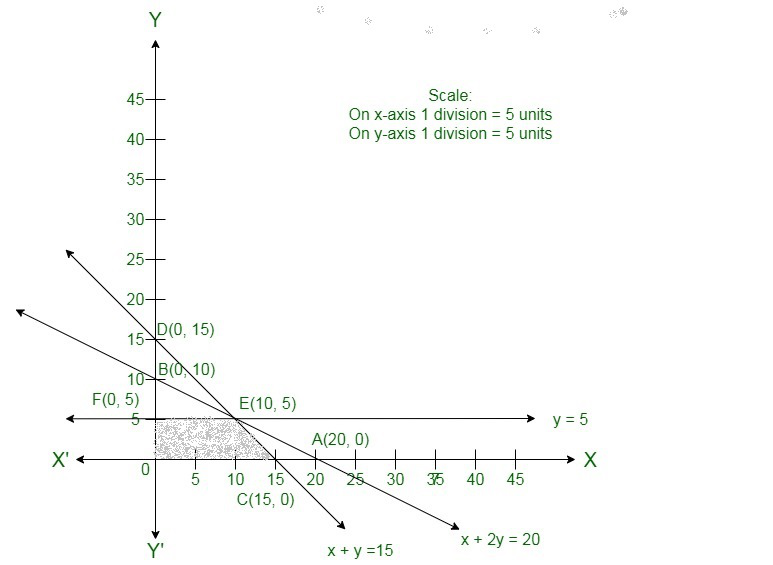
Convert the given in equations into equations, we will get the following equations:x + 2y = 20, x + y = 15, y = 5, x = 0 and y = 0.
The line x + 2y = 20 connects the coordinate axis at A(20, 0) and B(0,10).Connect these points to get the line x + 2y = 20.
Thus,
(0, 0) assume the in equation x + 2y ≤ 20.
Thus,
The area in xy-plane that have the origin represents the solution set of the given equation.
The line x + y = 15 connect the coordinate axis at C(15, 0) and D(0,15).Connect these points to get the line x + y = 15.
Thus,
(0, 0) assume the in equation x + y ≤ 15.
Thus,
The area in xy-plane that have the origin represents the solution set of the given equation.
y = 5 is the line passing through (0, 5) and parallel to the X axis. The area below the line y = 5 will assure the given in equation.
The area shown by x ≥ 0 and y ≥ 0:Hence,
All the point in the first quadrant assure these in equations.
Thus,
The first quadrant is the area shown by the in equations.
These lines are drawn using a suitable scale.
The corner points of the suitable area are O(0, 0), C(15, 0), E(10, 5) and F(0, 5)
The values of Z at these corner points are as follows.
Corner point
Z = 3x + 5y
O(0, 0)
3 × 0 + 5 × 0 = 0
C(15, 0)
3 × 15 + 5 × 0 = 45
E(10, 5)
3 × 10 + 5 × 5 = 55
F(0, 5)
3 × 0 + 5 × 5 = 25
Here we can see that the maximum value of the objective function Z is 55 which is at E(10, 5).
Therefore,
The best value of Z is 55.
Question 16. Minimize Z = 3x1 + 5x2
Subject to
x1 + x2 ≥ 3
x1 + x2 ≥ 2
x1, x2 ≥ 0
Solution:
Convert the given in equations into equations, we will get the following equations:
x1 + 3x2 = 3, x1 + x2 = 2, x1 = 0 and x2 = 0
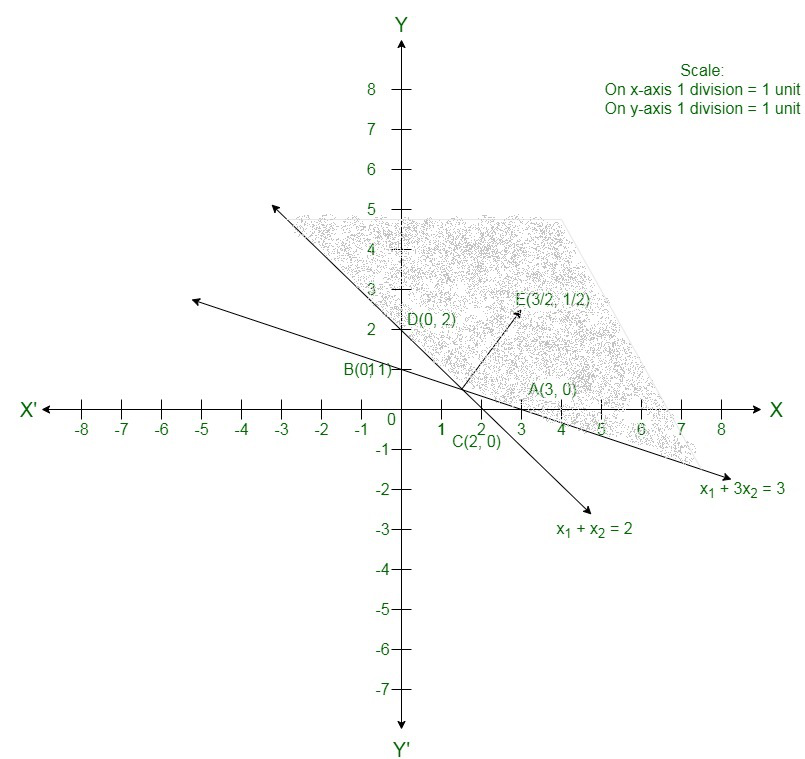
The area shown by x1 + 3x2 ≥ 3 :The line x1 + 3x2 = 3 connects the coordinate axes at A(3, 0) and B(0, 1) respectively.
After connecting these points we will get the line x1 + 3x2 = 3.
Thus,
(0,0) does not assure the in equation x1 + 3x2 ≥ 3.
Thus,
The area in the plane which does not have the origin represents the solution set of the in equation x1 + 3x2 ≥ 3.
The area shown by x1 + x2 ≥ 2:The line x1 + x2 = 2 connects the coordinate axes at C(2, 0) and D(0, 2) respectively.
After connecting these points we will get the line x1 + x2 = 2.
Thus,
(0,0) does not assure the in equation x1 + x2 ≥ 2.
Thus,
The area having the origin represents the solution set of the in equation x1 + x2 ≥ 2.
The area shown by x1 ≥ 0 and x2 ≥ 0:Hence,
All the points in the first quadrant assure these in equations.
Thus,
The first quadrant is the area shown by the in equations x1 ≥ 0 and x2 ≥ 0.
The suitable area determined by the system of constraints, x1 + 3x2 ≥ 3 , x1 + x2 ≥ 2, x1 ≥ 0, and x2 ≥ 0, are as follows.The corner points of the suitable area are O(0, 0), B(0, 1), E
(\frac{3}{2},\ \frac{1}{2}) and C(2, 0).The values of Z at these corner points are as follows.
Corner point
Z = 3x1 + 5x2
O(0, 0)
3 × 0 + 5 × 0 = 0
B(0, 1)
3 × 0 + 5 × 1 = 5
E
(\frac{3}{2},\ \frac{1}{2}) 3 ×
\frac{3}{2} + 5 ×\frac{1}{2} = 7C(2, 0)
3 × 2 + 5 × 0 = 6
Hence,
The minimum value of Z is 0 at the point O(0, 0).
Hence,
x1 = 0 and x2 = 0 is the best solution of the given LPP.
Therefore,
The best value of Z is 0.
Question 17. Maximize Z = 2x + 3y
Subject to
x + y ≥ 1
10x + y ≥ 5
x + 10y ≥ 1
x, y ≥ 0
Solution:
Convert the given in equations into equations, we will get the following equations:
x + y = 1, 10x +y = 5, x + 10y = 1, x = 0 and y = 0
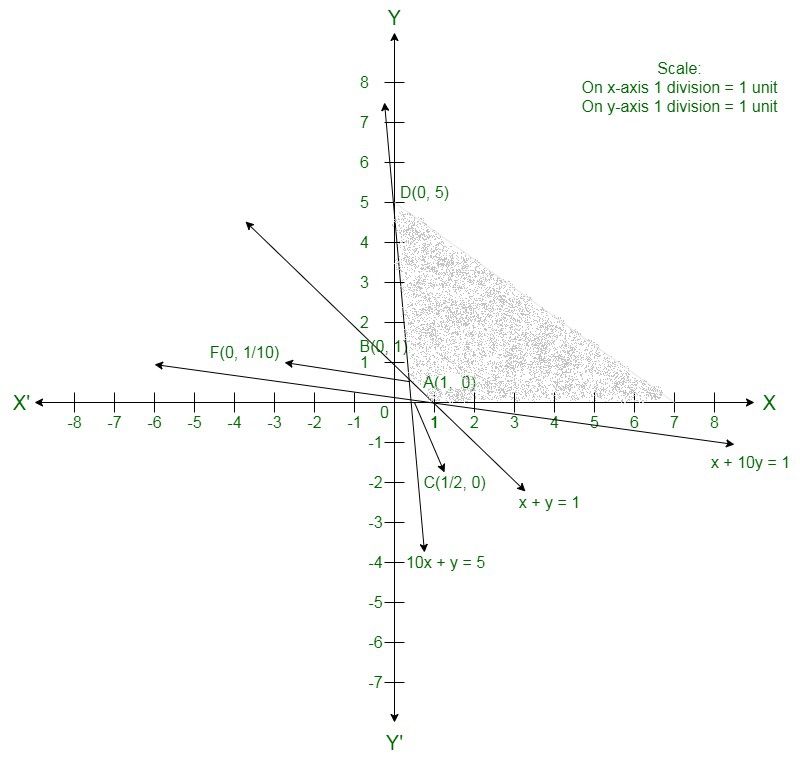
The area shown by x + y ≥ 1:The line x + y = 1 connects the coordinate axes at A(1, 0) and B(0,1) respectively.
After connecting these points we will get the line x + y = 1.
Thus,
(0,0) does not assure the in equation x + y ≥ 1.
Thus,
The area in xy plane which does not have the origin represents the solution set of the in equation x + y ≥ 1.
The area shown by 10x +y ≥ 5:The line 10x +y = 5 connect the coordinate axes at C
(\frac{1}{2},\ 0) and D(0, 5) respectively.After connecting these points we will get the line 10x +y = 5.
Thus,
(0,0) does not assure the in equation 10x +y ≥ 5.
Thus, the area which does not have the origin represents the solution set of the in equation 10x +y ≥ 5.
The area shown by x + 10y ≥ 1:The line x + 10y = 1 connect the coordinate axes at A(1, 0) and F
(0,\ \frac{1}{10}) respectively.After connecting these points we will have the line x + 10y = 1.
Thus,
(0,0) does not assure the in equation x + 10y ≥ 1.
Thus, the area which does not have the origin represents the solution set of the in equation x + 10y ≥ 1.
The area shown by x ≥ 0 and y ≥ 0:Here,
All the points in the first quadrant assure these in equations.
Thus,
The first quadrant is the area shown by the in equations x ≥ 0, and y ≥ 0.
The suitable area determined by the system of constraints x + y ≥ 1, 10x +y ≥ 5, x + 10y ≥ 1, x ≥ 0, and y ≥ 0, are as follows.
The suitable area is unbounded.Hence,
The maximum value is infinity i.e. the solution is unbounded.
Question 18. Maximize Z = -x1 + 2x2
Subject to
-x1 + 3x2 ≤ 10
x1 + x2 ≤ 6
x1 - x2 ≤ 2
x1, x2 ≥ 0
Solution:
Convert the given in equations into equations, we will get the following equations:
−x1 + 3x2 = 10, x1 + x2 = 6, x1 + x2 = 2, x1 = 0 and x2 = 0
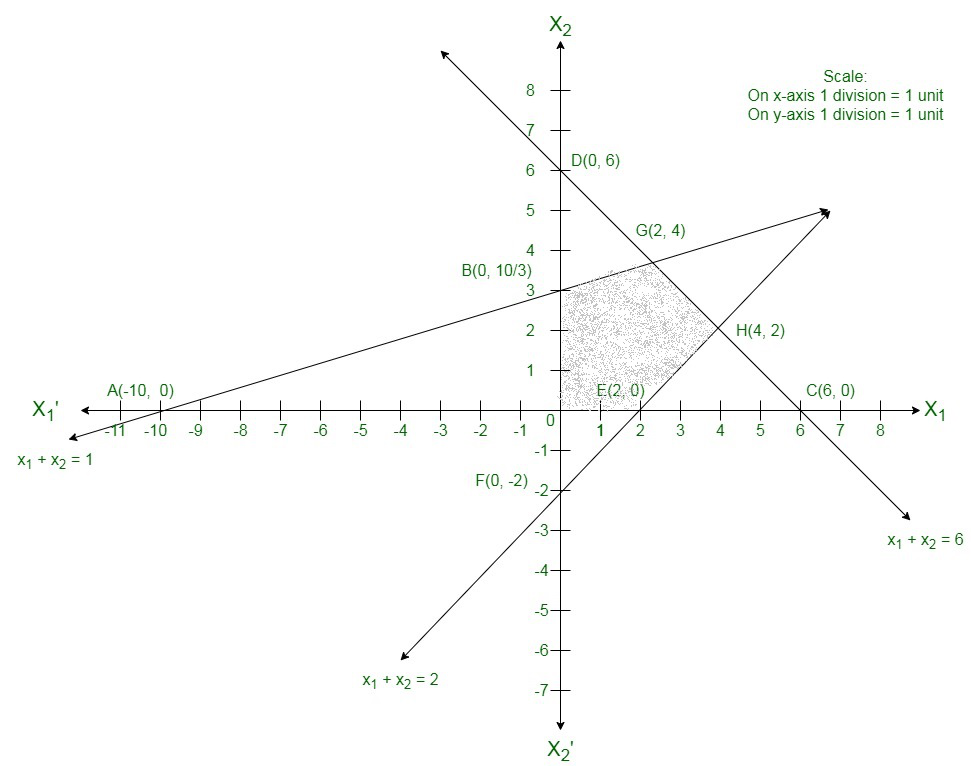
The area shown by −x1 + 3x2 ≤ 10:The line −x1 + 3x2 = 10 coincide the coordinate axes at A(−10, 0) and B
(0,\ \frac{10}{3}) respectively.After connecting these points we will get the line −x1 + 3x2 = 10.
Thus,
(0,0) satisfies the in equation −x1 + 3x2 ≤ 10 .
Thus,
The area region in the plane which have the origin shows the solution set of the in equation
−x1 + 3x2 ≤ 10.
The area shown by x1 + x2 ≤ 6:The line x1 + x2 = 6 connects the coordinate axes at C(6, 0) and D(0, 6) respectively.
After connecting these points we will get the line x1 + x2 = 6.
Thus,
(0,0) assure the in equation x1 + x2 ≤ 6.
Thus,
The area having the origin represents the solution set of the in equation x1 + x2 ≤ 6.
The area shown by x1− x2 ≤ 2:The line x1 − x2 = 2 coincide the coordinate axes at E(2, 0) and F(0, −2) respectively.
After connecting these points we will get the line x1 − x2 = 2.
Thus,
(0,0) assure the in equation x1− x2 ≤ 2.
Thus,
The area having the origin represents the solution set of the in equation x1− x2 ≤ 2.
The area shown by x1 ≥ 0 and x2 ≥ 0:Hence,
All the points in the first quadrant assure these in equations.
Thus,
The first quadrant is the region shown by the in equations x1 ≥ 0 and x2 ≥ 0.
The suitable area determined by the system of constraints, −x1 + 3x2 ≤ 10, x1 + x2 ≤ 6, x1− x2 ≤ 2, x1 ≥ 0, and x2 ≥ 0, are as follows.The corner points of the assure area are O(0, 0), E(2, 0), H(4, 2), G(2, 4) and B
(0,\ \frac{10}{3}) .The values of Z at these corner points are as follows.
Corner point
Z = −x1 + 2x2
O(0, 0)
−1 × 0 + 2 × 0 = 0
E(2, 0)
−1 × 2 + 2 × 0 = −2
H(4, 2)
−1 × 4 + 2 × 2 = 0
G(2, 4)
−1 × 2 + 2 × 4 = 6
B
(0,\ \frac{10}{3}) −1 × 0 + 2 ×
\frac{10}{3} =\frac{20}{3} Here we can see that the maximum value of the objective function Z is
\frac{20}{3} which is at B(0,\ \frac{10}{3}) .
Question 19. Maximize Z = -x + y
Subject to
-2x + y ≤ 1
x ≤ 2
x + y ≤ 3
x, x ≥ 0
Solution:
Here we need to maximize Z = x + y
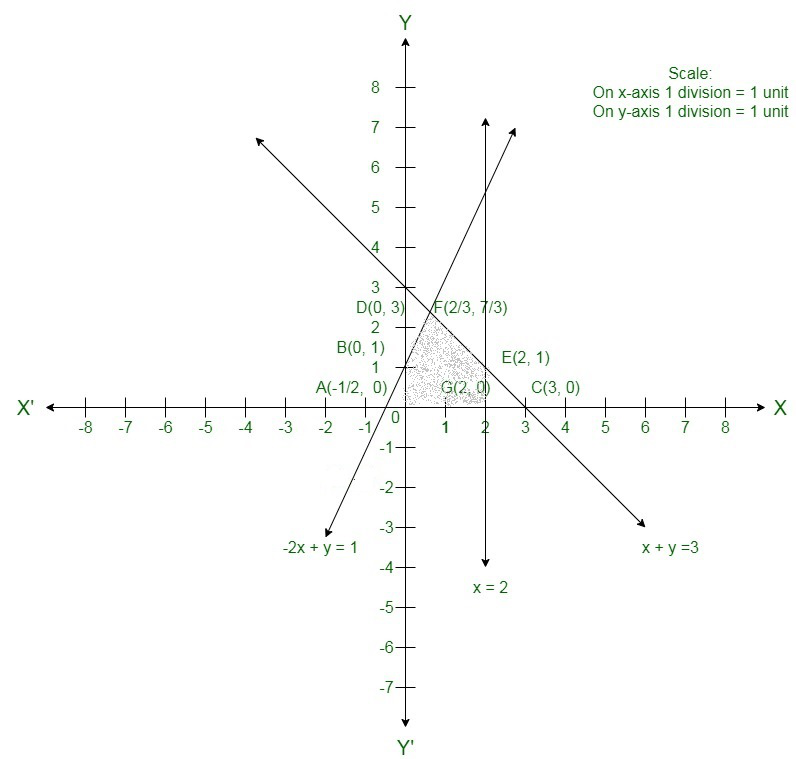
Convert the given in equations into equations, we will get the following equations:−2x + y = 1, x = 2, x + y = 3, x = 0 and y = 0.
The line −2x + y = 1 coincide the coordinate axis at A(\frac{-1}{2},\ 0) and B(0, 1).Now connect these points to get the line −2x + y = 1 .
Thus,
(0, 0) assure the in equation −2x + y ≤ 1.
Thus,
The area in xy-plane that have the origin represents the solution set of the given equation.
x = 2 is the line passing through (2, 0) and parallel to the Y axis.The area below the line x = 2 will assure the given in equation.
The line x + y = 3 coincide the coordinate axis at C(3, 0) and D(0, 3).Connect these points to get the line x + y = 3.
Thus,
(0, 0) assure the in equation x + y ≤ 3.
Thus,
The area in xy-plane that have the origin shows the solution set of the given equation.
The area shown by x ≥ 0 and y ≥ 0:Hence,
All the points in the first quadrant assures these in equations.
Thus,
The first quadrant is the area shown by the in equations.
These lines are drawn using a satisfactory scale.
The corner points of the suitable area are O(0, 0),G(2, 0), E(2, 1) and F
(\frac{2}{3},\ \frac{7}{3}) The values of Z at these corner points are as follows.
Corner point
Z = x + y
O(0, 0)
0 + 0 = 0
C(2, 0)
2 + 0 = 2
E(2, 1)
2 +1 = 3
F
(\frac{2}{3},\ \frac{7}{3})
\frac{2}{3}+\frac{7}{3}=\frac{9}{3}=3
Here we can see that the maximum value of the objective function Z is 3 which is at E(2, 1) and F(\frac{2}{3},\ \frac{7}{3}) .Therefore,
The best value of Z is 3.
Question 20. Maximize Z = -3x1 + 4x2
Subject to
x1 - x2 ≤ -1
x1 + x2 ≤ 0
x1, x2 ≥ 0
Solution:
Convert the given in equations into equations, we will get the following equations:
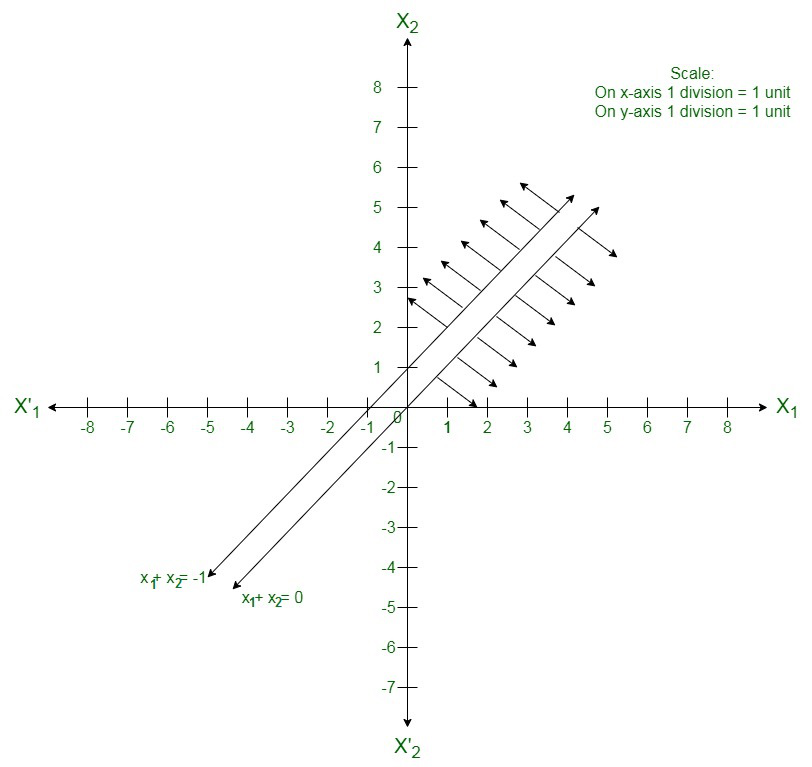
x1 − x2 = −1, −x1 + x2 = 0, x1 = 0 and x2 = 0
The area shown by x1 − x2 ≤ −1:The line x1 − x2 = −1 coincide the coordinate axes at A(−1, 0) and B(0, 1) respectively.
After connecting these points we will get the line x1 − x2 = −1.
Thus,
(0,0) does not assures the in equation x1 − x2 ≤ −1 .
Thus,
The area in the plane which does not have the origin shows the solution set of the in equation x1 − x2 ≤ −1.
The area shown by −x1 + x2 ≤ 0 or x1 ≥ x2:The line −x1 + x2 = 0 or x1 = x2 is the line passing through (0, 0).
The area to the right of the line x1 = x2 will assure the given in equation −x1 + x2 ≤ 0.
If we mark a point (1, 3) to the left of the line x1 = x2.Here, 1≤3 which is not assuring the in equation x1 ≥ x2.
Hence,
The area to the right of the line x1 = x2 will assure the given in equation −x1 + x2 ≤ 0.
The area shown by x1 ≥ 0 and x2 ≥ 0:Thus,
All the points in the first quadrant assure these in equations.
Thus,
The first quadrant is the area shown by the in equations x1 ≥ 0 and x2 ≥ 0.
The suitable area determined by the system of constraints, x1 − x2 ≤ −1, −x1 + x2 ≤ 0, x1 ≥ 0, and x2 ≥ 0, are as follows.Here we can see that the suitable area of the given LPP does not exist.
Practice Questions on Linear Programming
Question 1. A company manufactures two types of products, A and B. Each unit of A requires 2 hours of machining and 3 hours of labor, while each unit of B requires 3 hours of machining and 2 hours of labor. The company has 100 hours of machining time and 90 hours of labor available per week. If the profit per unit of A is Rs. 50 and per unit of B is Rs. 60, formulate a linear programming problem to maximize the profit.
Question 2. A diet is to contain at least 80 units of vitamin A and 100 units of vitamin C. Two foods X and Y are available. A unit of X costs Rs. 4 and contains 3 units of vitamin A and 4 units of vitamin C. A unit of Y costs Rs. 6 and contains 6 units of vitamin A and 3 units of vitamin C. Formulate this as a linear programming problem to minimize the cost of the diet.
Question 3. A farmer has 1000 acres of land on which he can grow wheat or barley. Each acre of wheat requires 20 kg of fertilizer and 5 hours of labor, while each acre of barley requires 40 kg of fertilizer and 4 hours of labor. The farmer has 40,000 kg of fertilizer and 5000 hours of labor available. If the profit per acre of wheat is Rs. 2000 and per acre of barley is Rs. 3000, set up a linear programming problem to maximize the farmer's profit.
Question 4. A company produces two types of chairs: standard and deluxe. Each standard chair requires 4 units of wood and 6 units of labor, while each deluxe chair requires 8 units of wood and 4 units of labor. The company has 160 units of wood and 120 units of labor available. If the profit on a standard chair is Rs. 80 and on a deluxe chair is Rs. 120, formulate a linear programming problem to maximize the profit.
Question 5. A factory produces two types of toys: dolls and cars. Each doll requires 2 hours in the cutting department and 1 hour in the finishing department. Each car requires 1 hour in the cutting department and 3 hours in the finishing department. The cutting department has 100 hours available, and the finishing department has 90 hours available. The profit on each doll is Rs. 30 and on each car is Rs. 20. Formulate this as a linear programming problem to maximize the profit.
Question 6. A company manufactures two types of products, X and Y. Each unit of X requires 2 kg of raw material A and 3 kg of raw material B, while each unit of Y requires 4 kg of A and 1 kg of B. The company has 800 kg of A and 600 kg of B available. If the profit per unit of X is Rs. 30 and per unit of Y is Rs. 50, formulate a linear programming problem to maximize the profit.
Question 7. A bakery produces two types of cakes: chocolate and vanilla. Each chocolate cake requires 200g of flour and 25g of cocoa, while each vanilla cake requires 100g of flour and 50g of vanilla essence. The bakery has 20 kg of flour, 1 kg of cocoa, and 2 kg of vanilla essence available. If the profit on a chocolate cake is Rs. 40 and on a vanilla cake is Rs. 30, set up a linear programming problem to maximize the profit.
Question 8. A company produces two types of beverages: cola and lemonade. Each liter of cola requires 0.6 units of flavoring and 0.8 units of carbonation, while each liter of lemonade requires 0.4 units of flavoring and 0.6 units of carbonation. The company has 480 units of flavoring and 640 units of carbonation available. If the profit per liter of cola is Rs. 12 and per liter of lemonade is Rs. 10, formulate a linear programming problem to maximize the profit.
Question 9. A furniture company manufactures tables and chairs. Each table requires 4 units of wood and 2 units of labor, while each chair requires 3 units of wood and 1 unit of labor. The company has 240 units of wood and 100 units of labor available. If the profit on a table is Rs. 60 and on a chair is Rs. 40, formulate this as a linear programming problem to maximize the profit.
Question 10. An airline company offers two types of seats: economy and business. Each economy seat occupies 3 square feet of space and generates a profit of Rs. 4000, while each business seat occupies 4 square feet and generates a profit of Rs. 7000. If the total available space is 180 square feet and the airline wants to have at least 20 economy seats and at least 10 business seats, formulate a linear programming problem to maximize the profit.
Also Read,
Conclusion
This exercise is part of Chapter 30 on Linear Programming from the RD Sharma Solutions for Class 12 Mathematics. Exercise 30.2 Set 2 likely focuses on applying linear programming techniques to solve practical problems. It typically includes word problems that students need to translate into mathematical models, formulate objective functions and constraints, and then solve using graphical or algebraic methods. The problems in this set may cover various real-world scenarios such as production planning, resource allocation, or optimization tasks, helping students understand how linear programming can be used to make informed decisions in business and industry.