
A polygon is a closed 2D shape made by joining three or more straight line segments.
The area of a polygon is the amount of space enclosed within its sides in a two-dimensional plane, measured in square units. It depends on the shape and size of the polygon, and different polygons have different formulas to calculate it.
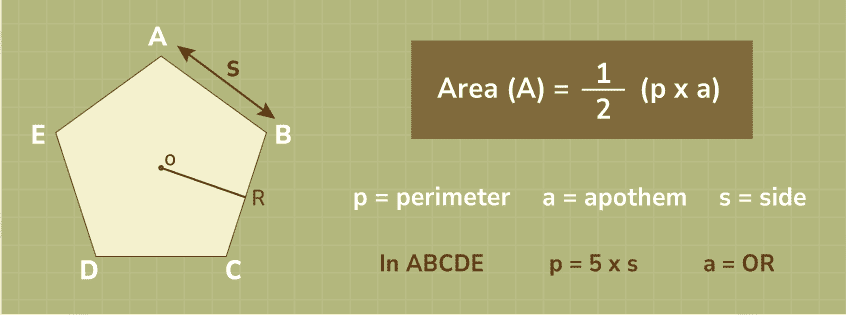
Formulas
The area of a polygon is calculated using different formulas for regular and irregular shapes, as shown for common polygons below:
- Area of Triangle = (1/2) × base × height
- Area of Rectangle = length × width
- Area of Parallelogram = base × height
- Area of Trapezium = (1/2) × (sum of lengths of its parallel sides or bases) × height
- Area of Rhombus = (1/2) × (product of diagonals)
- Area of Quadrilateral = (1/2) × Diagonal × (Sum of heights)
Area of Regular Polygons
A regular polygon is a polygon that has equal sides and equal angles. Thus, the technique to calculate the value of the area of regular polygons is based on the formulas associated with each polygon.
Regular Polygon | Area Formula |
|---|---|
| Area of an Equilateral Triangle | √3(side)2/4 |
| Area of a Square | side × side |
| Area of a Regular Pentagon | (5/2) (side) × (apothem) |
Now we see that the formula for area is different for different types of polygons. Suppose we have to give a common formula to find the area of a regular polygon. Then the formula for the same is,
A polygon having equal sides and equal angles is a regular polygon.
Area of Regular Polygon = (½) × Perimeter × Apothem
Area of Regular Polygon = (½) × (Number of Sides) × (Length of One Side) × (Apothem)
Example: Find the area of the regular polygon if the perimeter of the polygon is 20 cm and the apothem is 5 cm.
Solution:
Given,
- Perimeter of Polygon = 20 cm
- Length of Apothem = 5 cm
Area of Regular Polygon(A) = (½) × Perimeter × Apothem
A = (½) × 20 cm × 5 cm
A = 50 cm2
Thus, the area of the regular polygon is 50 cm2
Area of Irregular Polygon
An irregular polygon is a polygon in which all the sides are unequal. To find the area of an irregular polygon, we first divide the irregular polygon into smaller polygons, such as triangles and quadrilaterals, and then the area of each smaller polygon is found, and then the sum of all the polygons is found, which gives the area of the irregular polygon.
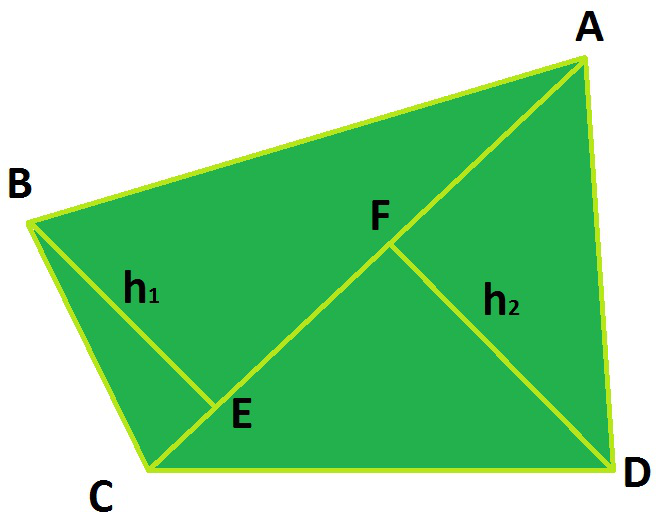
Area of Quadrilateral(ABCD) = (Area of Triangle ABC) + (Area of Triangle ACD)
In the above figure, the diagonal AC will act as a common base of the two triangles ABC and ADC with heights h1 and h2, respectively.
Area of Quadrilateral (ABCD) = Area of Triangle (ABC) + Area of Triangle (ACD)
Area of Quadrilateral (ABCD) = (1/2) × AC × h1 + (1/2) × AC × h2
Area of Quadrilateral (ABCD) = (1/2) × AC × (h1 + h2)
Thus, the area of the quadrilateral (ABCD) is (1/2) × AC × (h1 + h2).
Area of Polygons with Coordinates
If the coordinates of any polygon are given, then its area is calculated using the steps discussed below.
Step 1: First, find the distance of all the sides of the polygon, using the distance formula as,
D = \sqrt{(x_2 - x_1)^2 + (y_2 - y_1)^2}
Step 2: Finding all the sides of the polygon, we first check whether the polygon is a regular polygon or not.
Step 3: Now, if the polygon is regular, then use the formula.
Area of Regular Polygon = (Number of Sides × Length of One Side × Apothem)/2
Step 4: If the polygon is irregular, then its area is calculated by dividing the polygon into smaller polygons, and then the area of the smaller polygon is found using the known formula. And then the sum is found, which gives the area of the irregular polygon.
Example: Find the area of the polygon with coordinates A(1, 1), B(4, 1), C(1, 3), and D(4, 3)
Solution:
Rearrange the points in proper order:
A(1,1), B(4,1), D(4,3), C(1,3)AB: y is same ⇒ horizontal line
BD: x is same ⇒ vertical lineThus, adjacent sides are perpendicular ⇒ angle = 90°
So, the figure is a rectangleLength AB = |4 − 1| = 3
Breadth BC = |3 − 1| = 2Area of rectangle = length × breadth
= 3 × 2
= 6
Related Articles
Solved Examples
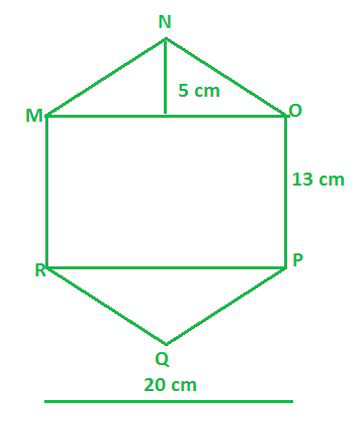
Example 1: Find the area of the given polygon.
Solution:
We are given the above figure which is a Hexagon and we are supposed to find out the area of the above figure MNOPQR.
Area of the figure MNOPQR = Area of triangle MNO + Area of triangle PQR + Area of rectangle MOPR
Area of the figure MNOPQR = (1/2) × MO × NK +(1/2) × PR × QL + PO × MO
Area of the figure MNOPQR = (1/2) × 20 × 5 + (1/2) x 20 × 5 + 13 × 20
Area of the figure MNOPQR = 10 × 5 + 10 × 5 + 260
Area of the figure MNOPQR = 50 cm2+ 50 cm2 + 260 cm2
Area of the figure MNOPQR = 360 cm2
Hence, the area of the given Hexagon MNOPQR is 360 cm2.
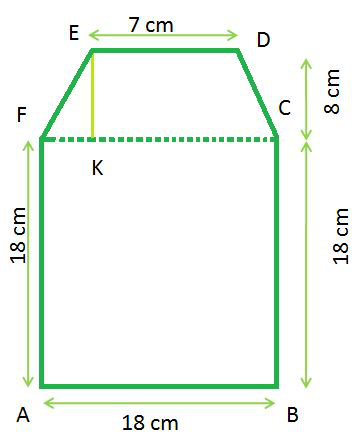
Example 2: Find the area of the given polygon.
Solution:
We are given the above figure which is a Hexagon and we are supposed to find out the area of the above figure ABCDEF.
Area of the figure ABCDEF = Area of Trapezium DEFC + Area of Square ABCF
Area of the figure ABCDEF = (1/2) × (ED+FC) × EK + (AF)2
Area of the figure ABCDEF = (1/2) × (7 + 18) × 8 + (18)2
Area of the figure ABCDEF = 4 × 25 + 18 × 18
Area of the figure ABCDEF = 100 cm2 + 324 cm2
Area of the figure ABCDEF = 424 cm2
Hence, the area of the given Hexagon ABCDEF is 424 cm2
Example 3: Find the area of the given polygon.
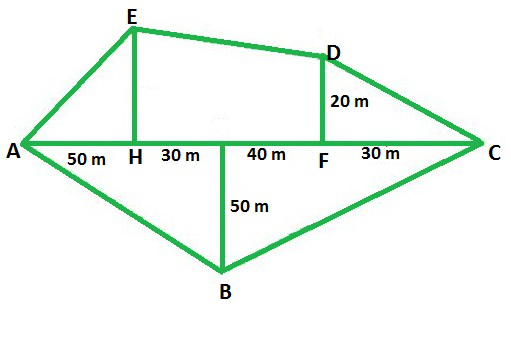
Solution:
We are given the above figure which is a Pentagon and we are supposed to find out the area of the above figure ABCDE.
Area of the figure ABCDE = Area of triangle AHE + Area of Trapezium DEHF + Area of triangle DFC + Area of Triangle ABC
Area of the figure ABCDE = (1/2) × AH × HE + (1/2) × (EH+DF) × HF + (1/2)× FC × DF + (1/2) × AC × GB
Area of the figure ABCDE = (1/2) × 50 × 30 + (1/2) × (30+20) × 70 + (1/2) × 30 × 20 + (1/2) × 150 × 50
Area of the figure ABCDE = 25 × 30 + 50 × 35 + 15 × 20 + 150 × 25
Area of the figure ABCDE = 750 m2 + 1750 m2+ 300 m2+ 3750 m2
Area of the figure ABCDE = 6550 m2
Hence, the area of the given Pentagon ABCDE is 6550 m2.
Example 4: Find the area of the given polygon, where the length of the diagonal AC is 18 cm.
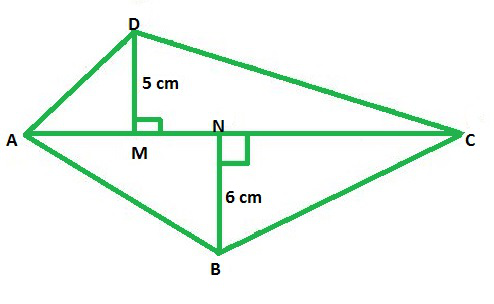
Solution:
We are given the above figure which is a quadrilateral, and we are supposed to find out the area of the above figure ABCD.
Area of the quadrilateral ABCD = Area of triangle ABC + Area of triangle ADC
Area of the quadrilateral ABCD = (1/2) × AC × DM + (1/2) × AC × BN
Area of the quadrilateral ABCD = (1/2) × AC × (BN+DM)
Area of the quadrilateral ABCD = (1/2) × 18 × (6+5)
Area of the quadrilateral ABCD = 9 × 11 cm2
Area of the quadrilateral ABCD = 99 cm2
Hence, the area of the given quadrilateral is 99 cm2.
Example 5: Find the area of the given polygon.
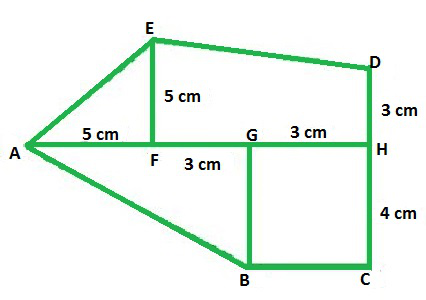
Solution:
We are given the above figure which is a Pentagon and we are supposed to find out the area of the above figure ABCDE.
Area of the figure ABCDE = Area of triangle AGB + Area of Rectangle BCHG + Area of triangle AFE + Area of Trapezium DEFH
Area of the figure ABCDE = (1/2) × AG × BG + BG × GH + (1/2) × AF × FE + (1/2) × (DH+EF) × FH
Area of the figure ABCDE = (1/2) × 8 × 4 + 4 × 3 + (1/2) × 5 × 5 + (1/2) × (3+5) × 6
Area of the figure ABCDE = 4 × 4 + 4 × 3 + 2.5 × 5 + 3 × 8 cm2
Area of the figure ABCDE = 16 + 12 + 12.5 + 24 cm2
Area of the figure ABCDE = 64.5 cm2
Hence, the area of the given Pentagon ABCDE is 64.5 cm2.
Example 6: Find the area of the given polygon.
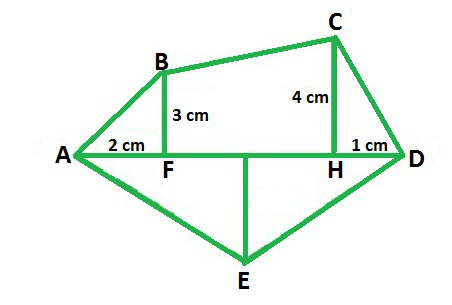
Solution:
We are given the above figure which is a Pentagon, and we are supposed to find out the area of the above figure ABCDE.
Area of the figure ABCDE = Area of triangle ADE + Area of triangle CHD + Area of Trapezium BCHF + Area of triangle ABF
Area of the figure ABCDE = (1/2) *AD*GE + (1/2) *HD*CH + (1/2) *(CH+BF)*FH + (1/2) *AF*BF
Area of the figure ABCDE = (1/2) × 7 × 4 + (1/2) × 1 × 4 + (1/2) × (4+3) × 4 + (1/2) × 2 × 3 cm2
Area of the figure ABCDE = 2 × 7 + 2 + 7 × 2 + 1 × 3 cm2
Area of the figure ABCDE = 14 + 2 + 14 + 3 cm2
Area of the figure ABCDE = 33 cm2
Hence, the area of the given Pentagon ABCDE is 33 cm2.
Practice Questions
Q1: Find the area of an equilateral triangle of side 6 cm.
Q2: Find the Area of a rectangular park whose length is 10 m and breadth is 30 m.
Q3: What is the area of a square whose diagonal is 6 cm?
Q4: What is the area of a rhombus whose diagonals measure 12 cm and 16 cm?
Q5: What is the area of a trapezium whose parallel sides measure 6 and 12 cm and the altitude is 8 cm?
Q6: Find the area of a regular pentagon with a side length of 5 cm.
Q7: A triangular garden has a base of 12 m and a height of 10 m. What is its area?
Q8: Calculate the area of a circle inscribed within a square whose side length is 4 m.
Q9: What is the area of a parallelogram with a base of 8 cm and a height of 5 cm?
Q10: A hexagonal plot of land has a side length of 10 m. Calculate its area.