
The area of a triangle represents the region enclosed by its three sides and is measured in square units. It depends on the triangle’s dimensions, such as its base and corresponding height.
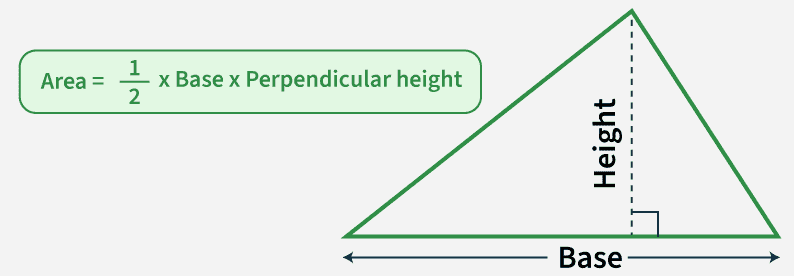
The area can be calculated using the formula:
Area of Triangle =
\frac{1}{2} \times base \times height .
The most general formula for the area of a triangle is given by half the product of its base and height. It applies to all types of triangles, whether they are equilateral, isosceles, or scalene.
Area of a Right-Angled Triangle
A triangle that contains a right angle is considered a right-angled triangle.
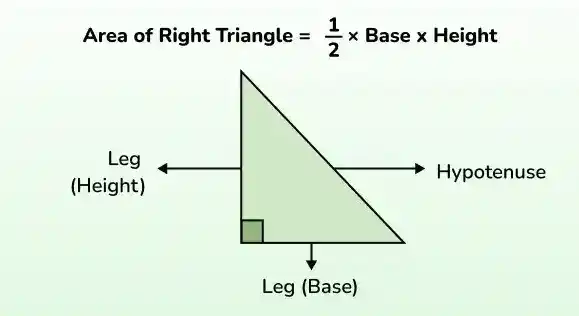
Formula:
A = 1/2 × a × c
where,
a is the base of the triangle
c is the height of the triangle
Example: Find the area of a right-angled triangle having base a = 5 cm and height c = 3 cm.
Solution:
Given:Base of the triangle (a) = 5 cm
Height of the triangle (c) = 3 cmWe have,
Area(A) = 1/2 × a × c
= 1/2 × 5 × 3
= 7.5 cm2
Area of an Equilateral Triangle
An equilateral triangle has all three sides equal and all three angles equal, measuring 60 degrees.
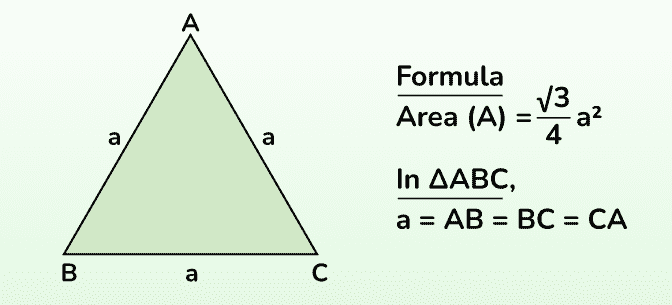
Formula:
A = (√3)/4 × side2
= (√3)/4 × a2
Example: Find the area of an equilateral triangle having a side of 6 cm.
Solution:
Given,side of the triangle (a) = 6 cm
Area(A) = (√3)/4 × a2
= (√3)/4 × 62
= 9√3 cm2
Area of an Isosceles Triangle
An isosceles triangle has two equal sides, and the angles opposite these equal sides are also equal.
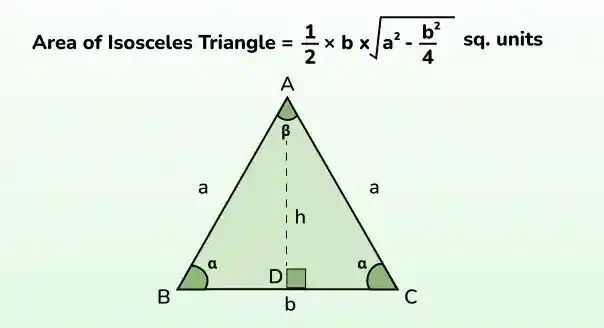
Formula:
A = ½ × b√(a2 - (b2/4))
Where,
a = both the equal sides and b = the third unequal side.
Example: What is the area of an isosceles triangle with sides 5 cm, 5 cm, and 6 cm?
Solution:
Using the Formula: A = ½ × b√(a2 - (b2/4))
- a = 5 cm (the equal sides),
- b = 6 cm (the base).
A = 3 \times \sqrt{25-\frac{36}{4}} = 3 \times \sqrt{25-9} = 3 \times\sqrt{16}
= 3 × 4 = 12 cm².
Area of a Scalene Triangle
A scalene triangle has all three sides of different lengths, and all three angles are different as well.
Key Features:
- No sides are congruent (all sides have different lengths).
- No angles are equal.
- It has no symmetry.
Example: A triangle with sides of 3 cm, 5 cm, and 7 cm is a scalene triangle.
By Heron's Formula
The area of a triangle with three sides given can be found using Heron's Formula. This formula is useful when the height is not given.
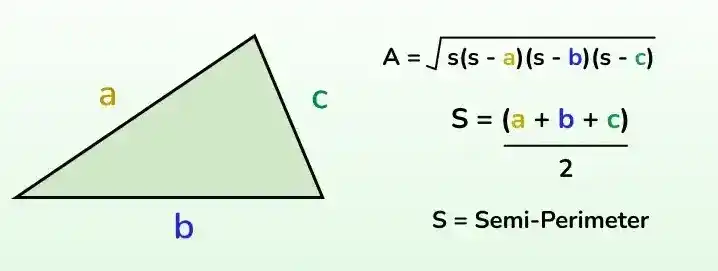
Heron's Formula is given by,
Area of Triangle = √{s(s - a)(s - b)(s - c)}where, a, b, and c are sides of the given triangle
and s = ½ (a+b+c) is the semi perimeter.
Example: What is the area of a triangle with sides of 3 cm, 4 cm, and 5 cm?
Solution:
Using Heron's formula,
s = (a+b+c)/2
= (3+4+5)/2
= 12/2 = 6Area = √{ s(s-a)(s-b)(s-c)}
= √{ 6(6-3)(6-4)(6-5)}
= √(6 × 3 × 2 × 1) = √(36)
= 6 cm2
With Two Sides and Included Angle (SAS)
The area of an SAS triangle is obtained by using the concept of trigonometry. Let us assume ABC is a right-angled triangle, and AD is perpendicular to BC.
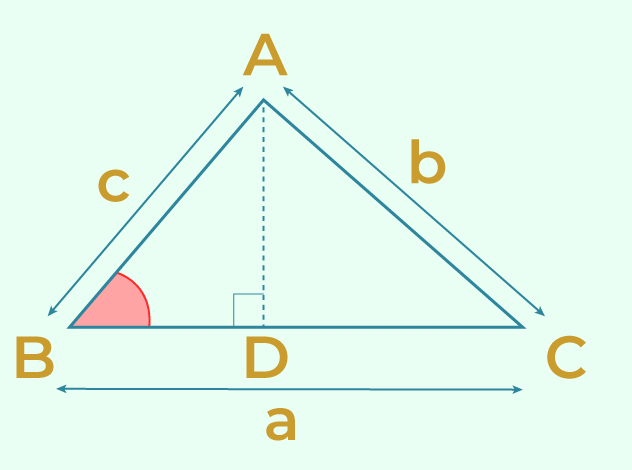
In the above figure,
Sin B = AD/AB
⇒ AD = AB Sin B = c Sin B
⇒ Area of Triangle ABC = 1/2 ⨯ Base ⨯ Height
⇒ Area of Triangle ABC = 1/2 ⨯ BC ⨯ AD
⇒ Area of Triangle ABC = 1/2 ⨯ a ⨯ c Sin B
= 1/2 ⨯ BC ⨯ AD
Thus,
Area of Triangle = 1/2 ac Sin B
Similarly, we can find that,
Area of Triangle = 1/2 bc Sin A
Area of Triangle = 1/2 ab Sin C
We conclude that the area of a triangle using trigonometry is given by half the product of two sides and the sine of the included angle.
In Coordinate Geometry
In coordinate geometry, if the coordinates of triangle ABC are given as A(x1, y1), B(x2, y2), and C(x3, y3), then its area is given by the following formula :
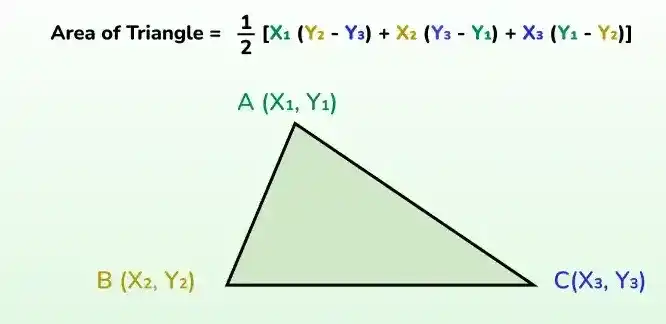
Area of △ABC =
⇒ Area of △ABC = ½[x1(y2 − y3) + x2(y3 − y1) + x3(y1 − y2)]
Summary Table
The formula for the area of a triangle depends on the dimensions of the triangle.
| Triangle Type | Formula |
|---|---|
| Right-Angled Triangle | ½ × base × height |
| Equilateral Triangle | (√3)/4 × side2 |
| Isosceles Triangle | ¼ × b√(4a2 - b2) |
| Using Heron's Formula | √{s(s - a)(s - b)(s - c)} ,where s = ½ (a+b+c) |
| When Two Sides and an Included Angle (SAS) are given | ½ × side 1 × side 2 × sin(θ) , where θ is the angle between the given two sides |
| In Coordinate Geometry | ½ |x1(y2 - y3 ) + x2(y3 - y1) + x3(y1 - y2)| , where (x1, y1), (x2, y2), and (x3, y3) are the coordinates of the triangle. |