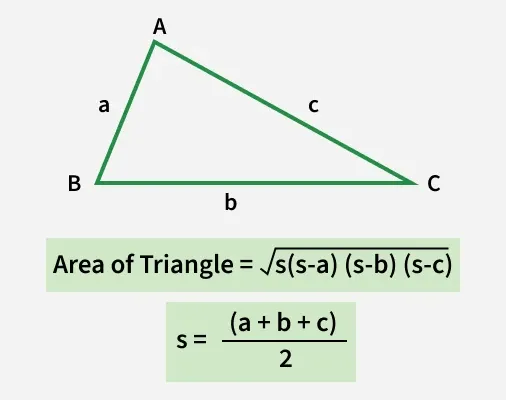
There are various methods to find the area of the triangle according to the parameters given, like the base and height of the triangle, coordinates of vertices, length of sides, etc.
Area of Triangle Using Coordinates of Vertices
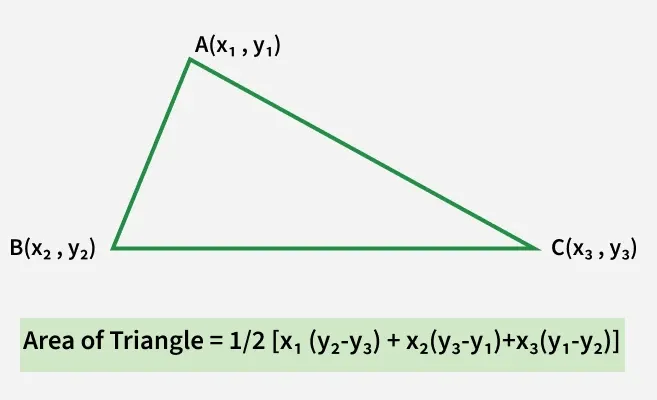
In this method, if coordinates of the vertices of a triangle are given then we will see how to found the area of the triangle.
If coordinates of the triangle are (x1, y1), (x2, y2), and (x3, y3) then the area of the triangle is given by:
Derivation of the Formula
Given triangle PQR with coordinates P(x1, y1), Q(x2, y2), and R(x3, y3), lets find the formula for its area:
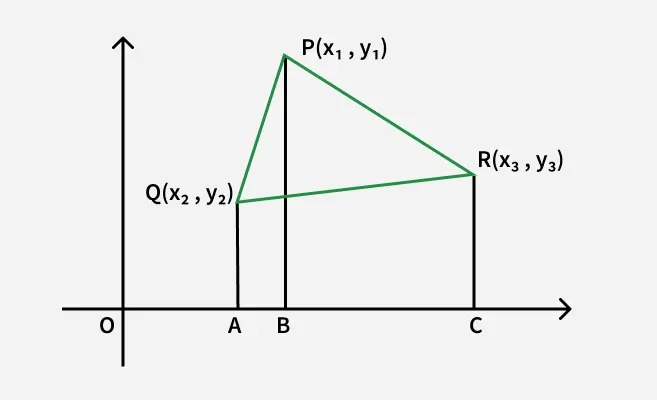
Step 1: Draw the perpendiculars from coordinates P, Q, and R to X-axis at A, B, and C respectively.
Step 2: Now if we look at the figure carefully, three different trapeziums are formed such as PQAB, PBCR, and QACR in the coordinate plane.
Step 3: So the area of ∆QPR is calculated as
Area of ∆PQR = [Area of trapezium PQAB + Area of trapezium PBCR] - [Area of trapezium QACR] . . . (1)
Step 4: Now calculating areas of all 3 trapeziums.
Since Area of a trapezium = (1 / 2) (sum of the parallel sides) × (distance between sides)
Finding Area of a Trapezium PQAB
⇒ Area of trapezium PQAB = (1 / 2)(QA + PB) × AB
⇒ QA = y2
⇒ PB = y1
⇒ AB = OB – OA = x1 – x2⇒ Area of trapezium PQAB = (1 / 2)(y1 + y2)(x1 – x2 ) . . . (2)
Finding Area of a Trapezium PBCR
⇒ Area of trapezium PBCR =(1 / 2) (PB + CR) × BC
⇒ PB = y1
⇒ CR = y3
⇒ BC = OC – OB = x3 – x1⇒ Area of trapezium PBCR =(1 / 2) (y1 + y3 )(x3 – x1) . . . (3)
Finding Area of a Trapezium QACR
⇒ Area of trapezium QACR = (1 / 2) (QA + CR) × AC
⇒ QA = y2
⇒ CR = y3
⇒ AC = OC – OA = x3 – x2
⇒ Area of trapezium QACR =(1 / 2)(y2 + y3 ) (x3 – x2 ). . . (4)Step 5: Substituting (2), (3) and (4) in (1),
⇒ Area of ∆PQR = (1 / 2)[(y1 + y2)(x1 – x2 ) + (y1 + y3 )(x3 – x1) – (y2 + y3 ) (x3 – x2 )]
⇒ Area of ∆PQR = (1 / 2) |[x1 (y2 – y3 ) + x2 (y3 – y1 ) + x3(y1 – y2)]|Therefore, this is the formula to find the area of triangle if coordinates are given.
Note: Observe that there is a mod, which indicates that, if we got a negative value we should only consider the numerical value as the area can't be negative.
Related Articles:
Sample Problems
Example 1: What is the area of the ∆ABC whose vertices are A(1, 2), B(4, 2), and C(3, 5)?
Solution:
Firstly, let's draw a diagram for a better understanding.
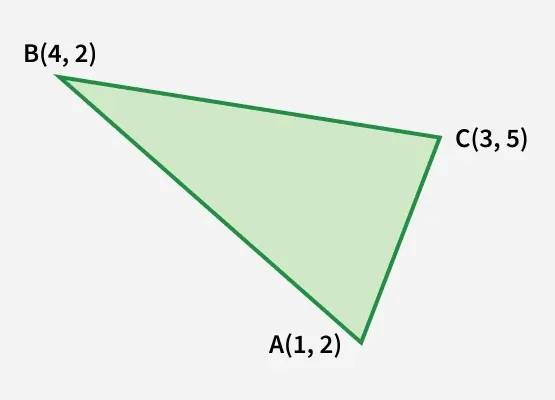
Now comparing the given coordinates with (x1, y1), (x2, y2), and (x3, y3).
Let, (x1, y1) = (1, 2)
⇒ (x2, y2) = (4, 2)
⇒ (x3, y3) = (3, 5)Now substitute the values in the formula for area of a triangle using coordinates (1 / 2) |[x1 (y2 – y3 ) + x2 (y3 – y1 ) + x3(y1 – y2)]|
⇒ (1 / 2) [1 (2 – 5 ) + 4 (5 – 2 ) + 3(2 – 2)]
⇒ (1 / 2) [(- 3) + 12 + 0]
⇒ (1 / 2) [9] = 4.5Hence the area of the triangle is 4.5 sq units
Example 2: What is the value of x1 whose area of a triangle is 1 of coordinates (x1, 1), (2, 3), and (4, 5)?
Solution:
Firstly, let's draw a diagram for a better understanding.
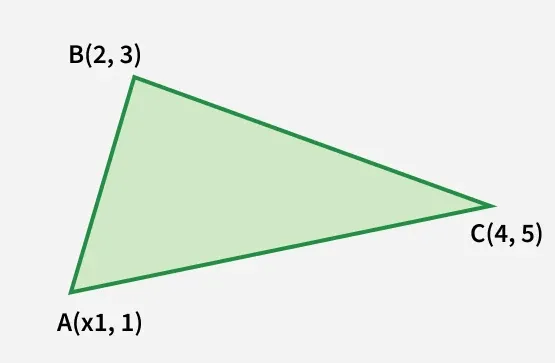
It is given that the area of the triangle is 1.
Now comparing the given coordinates with(x1, y1), (x2, y2), and (x3, y3).
Let, (x1, y1) = (x1, 1)
⇒ (x2, y2) = (2, 3)
⇒ (x3, y3) = (4, 5)Now we have to substitute the values in (1 / 2) |[x1 (y2 – y3 ) + x2 (y3 – y1 ) + x3(y1 – y2)]|
⇒ (1 / 2) [x1(3 - 5 ) + 2(5 - 1 ) + 4(1 - 3)] = 1
⇒ (1 / 2) [x1(- 2) + 8 + -8] = 1
⇒ -x1 = 1
⇒ x1 = -1Hence, the value of x1 is -1.
Other Method for Area of Triangle
There are other methods for finding area of triangle such as:
- Using Base and Height
- Using Heron's Formula
Let's discuss these methods as well.
Area of Triangle Using Base and Height
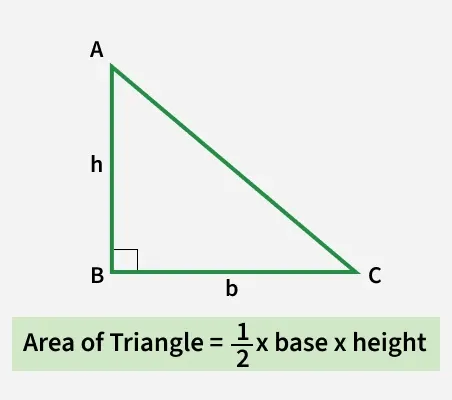
When the base and altitude of the triangle are given we will use this method and this method is the simplest of all the methods.
For a given triangle if the altitude of a triangle is 'h' and the base of the triangle is 'b' then the area of a triangle is given as:
Area of Triangle Using Heron's Formula
When both the base and height of the triangle are not given then we can use Heron's formula if the sides of the triangle are given.
If a, b, c are sides of the triangle then the area of the triangle is given as: