
SQL (Structured Query Language) allows users to store, retrieve, update and delete data efficiently. SQL is widely used across industries because it provides a robust, reliable and scalable way to handle large volumes of structured data.
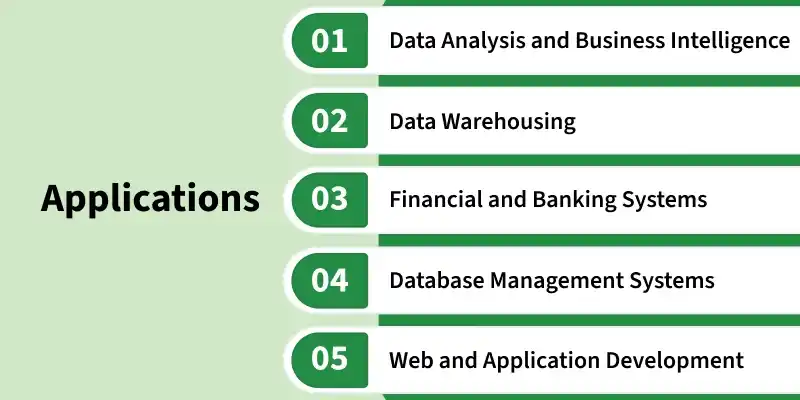
1. Database Management Systems (DBMS)
- Creates tables, schemas and indexes to organize data
- Alters database structures to meet evolving requirements
- Deletes or archives data while maintaining database integrity
- Ensures proper data storage and organization
2. Data Analysis and Business Intelligence (BI)
- Uses
SELECTqueries to fetch specific information - Supports aggregation functions like
SUM,AVG,COUNTfor analysis - Enables filtering and sorting using
WHERE,ORDER BYandGROUP BY - Helps generate business intelligence reports
3. Web and Application Development
- Ensures ACID properties (Atomicity, Consistency, Isolation, Durability)
- Uses
COMMITto save successful operations - Uses
ROLLBACKto undo incomplete or failed operations - Essential in banking, e-commerce and financial systems
4. Data Warehousing
- Performs ETL (Extract, Transform, Load) processes
- Integrates data from different databases and platforms
- Ensures data consistency and compatibility
- Supports large-scale enterprise data management
5. Financial and Banking Systems
- Tracks account transactions, balances and loans
- Maintains audit trails and ensures regulatory compliance
- Processes large volumes of financial data securely
- Example: Banks use SQL to manage ATM transactions, online banking and credit card processing
6. Healthcare Systems
- Stores patient data, medical history, prescriptions and appointments
- Facilitates secure access for doctors and staff
- Supports data analytics for medical research and reporting
- Example: Hospital management systems track patient treatments and lab results efficiently
7. Inventory and Supply Chain Management
- Tracks products, suppliers and stock levels in real-time
- Automates ordering and replenishment processes
- Analyzes supply chain performance for efficiency improvements
- Example: Retail companies like Amazon use SQL to manage millions of products and warehouse operations worldwide.