Addition of Matrices Worksheet will help students grasp the concept of matrix addition, improve their problem-solving skills, and prepare them for more advanced topics in mathematics.
Matrices are a fundamental concept in mathematics, particularly in linear algebra. They are rectangular arrays of numbers arranged in rows and columns. One common operation performed on matrices is addition.
In this article, we will learn about one interesting topic covered in school mathematics. We will look at some formulas and problems of Addition of Matrices. One can download the Unsolved worksheet on the addition of matrices for more clearer concept.
Important Formulas on Addition of Matrices
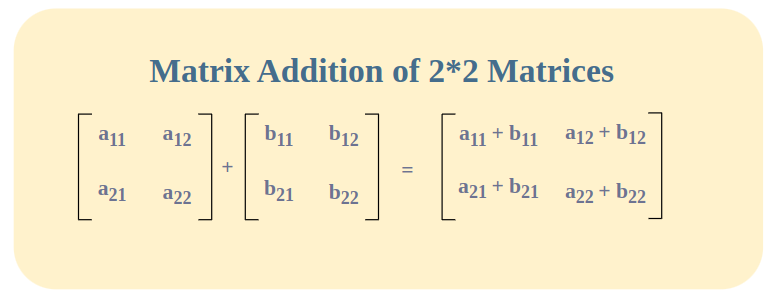
Suppose, A and B are two matrices of the same dimension m x n, then the addition of two matrices is given by matrix C of the dimension m x n
- C = A + B
Where,
cij = aij + bij
for all i = 1, 2, 3, ...,m and j = 1, 2, 3...,n.
Commutative Property of Addition of Matrices
- A + B = B + A
Associative Property of Addition of Matrices
- (A + B) + C = A + (B + C)
Additive Identity of Addition of Matrices
- A + O = A
Additive Inverse of Addition of Matrices
- A + (-A) = O
Addition of Matrices with Solution: Worksheet
1. Given matrices A and B where
A = \begin{bmatrix} 1 & 3\\ 5 & 7 \end{bmatrix} and B = \begin{bmatrix} 2 & 4\\ 6 & 8 \end{bmatrix}
Find the matrix C = A + B
To find the sum of matrix A and B is C
c11 = a11 + b11 = 1 + 2 = 3
c12 = a12 + b12 = 3 + 4 = 7
c21 = a21 + b21 = 5 + 6 = 11
c22 = a22 +b22 = 7 + 8 = 15
Resulting matrix C is
C =
\begin{bmatrix} 3 & 7\\ 11 & 15 \end{bmatrix}
2. Let A = \begin{bmatrix} 0 & -1\\ 3 & 2 \end{bmatrix} and B = \begin{bmatrix} 5 & 3\\ -3 & 4 \end{bmatrix}
Compute the elements of matrix C = A + B.
To find the elements of matrix C
c11 = a11 + b11 = 0 + 5 = 5
c12 = a12 + b12 = -1 + 3 = 2
c21 = a21 + b21 = 3 - 3 = 0
c22 = a22 +b22 = 2 + 4 = 6
Resulting matrix C is
C =
\begin{bmatrix} 5 & 2\\ 0 & 6 \end{bmatrix}
3. Verify the commutative property for matrices
A = \begin{bmatrix} 1 & 3\\ 2 & 4 \end{bmatrix} ( 1 3 ) and B = \begin{bmatrix} 4 & 3\\ 2 & 1 \end{bmatrix}
To verify the commutative property for matrices follow these steps
First we calculate A + B
c11 = a11 + b11 = 1 + 4 = 5
c12 = a12 + b12 = 3 + 3 = 6
c21 = a21 + b21 = 2 + 2 = 4
c22 = a22 +b22 = 4 + 1 = 5
Resulting matrix C1 is
C1 =
\begin{bmatrix} 5 & 6\\ 4 & 5 \end{bmatrix} Now, we calculate B + A
c11 = a11 + b11 = 4 + 1 = 5
c12 = a12 + b12 = 3 + 3 = 6
c21 = a21 + b21 = 2 + 2 = 4
c22 = a22 +b22 = 1 + 4 = 5
The resulting matrix C is
C2 =
\begin{bmatrix} 5 & 6\\ 4 & 5 \end{bmatrix} So, C1 and C2 are equal so, it follow the commutative property.
4. Given Matrices are
A = \begin{bmatrix} 1 & 0\\ 4 & 5 \end{bmatrix} and B = \begin{bmatrix} 3 & 1\\ -2 & 6 \end{bmatrix}
Show that A + B = B + A.
First we calculate A + B
c11 = a11 + b11 = -1 + 3 = 2
c12 = a12 + b12 = 0 + 1 = 1
c21 = a21 + b21 = 4 - 2 = 2
c22 = a22 +b22 = 5 + 6 = 11
Resulting matrix C1 is
C1 =
\begin{bmatrix} 2 & 1\\ 2 & 11 \end{bmatrix} Now, we calculate B + A
c11 = a11 + b11 = 3 + (-1) = 2
c12 = a12 + b12 = 1 + 0 = 1
c21 = a21 + b21 = - 2 + 4 = 2
c22 = a22 +b22 = 6 + 5 = 11
Resulting matrix C2 is
C2 =
\begin{bmatrix} 2 & 1\\ 2 & 11 \end{bmatrix} So, C1 and C2 are equal. Therefore A + B = B + A.
5. Given Matrices are
A = \begin{bmatrix} 2 & 1\\ 0 & -1 \end{bmatrix} , B = \begin{bmatrix} 3 & 5\\ 6 & 7 \end{bmatrix} and C = \begin{bmatrix} 4 & 8\\ 2 & 3 \end{bmatrix}
Verify the associative property (A + B) + C = A + (B + C).
First we calculate A + B
e11 = a11 + b11 = 2 + 3 = 5
e12 = a12 + b12 = 1 + 5 = 6
e21 = a21 + b21 = 0 + 6 = 6
e22 = a22 + b22 = -1 + 7 = 6
Resulting matrix E1 is
E1 =
\begin{bmatrix} 5 & 6\\ 6 & 6 \end{bmatrix} (A + B) + C
d11 = c11 + e11 = 4 + 5 = 9
d12 = c12 + e12 = 8 + 6 = 14
d21 = c21 + e21 = 2 + 6 = 8
d22 = c22 +e22 = 3 + 6 = 9
So, (A + B) + C =
\begin{bmatrix} 9 & 14\\ 8 & 9 \end{bmatrix} Now, we calculate B + C
e11 = c11 + b11 = 4 + 3 = 7
e12 = c12 + b12 = 8 + 5 = 13
e21 = c21 + b21 = 2 + 6 = 8
e22 = c22 +b22 = 3 + 7 = 10
Resulting matrix E2 is
E2 =
\begin{bmatrix} 7 & 13\\ 8 & 10 \end{bmatrix} A + (B + C)
d11 = a11 + e11 = 2 + 7 = 9
d12 = a12 + e12 = 1 + 13 = 14
d21 = a21 + e21 = 0 + 8 = 8
d22 = a22 + e22 = -1 + 10 = 9
So, A + (B + C) =
\begin{bmatrix} 9 & 14\\ 8 & 9 \end{bmatrix} So, (A + B) + C = A + (B + C).
6. If A = \begin{bmatrix} 1 & 4\\ 5 & 7 \end{bmatrix} , B = \begin{bmatrix} 0 & 2\\ 3 & 6 \end{bmatrix} and C = \begin{bmatrix} 2 & 1\\ 4 & 5 \end{bmatrix}
Prove that matrix addition is associative by calculating both (A + B) + C and A + (B + C).
First we calculate A + B
e11 = a11 + b11 = 1 + 0 = 1
e12 = a12 + b12 = 4 + 2 = 6
e21 = a21 + b21 = 5 + 3 = 8
e22 = a22 + b22 = 7 + 6 = 13
Resulting matrix E1 is
E1 =
\begin{bmatrix} 1 & 6\\ 8 & 13 \end{bmatrix} (A + B) + C
d11 = c11 + e11 = 2 + 1 = 3
d12 = c12 + e12 = 1 + 6 = 7
d21 = c21 + e21 = 4 + 8 = 12
d22 = c22 +e22 = 5 + 13 = 18
So, (A + B) + C =
\begin{bmatrix} 3 & 7\\ 12 & 8 \end{bmatrix} Now, we calculate B + C
e11 = c11 + b11 = 2 + 0 = 2
e12 = c12 + b12 = 1 + 2 = 3
e21 = c21 + b21 = 4 + 3 = 7
e22 = c22 +b22 = 5 + 6 = 11
Resulting matrix E2 is
E2 =
\begin{bmatrix} 2 & 3\\ 7 & 11 \end{bmatrix} A + (B + C)
d11 = a11 + e11 = 1 + 2 = 3
d12 = a12 + e12 = 4 + 3 = 7
d21 = a21 + e21 = 5 + 7 = 12
d22 = a22 +e22 = 7 + 11 = 18
So, A + (B + C) =
\begin{bmatrix} 3 & 7\\ 12 & 8 \end{bmatrix} So, (A + B) + C = A + (B + C).
7. Given matrix A = \begin{bmatrix} 6 & 7\\ 8 & 9 \end{bmatrix} and the zero matrix O = \begin{bmatrix} 0 & 0\\ 0 & 0 \end{bmatrix} , show that A +O = A.
A + O =
\begin{bmatrix} 6 & 7\\ 8 & 9 \end{bmatrix} +\begin{bmatrix} 0 & 0\\ 0 & 0 \end{bmatrix} c11 = a11 + 011 = 6 + 0 = 6
c12 = a12 + 012 = 8 + 0 = 8
c21 = a21 + 021 = 7 + 0 = 7
c22 = a22 +022 = 9 + 0 = 9
So, Addition of matrix A and O is
\begin{bmatrix} 6 & 8\\ 7 & 9 \end{bmatrix} It is equal to A matrix.
8. Given matrix A = \begin{bmatrix} -3 & 5\\ 7 & 2 \end{bmatrix} , find the result of A + zero matrix.
A + O =
\begin{bmatrix} -3 & 5\\ 7 & 2 \end{bmatrix} +\begin{bmatrix} 0 & 0\\ 0 & 0 \end{bmatrix} c11 = a11 + O11 = -3 + 0 = -3
c12 = a12 + O12 = 5 + 0 = 5
c21 = a21 + O21 = 7 + 0 = 7
c22 = a22 +O22 = 2 + 0 = 2
So, Addition of matrix A and O is
\begin{bmatrix} -3 & 5\\ 7 & 2 \end{bmatrix}
9. Given matrix A = \begin{bmatrix} 2 & -3\\ 4 & -5 \end{bmatrix} , find the additive inverse −A and verify that A + (−A) = O.
Additive inverse -A =
\begin{bmatrix} -2 & 3\\ -4 & 5 \end{bmatrix} So, A + (-A) =
\begin{bmatrix} 2 & -3\\ 4 & -5 \end{bmatrix} +\begin{bmatrix} -2 & 3\\ -4 & 5 \end{bmatrix} =
\begin{bmatrix} 0 & 0\\ 0 & 0 \end{bmatrix} So, A + (-A) = O.
1O. Given matrix A = \begin{bmatrix} 3 & 4\\ -2 & 1 \end{bmatrix} , find the additive inverse −A and verify that A + (−A) = O.
Additive inverse -A =
\begin{bmatrix} 3 & 4\\ -2 & 1 \end{bmatrix} So, A + (-A) =
\begin{bmatrix} 3 & 4\\ -2 & 1 \end{bmatrix} +\begin{bmatrix} -3 & -4\\ 2 & -1 \end{bmatrix} =
\begin{bmatrix} 0 & 0\\ 0 & 0 \end{bmatrix} So, A + (-A) = O.
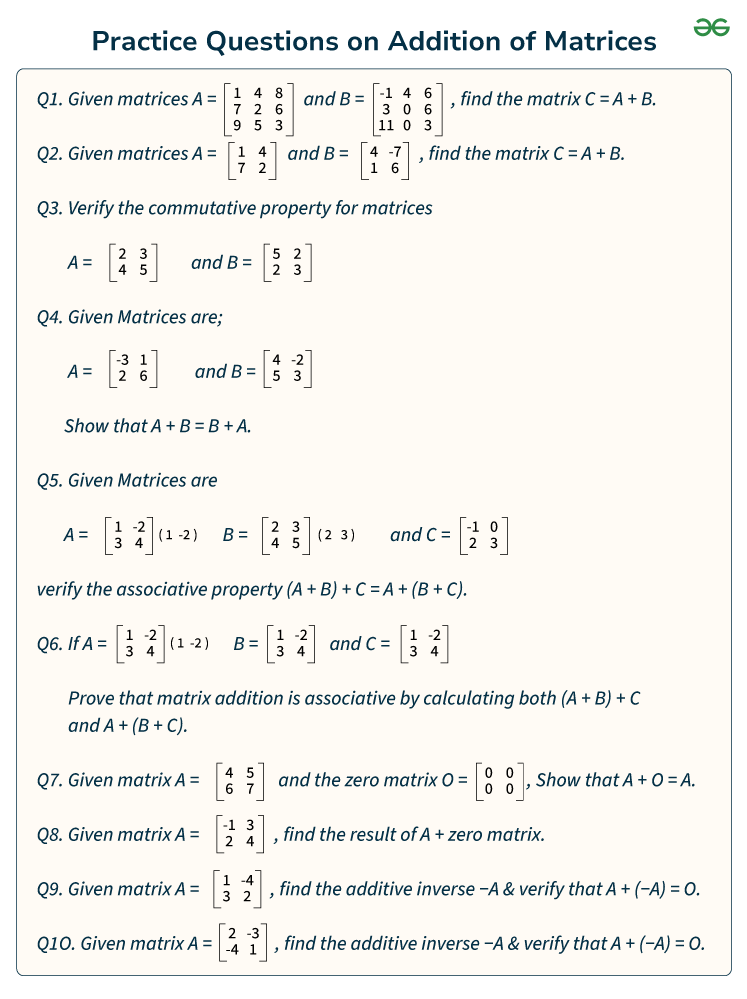
Practice Questions on Addition of Matrices: Unsolved