
Types of numbers in mathematics refer to the different categories into which numbers are classified based on their properties and how they are used. These include:
Natural Numbers
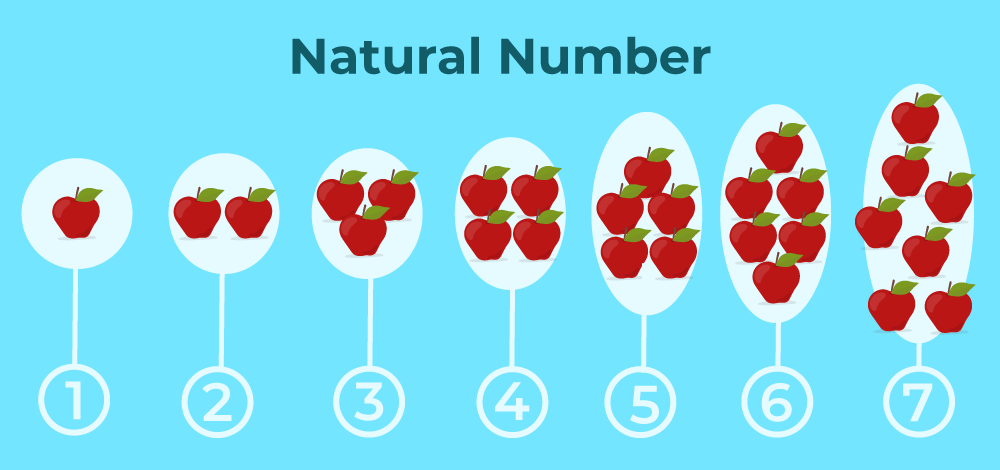
Natural Numbers are the numbers used for counting. They are 1, 2, 3, 4, . . . and continue to in. They are represented by the symbol
Whole Numbers
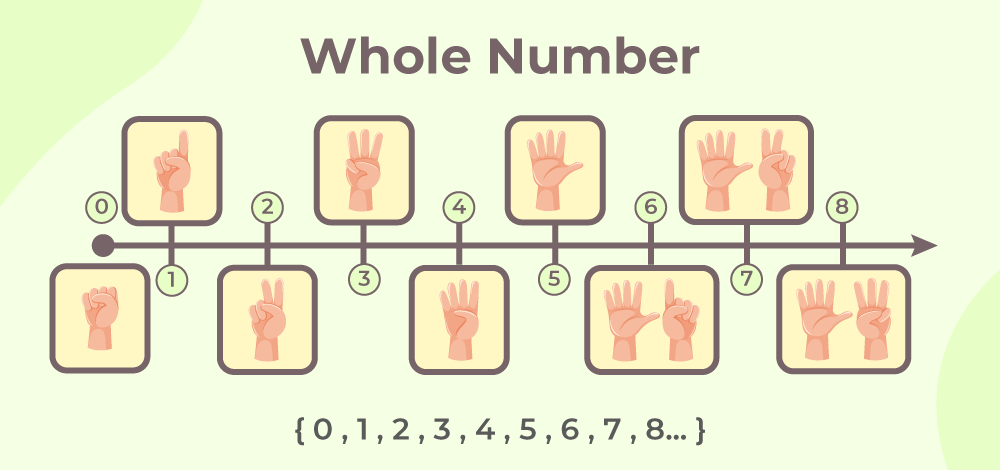
After the discovery of 0 Whole Numbers became the natural continuation of Natural Numbers. As Whole Numbers are defined as the collection of Natural Numbers including 0 i.e., 0, 1, 2, 3, 4, . . . and goes on forever. They are represented by the symbol
Integers
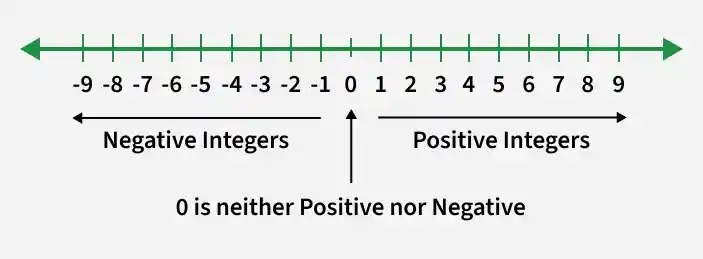
Integers include positive numbers, negative numbers, and zero and are represented by
Rational Numbers
Rational Numbers are those numbers that can be represented in the p/q form, where p and q are both integers and q can never be 0. For example, 1/2, 3/5, 17/41, 13/7, etc. They are represented by the symbol
Irrational Numbers
Irrational Numbers are defined as such numbers that can't be represented as the ratio of two integers.
Irrational Numbers are non-terminating and non-repeating in nature i.e. they don't have decimal value limited to finite places and also the pattern of digits in their decimal expansion does not repeat. They are represented by the symbol
Real Numbers
The collection of rational and irrational numbers is known as Real Numbers but the name comes from the fact that they can be represented on the real number line. All the examples of rational and irrational numbers are examples of Real Numbers as well. All the numbers except imaginary numbers are included under Real Numbers.
Imaginary Numbers
Imaginary numbers are numbers that arise when we take the square root of a negative number. Since no real number has a negative square, we define a new number i such that
i = \sqrt{-1} \ and \ i^2 = -1
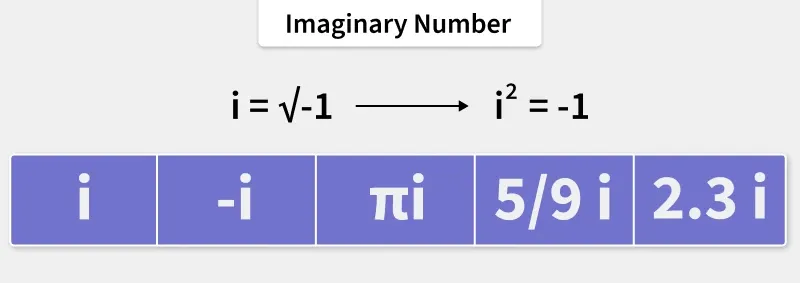
Any number that can be written in the form bi, where b is a real number, is called an imaginary number.
Complex Numbers
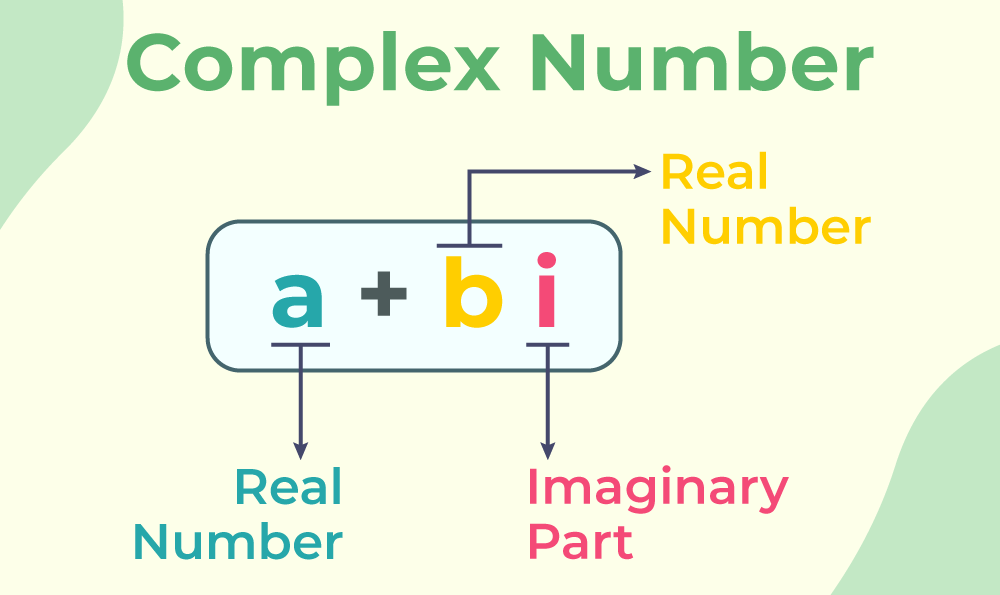
Complex numbers are numbers that have two parts:
- a real part, and
- an imaginary part.
They are represented by the symbol
Relationship Among Different Types of Numbers
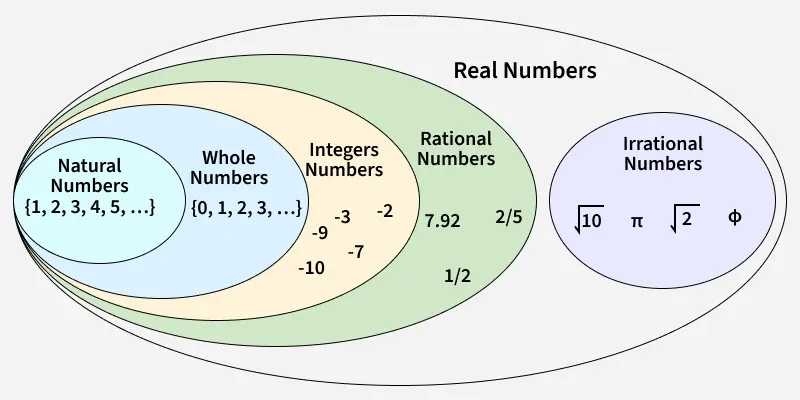
The different types of numbers are not isolated from one another; instead, they are related in a structured way. Each new set of numbers expands the previous set by including additional kinds of numbers needed to solve more complex mathematical problems.
\mathbb{N} \subset \mathbb{W} \subset \mathbb{Z} \subset \mathbb{Q} \subset \mathbb{R} \subset \mathbb{C} This inclusion shows the hierarchical relationship among the number sets.