
A set is a well-defined collection of distinct objects, known as elements or members. A set is usually denoted by curly braces {}.
- Example: A = {1, 2, 3} is a set with three elements: 1, 2, and 3.
An object inside a set is called an element or member.
- Notation: 2∈A means "2 is an element of set "
- If an element is not in a set, we write 4 ∉ A.
There are many operations on sets, including union, intersection, difference, symmetric difference, complement, and Cartesian product, each serving a unique purpose in manipulating and analyzing relationships between sets.
Symmetric Difference
The symmetric difference between two sets A and B is denoted as A Δ B and is defined as the set of elements that are in either of set but not in their intersection. Mathematically, this can be expressed as:
A Δ B = (A - B) ∪ (B -A)
Where,
- A - B is a set of elements in A, but not in B,
- B - A is a set of elements in B, but not in A.
The symmetric difference can also be understood as union of both sets minus their intersection:
A Δ B = (A ⋃ B) - (A ⋂ B)
Notation of Symmetric Difference
The most common notation for symmetric difference is A △ B, where the symbol △ represents the symmetric difference operation. This notation is consistent across the various mathematical texts and is widely understood.
How to Find the Symmetric Difference?
To find Symmetric difference between the two sets A and B, follow these steps:
- Find elements that are unique to set A, which is A - B.
- Find elements that are unique to set B, which is B - A.
- Take Union of these unique elements: A Δ B = (A - B) ∪ (B -A)
Example: Find symmetric difference between A and B ( A Δ B) if A = {1, 2, 3} and B = {2, 3, 4, 5}.
Solution:
If A = {1, 2, 3} and B = {2, 3, 4, 5}:
- A - B = {1} (elements in A not in B)
- B - A = {4, 5}(elements in B not in A)
- Symmetric Difference: A Δ B = {1, 4, 5}
Visualizing Symmetric Difference with Venn Diagrams
Venn diagram can be a helpful tool to visualize the symmetric difference of the two sets. Draw two overlapping circles one for each set. The symmetric difference is represented by portions of each circle that do not overlap.
In a Venn diagram:
- Shade region representing the elements unique to set A (left side of A not overlapping with B)
- Shade region representing the elements unique to set B (right side of B not overlapping with A)

Properties of Symmetric Difference
The symmetric difference operation has several interesting properties such as:
Commutativity Property
- Symmetric difference of two sets is commutative means that the order of sets does not matter:
A Δ B = B Δ A
Associativity Property
- Symmetric difference is associative means that when dealing with three sets, the grouping of sets does not change result:
A Δ (B Δ C) = (A Δ B) Δ C
Distributivity Property
Symmetric difference distributes over intersection of sets:
A Δ (B ∩ C) = (A Δ B) ∩ (A Δ C)
and symmetric difference distributes over union as:
A Δ (B ∪ C) = (A Δ B) ∪ (A Δ C)
Difference vs Symmetric Difference
Some of the key differences between difference of sets and symmetric difference of sets are listed in the following table:
| Aspect | Difference (A − B) | Symmetric Difference (A Δ B) |
|---|---|---|
| Definition | Elements in A but not in B. | Elements in either A or B, but not in both. |
| Notation | A − B or A∖B | A Δ B |
| Formula | A − B = {x∣ x ∈ A and x ∉ B} | A Δ B = (A − B) ∪ (B − A) |
| Mutual Inclusion | Not commutative: A−B≠B−A | Commutative: A Δ B = B Δ A |
| Example | If A={1, 2, 3} B = {2, 4}, then A − B = {1, 3} | If A={1, 2, 3} B = {2, 4}, then A Δ B = {1, 3, 4}. |
| Resulting Set | Contains only elements unique to the first set. | Contains elements unique to either set, but not both. |
| Empty Set Condition | A − B = ∅ if all elements of A are in B. | A Δ B = ∅ only if A = B. |
| Use Case | Finding elements exclusive to one set. | Identifying elements that are not shared between two sets. |
Solved Examples on Symmetric Difference
Example 1: If A = {a, b, c, d} and B = {c, d, e, f}, then find A Δ B.
Solution:
Given: A = {a, b, c, d} and B = {c, d, e, f}
- A - B = {a, b}
- B - A = {e, f}
A Δ B = (A - B) ∪ (B -A) = {a, b} ∪ {e, f} = {a, b, e, f}
Example 2: If A = {1, 3, 5, 7} and B = {2, 4, 6, 7}, Find A Δ B.
Solution:
Given: A = {1, 3, 5, 7} and B = {2, 4, 6, 7}
- A - B = {1, 3, 5}
- B - A = {2, 4, 6}
A Δ B = (A - B) ∪ (B -A) = {1, 3, 5} ∪ {2, 4, 6} = {1, 3, 5, 2, 4, 6}
Worksheet: Symmetric Difference of Sets
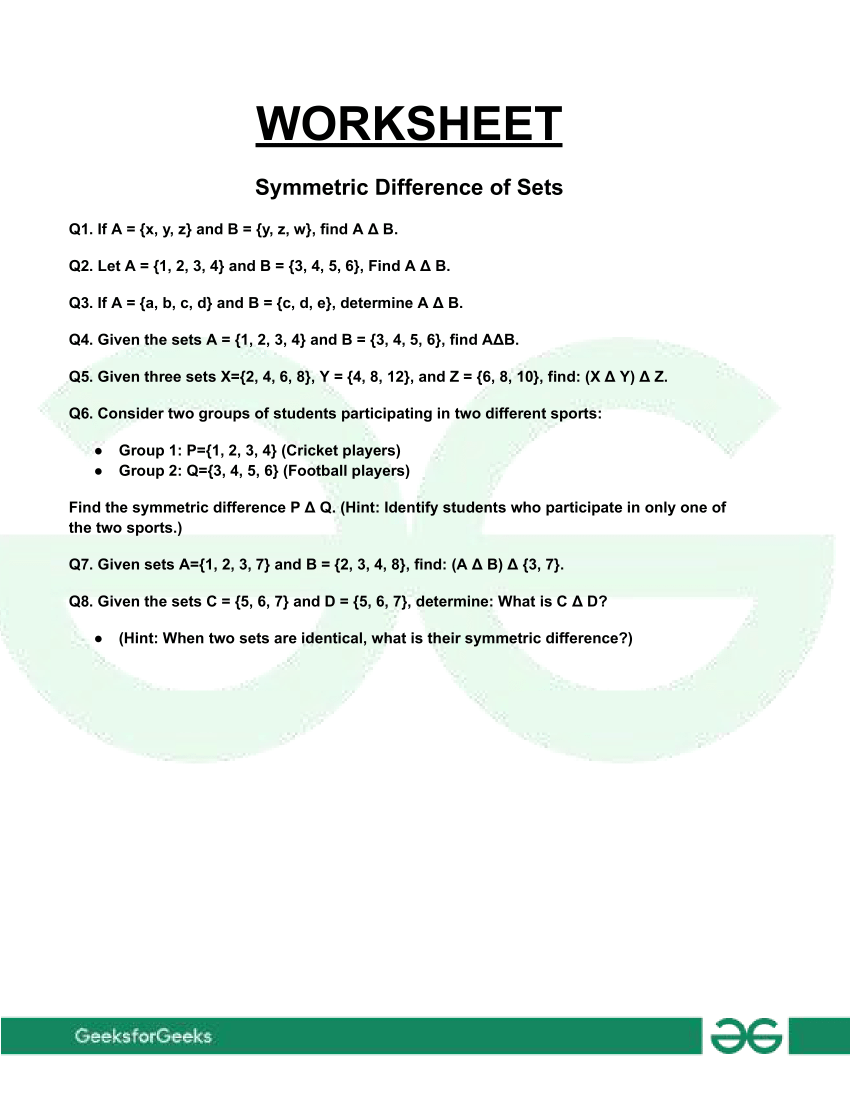
You can download this free worksheet on symmetric difference on sets with answer key from following: