
The surface area of a cone is the total area covered by its outer surface. It represents the amount of material needed to completely cover the cone from the outside.
The surface area of a cone consists of two parts:
- Circular base area
- Lateral (curved) surface area
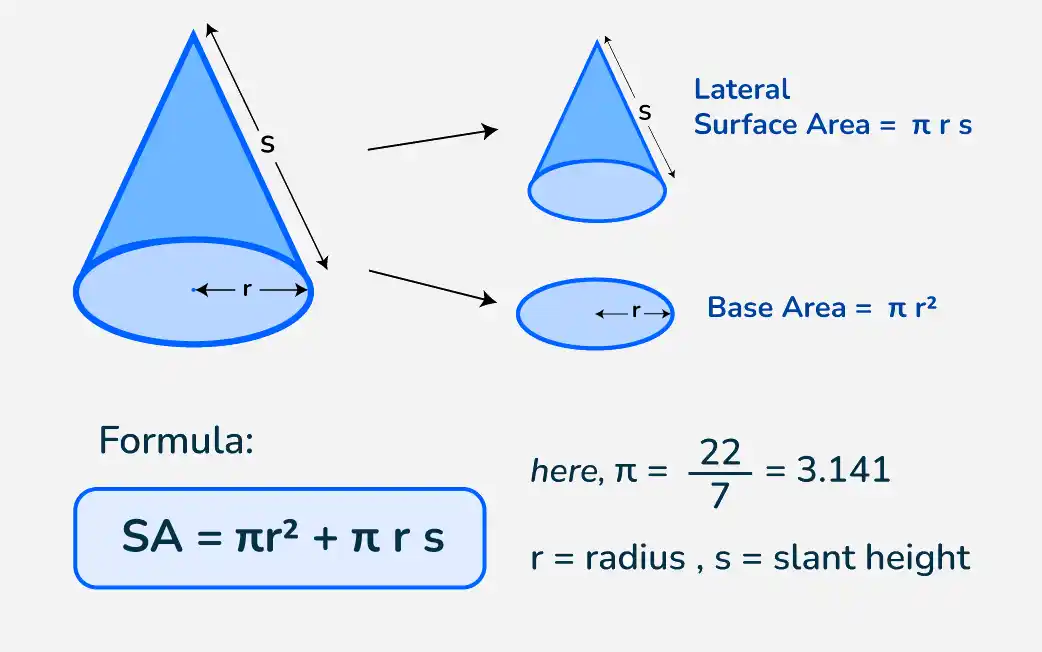
Total Surface Area of Cone
The total surface area (TSA) of a cone is the sum of the areas of its curved surface and its circular base. It represents the entire outer area of the cone.
Total Surface Area = πr(r + l) Square Units
Where,
- r = radius of the base of the cone
- l = slant height of the cone
Curved Surface Area of Cone
The curved surface area (CSA) of a cone is the area of its curved or slanting surface, excluding the circular base. In simple terms, it shows how much area the side surface of the cone covers and is also known as the lateral surface area of the cone.
The formula for the CSA (curved surface area) of the cone is given as follows:
Curved Surface Area (S) = πrl Square Units
where,
- "r" is the Radius of the Base of a Cone
- "l" is the Slant Height of the Cone
Derivation of the Surface area of a cone
Think of a cone as a shape formed by rotating a triangle. Objects like ice-cream cones and conical flasks have this shape.
To paint or cover a cone, we need to know how much area its outer surface has. This is called the surface area of a cone.
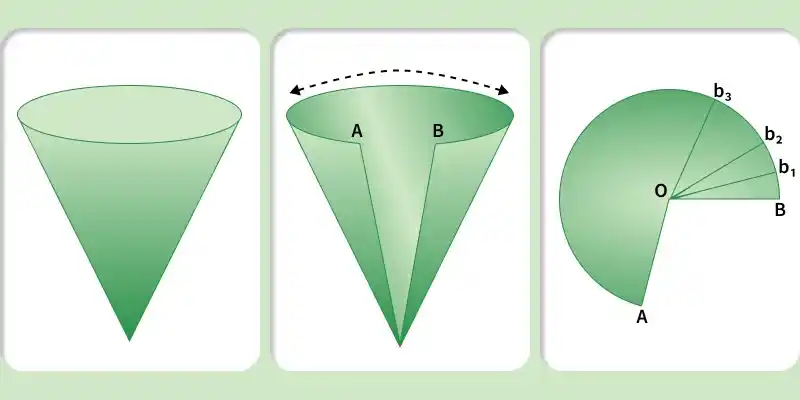
Step 1: Opening the Curved Surface
Take a paper cone and cut it along its slant height from the base to the apex.
When the cone is opened, its curved surface spreads out to form a sector of a circle.Let:
- O be the centre of the sector
- A and B be the endpoints of the curved edge
The radius of this sector is equal to the slant height (l) of the cone.
Step 2: Dividing the Sector
Now divide the sector into a large number of small triangular strips Ob₁, Ob₂, Ob₃, …, Obₙ
Each small triangle has:
- Height = slant height (l)
- Base = a small part of the curved boundary
Step 3: Finding Curved Surface Area
The area of one small triangle is approximately:
(1/2) × (base) × l
Adding the areas of all such small triangles:
Curved Surface Area = (1/2) × (total curved boundary) × l
The total curved boundary is equal to the circumference of the base of the cone = 2πr
So,
Curved Surface Area (CSA)
= (1/2) × 2πr × l
= πrlStep 4: Total Surface Area of a Cone
The total surface area of a cone includes:
Curved surface area = πrl
Area of the circular base = πr²Therefore,
Total Surface Area (TSA)
= πrl + πr²
= πr(l + r)
Surface Area of a Cone with Slant Height
Considering the slant height, height, and radius of the cone, they form a right-angle triangle, where the slant height is the hypotenuse, the base is the radius of the base, and the height is the altitude of the right-angle triangle.
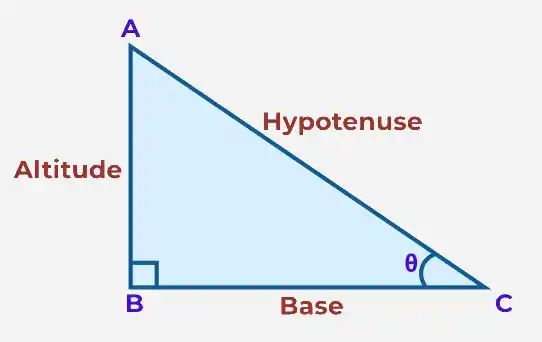
Using Pythagoras' Theorem, we get l² = r² + h².
Thus, the slant height of a cone (l) = √(r2 + h2)
So, by replacing the value of slant in the surface area formula of a cone, we get
Curved Surface Area (CSA) = πr√(r2 + h2) square units
Total Surface Area (TSA) = πr2 + πr√(r2 + h2) square units
Solved Question
Question 1: Find the total surface area of a right circular cone if its radius is 10 cm and its slant height is 15 cm. (Use π = 3.14).
Solution:
Given:
Radius (r) = 10 cm
Slant height (l) = 15 cm
Total Surface Area of cone = πr (r + l)Calculation:
TSA = 3.14 × 10 × (10 + 15)
TSA = 3.14 × 10 × 25
TSA = 3.14 × 250
TSA = 785 sq. cm
Question 2: What is the height of a cone if its radius is 14 units and its curved surface area is 1100 square units? (Use π = 22/7)
Solution:
Given
- Radius of cone (r) = 14 units
- Curved surface area of the cone = 1100 square units
Let the slant height of the cone be "l" and the height of the cone be "h".
We know that,
Curved surface area of the cone = πrl square units
⇒ 1100 = (22/7) × 14 × l
⇒ 44 × l = 1100
⇒ l = 1100/44 = 25 unitsWe know that,
slant height (l) = √(h2 + r2)
⇒ h = √(l2 - r2)
= √(252 - 142) = √429 = 20.71 unitsThus, height of cone is 20.71 units.
Question 3: Determine the slant height of the cone if the total surface area of the cone is 525 sq. cm and the radius is 7 cm. (Use π = 22/7)
Solution:
Given
- Radius of cone (r) = 7 cm
- Total surface area of the cone = 525 sq. cm
Let, slant height of cone be "l"
We know that,
Total surface area of Cone = πr (r + l) square units
⇒ (22/7) × 7 × (7 + l) = 525
⇒ 22 × (7 + l) = 525
⇒ 7 + l = 23.86
⇒ l = 16.86cmTherefore, slant height of cone is 16.86 cm.
Question 4: The radius of a cone is 9 cm, and its curved surface area is 407 cm². Calculate the height of the cone.
Solution:
Given
- Radius of cone (r) = 9 cm
- Total surface area of the cone = 407 cm2
Let, slant height of cone be "l"
We know that,
CSA = πrl square units
⇒ (22/7) × 9 × l = 407
⇒ 22 × 198/7 × l = 407
⇒ l = 2849/198
⇒ l = 14.39cmUse Pythagoras' theorem to find height h
l2 = r2 + h2
(14.39)2 = 92 + h2
207.09 - 81 = h2
h = √126.09
h = 11.23 cmTherefore, height of cone is 11.23 c
Practice Questions
Question 1. Find the CSA and TSA of the cone if its radius and height are 5 cm and 12 cm, respectively.
Question 2. If the slant height is 12 cm and the base radius is 7 cm, find the curved surface area and total surface area of the cone.
Question 3. Find the total surface area of the cone if the CSA is 144 cm2 and the base radius is 7 cm.
Question 4. Find the curved surface area of the cone if the radius is 14 cm and Slant slant height is 20 cm.