
In mathematics, a set is simply a collection of distinct objects, called elements or members, grouped together because they share some property or characteristic. You can think of it like a "basket" where you collect items that fit a certain rule or idea.
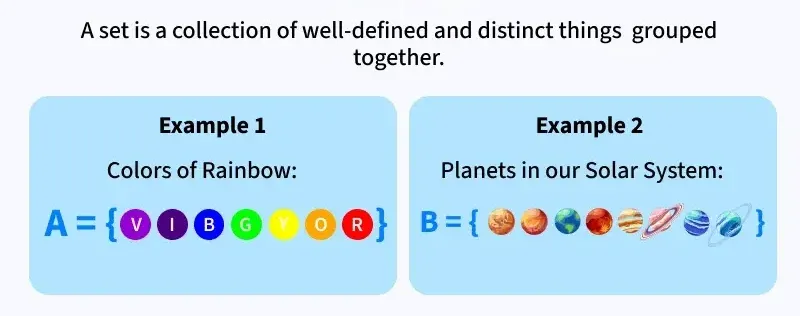
Some other examples:
- A set of all vowels in the English alphabet:
{a, e, i, o, u} - A set of numbers greater than 5:
{6, 7, 8, 9, 10, ...}
Definition of Sets
A set A is written as:
A = {x ∣ property of x}
This means A is the set of all x such that x satisfies a certain property.
Key characteristics of sets are:
- Well-defined: The contents of the set are specified and identifiable.
Example: The set of natural numbers less than 5 is {1, 2, 3, 4}.
- Distinct Elements: A set cannot have duplicate elements.
Example: {1, 2, 2, 3} is the same as {1, 2, 3}.
- Order of Elements: The order of elements does not matter.
Example: {1, 2, 3} is the same as {3, 2, 1}.
Examples of Sets
Finite Sets
- A set of vowels in the English alphabet: A = {a, e, i, o, u}
- A set of natural numbers less than 6: B = {1, 2, 3, 4, 5}
- A set of primary colors: C = {red, blue, yellow}
Infinite Sets
- A set of natural numbers: N = {1, 2, 3, 4, . . .}
- A set of integers: Z = {. . . , -3, -2, -1, 0, 1, 2, 3, . . . }
- A set of real numbers greater than 0: R+ = {x∣ x > 0}
Empty (Null) Set
- A set of months with 32 days: ∅ = {}
- A set of natural numbers less than 1: ∅ = {}
Real-World Examples of Set
- Set of Days in a Week: D = {Monday, Tuesday, Wednesday, Thursday, Friday, Saturday, Sunday}
- Set of Colors in a Traffic Light: T = {red, yellow, green}
Types of Sets
Sets can be classified based on their properties and characteristics. Some common types of sets are:
Operations on Sets
Operations on sets are rules that combine, compare, or manipulate sets to create new sets. Some of these operations are:
- Union: A ∪ B = {x ∣ x∈ A or x ∈ B}
- Intersection: A ∩ B = {x ∣ x ∈ A and x ∈ B}
- Difference: A − B = {x ∣ x ∈ A and x ∉ B}
- Complement: If U is the universal set, the complement of A is: Ac = U − A.
Solved Examples
Question 1: Given the set A = {1, 2, 3, 4, 5}, identify the type of set.
Solution:
The set A = {1, 2, 3, 4 ,5} is a Finite Set because it contains a definite number of elements (5 elements in this case).
Question 2: Let A = {1, 2, 3} and B = {3, 4, 5}. Find the union of sets A and B.
Solution:
The union of two sets A and B is the set of all elements that are in A, B, or both.
A ∪ B = {1, 2, 3, 4, 5} (Notice the duplicate element 3 is only counted once).
Question 3: Let A = {2, 4, 6, 8} and B = {1, 2, 3, 4}. Find the intersection of sets A and B.
Solution:
The intersection of two sets A and B is the set of all elements that are common to both sets.
A ∩ B = {2, 4}
Question 4: Let A = {1, 2, 3, 4, 5} and B = {3, 4, 5, 6, 7}. Find the difference A − B.
Solution:
The difference A − B consists of elements that are in A but not in B.
A − B = {1, 2}
Question 5: Let U = {1, 2, 3, 4, 5, 6, 7} be the universal set, and A = {2, 4, 6}. Find the complement of A (denoted as Ac).
Solution:
The complement of set A, denoted Ac, consists of all the elements in the universal set U that are not in A.
Ac = U − A = {1, 3, 5, 7}
Unsolved Questions
Question 1: Given the set B = {a, e, i, o, u}, identify the type of set.
Question 2: Let X = {1, 2, 3, 4} and Y = {3, 4, 5, 6}. Find the union of sets X and Y.
Question 3: Let M = {2, 5, 7, 10} and N = {1, 5, 9, 10}. Find the intersection of sets M and N.
Question 4: Let P = {1, 3, 5, 7, 9} and Q = {2, 4, 6, 8, 10}. Find the difference P − Q.
Question 5: Let U = {2, 4, 6, 8, 10, 12, 14} be the universal set, and S = {6, 8, 12}. Find the complement of S (denoted as Sc).