Reflection is a geometric transformation that produces a mirror image of a figure by flipping it across a fixed line called the line of reflection. Each point of the figure is mapped to a corresponding point on the opposite side of the line at the same perpendicular distance from it.
Reflection is a rigid transformation, meaning the reflected figure has the same size and shape as the original figure.
The line of reflection acts as a mirror, reversing the figure's orientation.
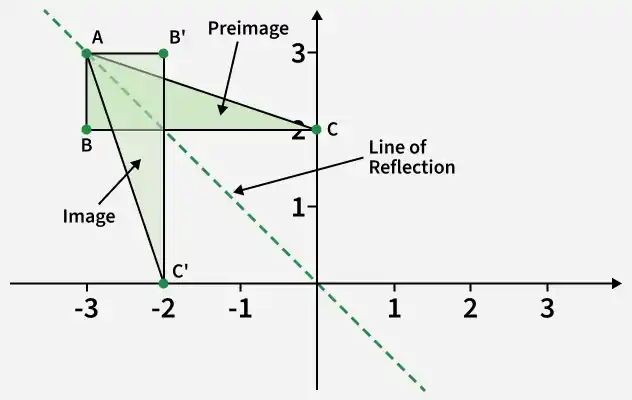
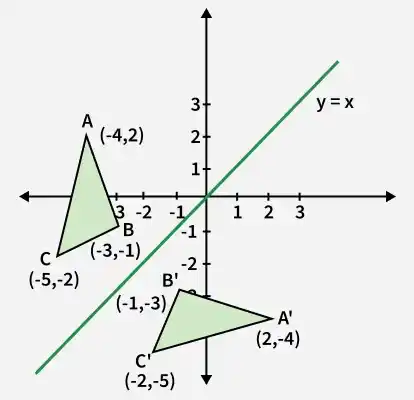
The image above illustrates the reflection of a triangle across the line y = -x, showing the pre-image, image, and line of reflection.
Terms Related to Reflection
Line of Reflection: The fixed line across which a figure is reflected.
Pre-image: The original figure before reflection.
Image: The figure obtained after reflection.
Mirror Image: The reflected figure that appears as a mirror copy of the original.
Isometry: A transformation that preserves distances and angles; reflection is an example of an isometry.
Coordinate Rules for Reflections
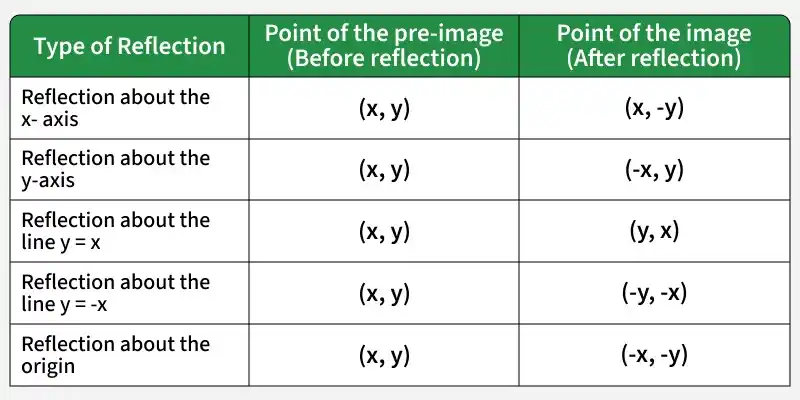
The position of a point changes according to the line of reflection. The following are the most common reflection rules on the coordinate plane:
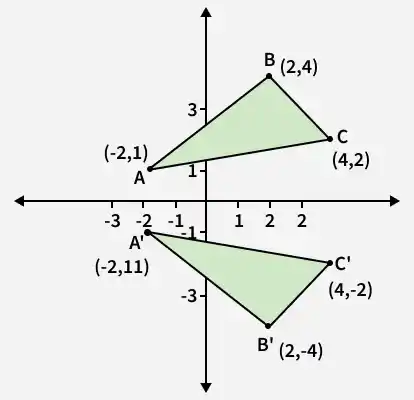
1. Reflection about the x-axis: The x-coordinate remains the same, while the y-coordinate changes its sign. Rule: (x, y) → (x, -y)
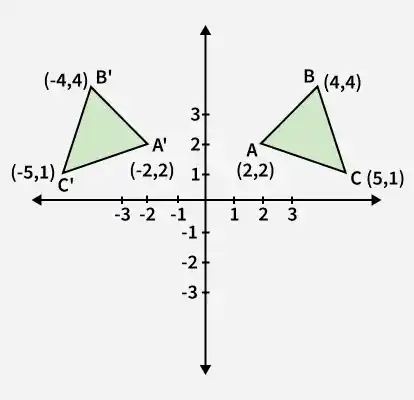
2. Reflection about the y-axis: The y-coordinate remains the same, while the x-coordinate changes its sign. Rule: (x, y) → (-x, y)
3. Reflection about the line y = x: The x-coordinate and y-coordinate interchange their positions. Rule: (x, y) → (y, x)
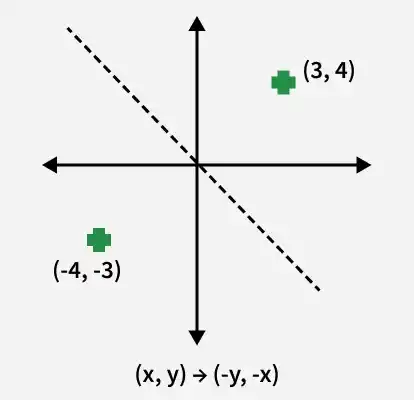
4. Reflection about the line y = -x: The coordinates interchange their positions, and both signs are reversed. Rule: (x, y) → (-y, -x)
5. Reflection about the origin: Both coordinates change their signs. Rule: (x, y) → (-x, -y)
6. Reflection about the vertical line x = a: The y-coordinate remains unchanged, while the x-coordinate is reflected across the line x = a. Rule: (x, y) → (2a - x, y)
7. Reflection about the horizontal line y = b: The x-coordinate remains unchanged, while the y-coordinate is reflected across the line y = b. Rule: (x, y) → (x, 2b - y)
Reflecting Shapes
Reflecting shapes in geometry follows the same principles as reflecting individual points, with each vertex of the shape being reflected according to the given rule. The shape's reflection is formed by connecting the reflected points in the same order as the original shape.
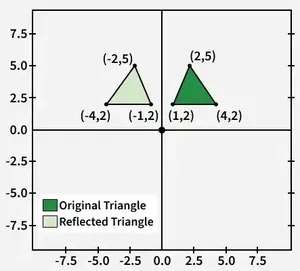
Example: Reflect the triangle with vertices (1,2), (4,2), and (2,5) over the y-axis.
Solution:
Apply the reflection rule (x,y)→(−x,y) to the each vertex:
(1,2)→(−1,2)
(4,2)→(−4,2)
(2,5)→(−2,5)
The reflected the triangle has vertices (−1,2), (−4,2) and (−2,5).
Reflection Symmetry
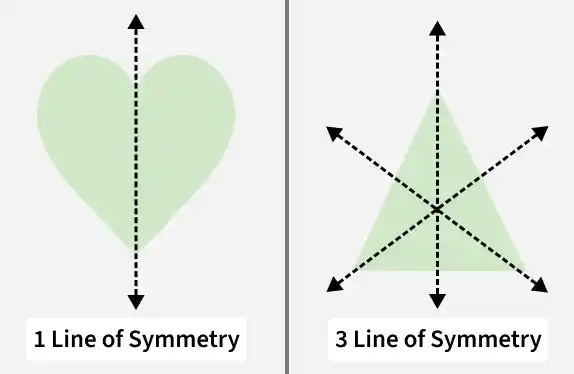
Reflection symmetry occurs when a figure can be divided by a line so that both halves are mirror images of each other. This line is called the line of symmetry. If a figure can be folded along this line and both halves match exactly, the figure is said to have reflection symmetry.
Examples:
A heart has one line of symmetry.
An equilateral triangle has three lines of symmetry.
Solved Examples
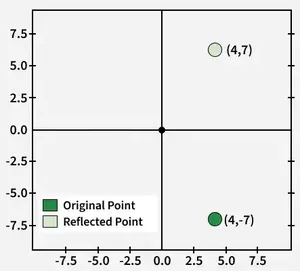
Example 1: Reflect the point (4, -7) over the x-axis.
Solution:
The rule for the reflecting over the x-axis is (x,y)→(x,−y).
Applying this rule: (4,−7)→(4,7).
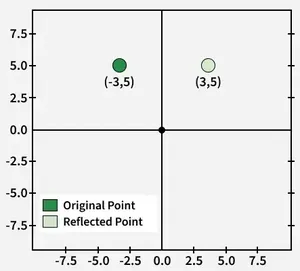
Example 2: Reflect the point (−3, 5) over the y-axis.
Solution:
The rule for the reflecting over the y-axis is (x,y)→(−x,y).
Applying this rule: (−3,5)→(3,5).
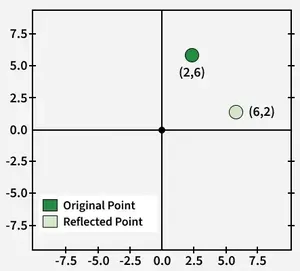
Example 3: Reflect the point (2,6) over the line y=x.
Solution:
The rule for reflecting over the line y=x is (x,y)→(y,x).
Applying this rule: (2,6)→(6,2).
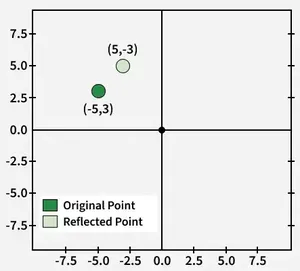
Example 4: Reflect the point (−5, 3) over the line y = −x.
Solution:
The rule for reflecting over the line y=−x is (x,y)→(−y,−x).
Applying this rule: (−5,3)→(−3,5).
Unsolved Questions
Q1: Reflect the point (5, −3) over the x-axis. What are the coordinates of the reflected point?
Q2: A triangle has vertices at (2,4), (4,6), and (6,4). Reflect this triangle over the y-axis. What are the coordinates of the reflected vertices?
Q3: Reflect the point (−7, 2) over the line y = x. What are the coordinates of the reflected point?
Q4: A rectangle has vertices at (1, 2), (5, 2), (5, 6), and (1, 6). Reflect this rectangle over the x-axis. What are the coordinates of the reflected vertices?
Q5: Reflect the point (3, −4) over the line y = −x. What are the coordinates of the reflected point?
Q6: A pentagon has vertices at (2,3), (3,5), (5,4), (4,2), and (1,1). Reflect this pentagon over the y-axis. What are the coordinates of the reflected vertices?
Q7: Reflect the point (6, −1) over the vertical line x=2. What are the coordinates of the reflected point?
Q8: A square has vertices at (0,0), (0,2), (2,2), and (2,0). Reflect this square over the line y=x. What are the coordinates of the reflected vertices?
Q9: Reflect the point (8, −5) over the horizontal line y=3. What are the coordinates of the reflected point?
Q10: A triangle has vertices at (3, 4), (7, 2), and (5, 6). Reflect this triangle over the line y=−x. What are the coordinates of the reflected vertices?