
Rational and Irrational Numbers are types of real numbers with different properties.
- Rational numbers can be written as a fraction p/q, where both p and q are integers but Irrational numbers, on the other hand, cannot be expressed as a ratio of two integers.
- The decimal form of a rational number will either terminate or repeat, while the decimal of an irrational number is non-terminating and non-repeating.
- Rational numbers include familiar values like fractions, whole numbers, and repeating decimals. Irrational numbers include numbers like π and √2, which have infinite non-repeating decimal expansions.
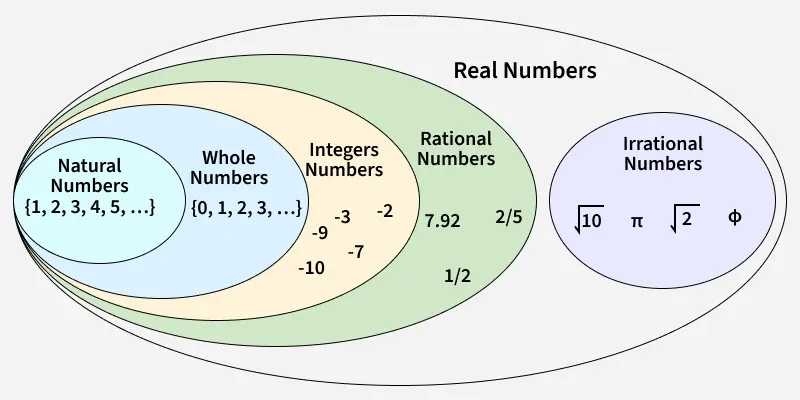
Rational Numbers
In simpler terms, rational numbers are like fractions – they show the relationship between two whole numbers.
A Rational Numbers is any number that can be expressed as the ratio of two integers. In mathematical terms, a rational number is a number that can be written in the form
\frac{p}{q} , where p and q are integers, and q is not equal to zero.This means that fractions, whole numbers, and terminating or repeating decimals are all examples of rational numbers.
Examples
- Fractions: Numbers like 12/21 or 34/43 are rational because they are represented as a ratio of integers.
- Whole Numbers: Numbers like 5 and 7 are also rational because they can be written as 5/1 and 7/1.
- Repeating Decimals: The decimal 0.333... (repeating) is rational because it can be expressed as 1/3.
Irrational Numbers
Unlike rational numbers, irrational numbers cannot be written as a simple fraction. They are numbers whose decimal expansions are non-terminating and non-repeating. In other words, the decimal goes on forever without forming any recurring pattern. The most well-known irrational numbers are π (pi) and √2.
An Irrational Numbers is a type of real number that cannot be expressed as a simple fraction (ratio) of two integers. In other words, it's a number that cannot be written in the form a/b, where "a" and "b" are integers and "b" is not equal to zero.
Examples: √5, √11, √21, etc., are irrational